
Where social science and data analyses helps hooking the player or the buyer: the design of modern interactive entertainment relies heavily on principles derived from social sciences to construct engaging and commercially successful experiences. These methods are not arbitrary but are a systematic application of established psychological concepts, from the variable rate reinforcement seen in operant conditioning to cognitive biases like loss aversion and the endowment effect.
This article is the 2nd of a 3-parts:
- Data-Driven and Statistical Tricks for Games and Marketing
- Cognitive Science Tricks for Games and Marketing
- More Cognitive Science Tricks for Games and Marketing
It follows:

Behavioral and Cognitive Theories – Key Takeaways
A significant portion of modern engagement strategy is built upon the foundations of behavioral psychology, specifically the principles of operant conditioning. This framework centers on shaping behavior by associating voluntary actions with consequences, primarily through reinforcement. The most potent schedule of reinforcement used is variable rate, where a reward is delivered after an unpredictable number of actions. This unpredictability, seen in game loot drops or random marketing offers, maximizes engagement by making the behavior itself compelling, as the user is driven by the persistent possibility of an imminent reward. Simpler schedules like fixed interval (e.g., daily login bonuses) and fixed ratio (e.g., loyalty card stamps) are also employed to build consistent, predictable habits and reward sustained user patronage.
Complementing behavioral conditioning is the application of a wide range of documented cognitive biases and heuristics to influence user perception and decision-making. Principles like loss aversion are leveraged to create a fear of missing out on limited-time offers or breaking a reward streak, as the pain of a loss is a stronger motivator than an equivalent gain. The sunk cost fallacy and the endowment effect are exploited to retain users by making them psychologically overvalue the time, effort, or money they have already invested in a game character or a service. Other biases like anchoring are used to manipulate price perception in digital storefronts, while social proof, through leaderboards and user testimonials, is applied to validate a user’s choice to engage with a product by showing that many others are doing the same.
Part #2: Psychological and Engagement Tricks

11. Intermittent Rewards (Variable Rate Reinforcement)
This is a direct application of operant conditioning:
The brain releases dopamine not just when a reward is received, but in anticipation of it.
Because the player cannot predict which action will yield the reward, a steady, highly compelling loop is created. The possibility that the next monster defeated or the next chest opened could be the one with a rare item keeps the player repeating the action far longer than if the reward was predictable.
The implementation can be managed by server-side loot tables and a pseudo-random number generator (RNG). When a player performs an action (e.g., opens a chest), the client sends a request to the server. The server then executes a script that “rolls” against a weighted probability table. For example, a legendary item might have a 0.1% chance, an epic item a 1% chance, and a common item a 98.9% chance. The server’s authority over the RNG is critical to prevent client-side hacking.
Game application: in a sci-fi shooter, defeating an enemy transport ship drops a cargo container. Most containers hold standard ammunition. However, there is a 0.5% chance a container will hold a “Prototype Weapon Schematic.” Players will destroy hundreds of transports, driven by the unpredictable, high-value reward.
12. The Hook Model
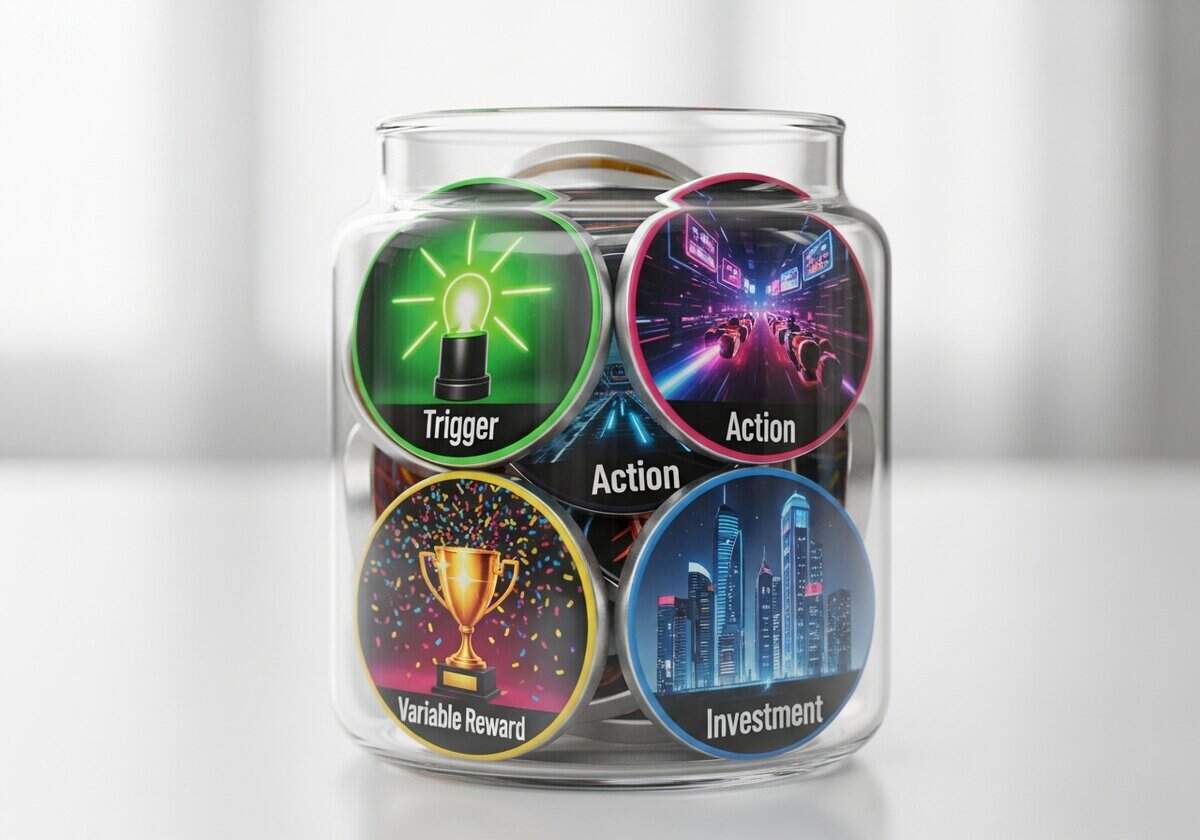
This model creates a habit loop through four stages: Trigger, Action, Variable Reward, Investment. A trigger (e.g., a push notification) prompts an action (opening the game), which leads to a variable reward (e.g., a random daily login bonus). The final step, investment (e.g., spending a few minutes arranging your base), makes the next trigger more likely to be effective by increasing the user’s stored value in the system.
It builds a psychological cycle that integrates the game into a user’s daily routine.
The IT system to support this is multifaceted. The “Trigger” often relies on a push notification service connected to a timing system (e.g., send a notification if the user hasn’t logged in for 24 hours). The “Action” is logged by the game server. The “Variable Reward” uses the RNG systems described previously. The “Investment” phase logs user-generated content or progress to a persistent database, ensuring their effort is saved and loaded for the next session.
Game application: a virtual pet game sends a push notification at 8 AM (“Your pet is hungry!”). The player opens the app (Action) and feeds the pet, which sometimes gives a rare “Shiny Treat” (Variable Reward). The player then uses the treat to teach the pet a new trick, which is saved (Investment), making them more likely to respond to tomorrow’s hunger notification.
13. Fear of Missing Out (FOMO)

FOMO leverages the psychological principle of loss aversion. The feeling that one might miss a unique opportunity, a limited-time item, or a special event is a powerful motivator.
This is not about gaining something, but about preventing the negative feeling of regret associated with missing out.
It pressures players to log in frequently, even when they might otherwise not, simply to maintain access to time-sensitive opportunities.
This is implemented using a server-side event management system. The system’s clock is the single source of truth for all time-based events. Developers define event start and end times in a central configuration file. The game client frequently syncs with the server’s clock to display accurate countdown timers in the user interface, such as “Event ends in 2d 4h 15m.” When the server time passes the event end time, the related content or offer is simply no longer served to any game clients.
Game application: an online fantasy RPG announces a “Blood Moon” event that lasts only for a single weekend. During this time, players can acquire a unique “Blood-soaked Armor” set that is unobtainable at any other time. This creates a massive surge in logins over the weekend from players who do not want to miss their only chance to get the armor.
14. Social Proof and Competition
This taps into fundamental human drives for social validation and status. Seeing that many other people are playing a game, or seeing a friend’s high score on a leaderboard, validates the player’s own choice to play and introduces a competitive drive. Guilds and team features create a sense of belonging and obligation, where a player’s performance directly impacts their peers, creating strong pressure to participate and perform well.
The technology behind this includes leaderboards, which are essentially sorted database queries displayed in the game client. These databases need to be able to ingest high volumes of score updates and perform fast sorting operations. Guild systems require a more complex database schema to manage memberships, roles, and a shared inventory or chat system. Network infrastructure must support real-time communication protocols (like WebSockets) for features like guild chat to function effectively.
Simple game example: in a mobile racing game, after a player completes a race, the results screen shows their time alongside the slightly better time of one of their friends, with the message “Beat Alex’s Time!”. This direct, personal challenge uses social proof and competition to encourage the player to immediately try the race again.
15. The Zeigarnik Effect
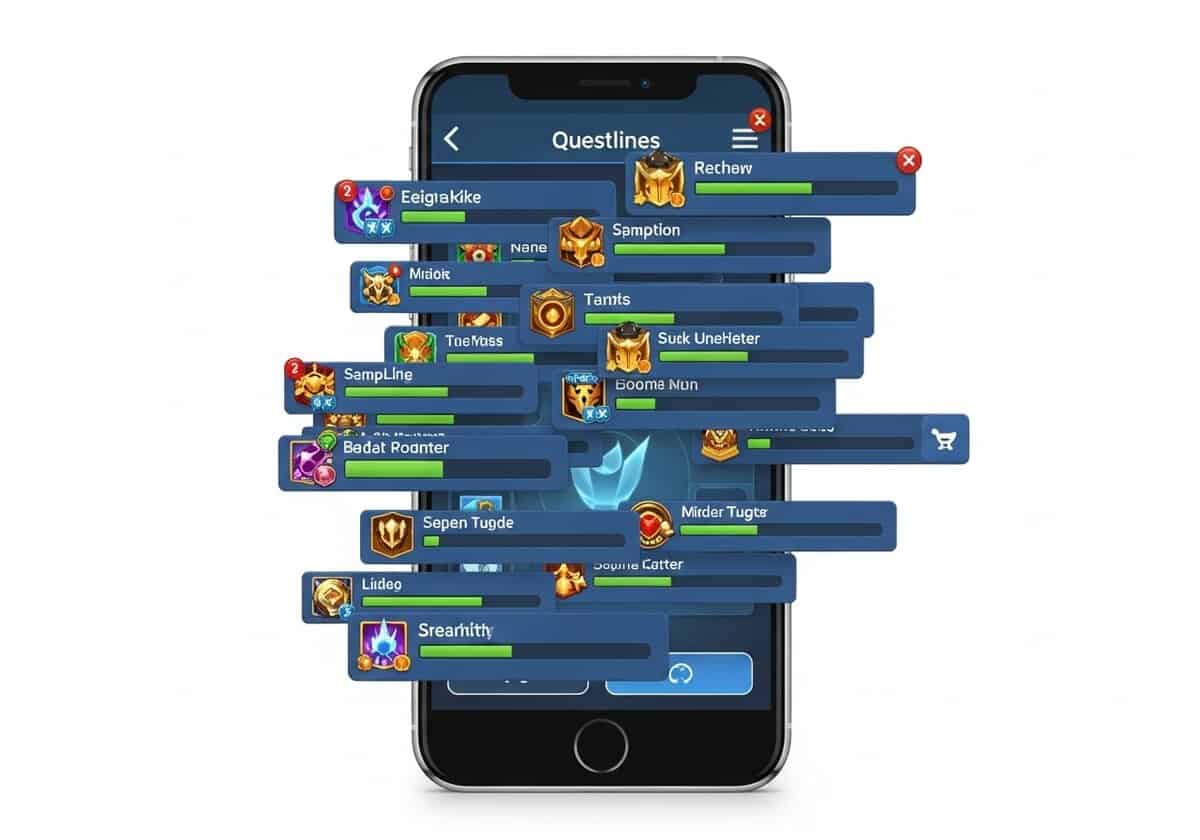
This psychological effect posits that people have a better memory for incomplete tasks than for completed ones. By presenting players with multiple, overlapping questlines and progress bars, the game ensures that there is always an “unfinished task” in the back of the player’s mind. This creates a mental tension that can only be resolved by returning to the game and completing the task, making the game more mentally pervasive.
The implementation requires a sophisticated quest and state management system. Each player’s progress on dozens or hundreds of different quests and objectives is stored in a database. The game’s UI is specifically designed to highlight these incomplete tasks. For example, the main screen might show multiple icons, each with a progress bar: “Daily Quests (2/5)”, “Main Story (Chapter 3)”, “Guild Task (80% complete)”. This constantly reminds the player of all their pending activities.
Game application: in an open-world adventure game, a player might be on their way to a main story objective when they discover a side quest to collect five rare flowers. They collect three before getting sidetracked by a monster attack. When they log off, the lingering thought of the “2 flowers remaining” creates a mental itch that pulls them back into the game later.
16. The Sunk Cost Fallacy

One of the most used trick in game (and in many life situation too): this taps into the cognitive bias where individuals feel compelled to continue an endeavor because of the resources (time, money, effort) they have already invested. In games, long-term progression systems, collections, and achievements are designed to maximize this effect. The more a player invests in leveling up a character or building a base, the harder it becomes psychologically to abandon that investment, even if the game is no longer fun.
This is enabled by the persistent storage of player data. Every hour played, every item collected, and every dollar spent is logged in a server-side database tied to the player’s account. The game’s UI constantly reflects this investment by displaying high character levels, vast inventories of items, and “time played” statistics. These serve as constant reminders of the player’s accumulated “sunk cost,” reinforcing their commitment.
Game application: a player in a space fleet strategy game has spent 500 hours building up their flagship. A new, competing space game is released that looks more interesting. However, the thought of abandoning the flagship, which they have invested so much in, is too painful. They decide to stick with the current game because of their prior investment.
17. Appointment Gaming

This mechanic conditions players to integrate the game into their daily or weekly schedule, creating a habit.
By making important resources or events available only at specific, recurring times, the game trains the player to return at that appointed time. This transforms the game from a random leisure activity into a scheduled part of their routine, much like a favorite TV show.
The implementation relies on a server-authoritative clock and an event scheduling system. A developer configures a task to run at a specific time (e.g., 12:00 PM UTC daily). When that time is reached, the server grants a reward to all players who log in within a certain window. This can be as simple as a cron job on a Linux server that triggers a script. The game client UI displays timers counting down to the next “appointment” to build anticipation.
Game application: a farming simulation game has a “Merchant Ship” that arrives at the town dock every day at 6:00 PM local time and stays for only one hour. The ship offers the best prices for crops and sells rare seeds. Players learn to schedule a break in their evening to log in and conduct their business with the ship, making the game a fixed part of their day.
18. “Juiciness” and Satisfying Feedback

“Juiciness” refers to providing exaggerated, multi-sensory feedback to player actions, which taps into the brain’s reward system. A simple button press is made more satisfying if it is accompanied by a smooth animation, a pleasing sound effect, and subtle screen shake. This positive reinforcement on a micro-level makes the core actions of the game feel intrinsically good, regardless of the strategic outcome, making the gameplay loop itself highly satisfying.
Example: the exciting sounds of golden coins falling on your side in a casino machine.
This is not a network or statistics feature, but one of pure client-side software engineering and artistry. It involves layering multiple feedback systems onto a single action. For example, when a player matches gems in a puzzle game, the code triggers not just the removal of the gems, but also a particle effect system, a sound playback event, a score animation, and a brief camera shake function. Each of these small, additive effects combines to create a “juicy” feel.
Game application: in a tile-matching puzzle game, when a player clears a line, the blocks don’t just disappear. They flash brightly, emit a bassy “thump” sound, send out little star particles, the score numbers fly out from the cleared line, and the whole screen shakes for a fraction of a second. This makes the simple act of clearing a line feel powerful and rewarding.
19. Narrative Immersion

A strong narrative engages players emotionally, providing context and purpose for their in-game actions. This taps into the human need for meaning and storytelling. When a player feels they are part of an epic story and are emotionally invested in the fate of its characters, their motivation shifts from pure mechanics to a desire to see what happens next.
This can create a powerful, long-term hook that gameplay mechanics alone cannot replicate.
The technical implementation involves a good story engine or quest system that tracks the player’s progress through a branching or linear narrative. This system stores “story flags” in the player’s save data. These flags determine which characters appear, what dialogue options are available, and which zones are accessible. High-quality voice acting, music, and cinematic cutscenes, which are large data assets that must be efficiently streamed or pre-loaded by the game client, are used to enhance the emotional impact of the narrative.
Game application: in a story-driven adventure game, a player’s companion character, a robot, sacrifices itself to save the player from a powerful enemy in a scripted cutscene. The player, now emotionally invested in avenging their fallen companion, is powerfully motivated to continue the main story quest to defeat the enemy, driven by the narrative rather than just loot or experience points.
20. Loss Aversion

This principle states that the pain of losing something is psychologically about twice as powerful as the pleasure of gaining something of equal value. Games utilize this by framing rewards as something the player is about to lose.
Tip: a daily login bonus is not just a “gain”; missing it is framed as a “loss” of a guaranteed reward. This creates a defensive, preservation-focused mindset that encourages consistent engagement.
This is implemented through streak-based reward systems. The server tracks a player’s consecutive login days. The UI presents this as a streak, often with increasingly valuable rewards for each consecutive day. For example, “Day 7 Login: Claim your Legendary Chest! Warning: If you miss a day, your streak will reset to Day 1.” The “Warning” message explicitly triggers loss aversion, as the player is motivated to log in to avoid losing their progress toward the valuable reward.
Game application: a fitness-based game gives the player 10 “Energy” every day they log in. After a 7-day streak, it upgrades to 20 Energy per day. The UI displays: “You are on a 15-day streak! Don’t miss tomorrow, or you’ll lose your 2x Energy bonus!” The fear of losing the doubled bonus is a stronger motivator to log in than the bonus itself.
This post continues with 25 more last tricks in “More Cognitive Science Tricks for Games and Marketing” below:

Glossary of Terms Used
User experience (UX): the overall satisfaction and perception of a user when interacting with a product, system, or service, encompassing usability, accessibility, design, and emotional response throughout the entire interaction process.
User Interface (UI): a system that enables interaction between users and software applications, encompassing visual elements, controls, and overall layout to facilitate user tasks and enhance experience.