
New product designs, innovations, and especially game mechanics are built to tap into fundamental human motivations for competence, autonomy, and social relatedness. By creating systems that generate predictable emotional and behavioral responses, such as the compulsion to complete an unfinished task or the desire to avoid missing a limited-time opportunity, developers can build powerful feedback loops that encourage sustained player involvement and emotional investment.
This article is the 3nd of a 3-parts:
- Data-Driven and Statistical Tricks for Games and Marketing
- Cognitive Science Tricks for Games and Marketing
- More Cognitive Science Tricks for Games and Marketing
It follows the part #1 here:

and the part #2 here:
Part #3: More Psychological and Engagement Tricks
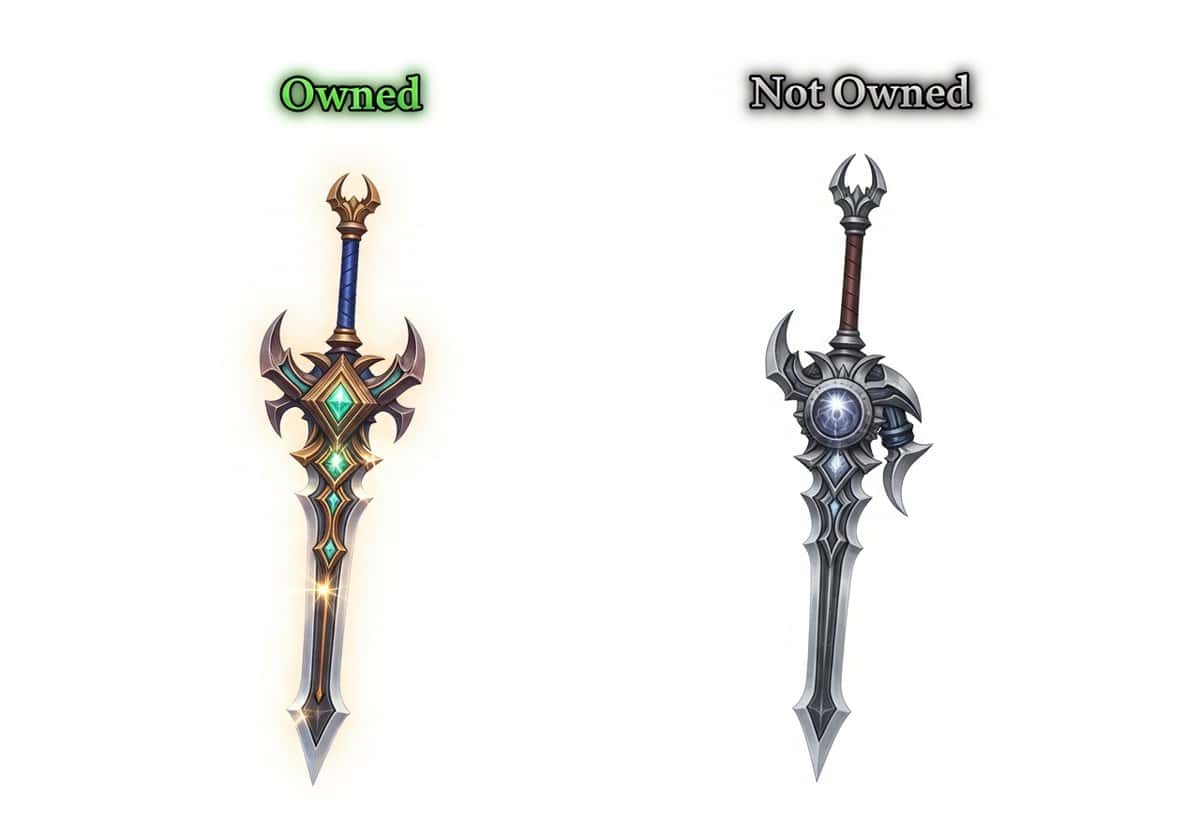
21. Endowment Effect
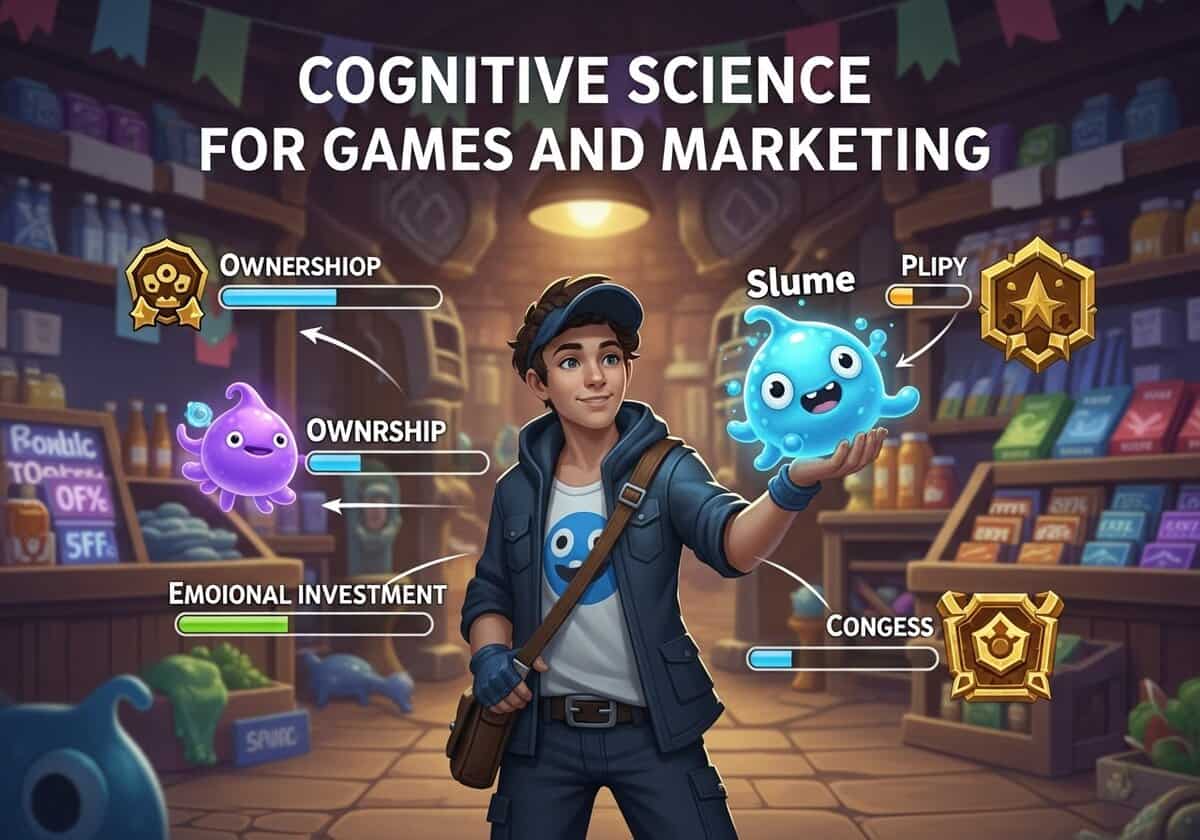
This cognitive bias causes people to overvalue things that they own. Once a player feels a sense of ownership over an in-game item, they will value it more highly than an identical item they do not own.
Games foster this effect by allowing customization, naming, and improvement of items, creating a personal attachment that makes the player more invested in the game world where their prized possessions exist.
The IT system enables this by providing persistent item databases that store not just the item’s existence but also its customized properties. This can include its name (a string), its color (a hex value), its stats (which are upgraded through player action), and its history (e.g., “Defeated the Lich King”). When the player views the item, the client pulls all this personalized data from the server, reinforcing the item’s unique identity and the player’s ownership of it.
Game application: in a monster-battling game, a player captures a basic “Slime” creature. They spend resources to upgrade it, evolve its appearance, and give it a unique name. A special offer appears in the shop for a much stronger, pre-leveled creature. However, the player is unwilling to replace their personalized, self-raised creature because the endowment effect has made it feel more valuable than the objectively superior new one.
22. Scarcity

Often used in advertisement marketing and websites, scarcity increases perceived value by implying high demand or limited supply. An item is seen as more desirable if it is rare, exclusive, or available for a limited time. This taps into the desire for status and uniqueness. Owning a scarce item signals dedication, luck, or wealth to other players, making it a powerful social signifier and a highly sought-after commodity.
Tip: this tricks combines very well with data-driven tricks seen in part 1
Scarcity is created and managed through server-side controls. For items with probabilistic scarcity (rare drops), the server uses RNG with very low probabilities, as described in intermittent rewards. For items with managed scarcity, the server might be programmed to only allow a certain number to exist in the entire game world (e.g., “Only 100 ‘Swords of the Founder’ will ever be created”). For time-based scarcity, the event system is used to make items available for only a short period.
Game application: an online multiplayer game sells a unique motorcycle skin in its cash shop for one week only, with a message that it will “never be sold again.” Years later, players who own the skin are seen as veterans. The skin’s scarcity has turned it into a status symbol, and new players who see it feel a desire for similar exclusive items.
23. Core Loops
The core loop is a sequence of actions that a player repeats continuously. The psychological power of a well-designed loop is its ability to become intrinsically motivating and habit-forming.
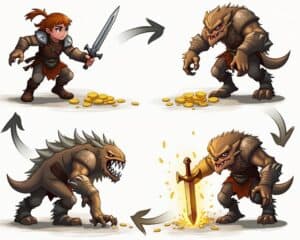
A simple, rewarding loop (e.g., Fight monster -> Get gold -> Use gold to upgrade sword -> Fight stronger monster) provides a constant sense of progress and competence. It is the fundamental gameplay rhythm that players learn and master.
The technical implementation of a core loop involves linking several different game systems together in a cycle. In the example above, the combat system rewards the player with virtual currency, which is stored in the player database. The inventory system allows the player to spend that currency to modify an item’s stats, also saved to the database. The matchmaking or world-spawning system then presents the player with a more difficult challenge, which feeds back into the combat system.
Game application: a mobile action-RPG has a simple core loop. 1) The player enters a short, 30-second dungeon (Action). 2) They collect loot and an experience gem (Reward). 3) They use the loot and gem to slightly improve their character’s stats back in the main menu (Investment). This loop is so fast and rewarding that players can perform it dozens of times in a single session.
24. Gacha Mechanics

Gacha mechanics are an extreme form of intermittent rewards, modeled after capsule-toy vending machines: they tap into the powerful thrill of summoning or opening a pack, where the anticipation of a rare result is a major part of the experience.
The cycle of spending currency, watching an elaborate opening animation, and then seeing the results can be highly compelling, triggering the same psychological responses as gambling.
This system is entirely dependent on a server-side RNG and a database of potential rewards (the “pool”). Each item in the pool is assigned a rarity and a corresponding probability. When a player “pulls,” the server executes a roll and grants the resulting item to their account. Math and statistics are used to publicly display the probabilities (e.g., “5-star character: 1% chance”), which is a legal requirement in many regions, to provide transparency into the statistical model being used.
Game application: in a hero-collection RPG, players spend “Soul Gems” to summon a random hero. The summoning animation is a flashy spectacle of light and energy. Most of the time, a common 3-star hero appears. But the player keeps spending gems, chasing the dopamine rush of the moment when the animation might reveal an ultra-rare 5-star hero, which has a 0.6% probability.
25. Pay to Skip
This monetization strategy leverages a player’s impatience. By creating artificial waiting periods or “grindy” challenges, the game first creates a negative stimulus (boredom or frustration). It then immediately offers a paid solution to remove that negative stimulus.
The purchase is not framed as buying an advantage, but as buying back the player’s time, which can be a very persuasive proposition for adults with disposable income but limited leisure time.

Easy to implement, this one requires also a server-side time-gating mechanism. When a player starts an action (e.g., “Upgrade Town Hall”), the server stores a “completion_timestamp” in its database (e.g., current time + 8 hours). The game client pulls this timestamp and displays a countdown. A “Pay to Skip” button is shown next to it. If the player clicks it and completes a purchase, the server simply updates the timestamp to a past value, instantly completing the action.
Game application: in a mobile strategy game, upgrading the main castle to level 5 takes 24 real-world hours. The player is locked out of other upgrades during this time. A button next to the timer offers to “Instantly Complete for 100 Gems.” A busy player who wants to continue playing without waiting for a full day is highly tempted to pay the small fee to skip the timer.

26. Streaks and Daily Challenges
Used of course only in games, streaks build habits by leveraging the psychological desire for consistency and the Zeigarnik effect. An unbroken chain becomes an achievement in itself that the player feel motivated to maintain. Daily challenges create a small, achievable goal that gives the player a clear reason to log in every day. Completing these challenges provides a reliable dose of accomplishment, reinforcing the daily login habit, thus returning.
This is implemented with a server-side system that logs player activity against the calendar. For streaks, the server checks the timestamp of the player’s last login and compares it to the current date to see if the chain is broken. For daily challenges, a server script resets a list of tasks every day at a fixed time (e.g., 00:00 UTC). The player’s completion of these tasks is tracked in a database, and rewards are granted automatically upon completion.
Game application: a mobile word game has a “Daily Puzzle.” It also tracks the “Daily Puzzle Streak.” A player has completed the puzzle for 35 consecutive days. On day 36, they are busy but make a point to open the app for five minutes to solve the puzzle, not just for the small reward, but primarily to avoid breaking their 35-day streak.
27. The “Near Miss” Effect
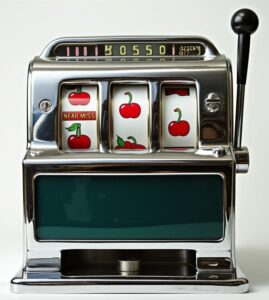
This psychological phenomenon occurs when a player perceives they were very close to achieving a desired outcome. In gambling, it’s getting two out of three cherries on a slot machine. This near miss can be more stimulating than a clear loss, as it signals that a win is possible and encourages another attempt. It triggers the brain’s reward system in a similar way to a win, creating a powerful “try again” impulse.
This effect is engineered into reward systems using statistics and visual design. For a loot box opening, the server might have already determined the player will receive a common item. However, the client-side animation might rapidly show several legendary items flashing by before settling on the common one. The math ensures the final outcome is random, but the visual presentation is deliberately designed to create the illusion of a near miss, stimulating the player to try again.
Game application: in a digital collectible card game, when a player opens a card pack, the five cards are revealed one by one. The fourth card revealed is a legendary, ultra-rare card, causing a spike of excitement. The fifth and final card (the one they actually get to keep from this specific slot) is a common one. The feeling of “almost getting” the legendary card makes the player want to buy another pack immediately.
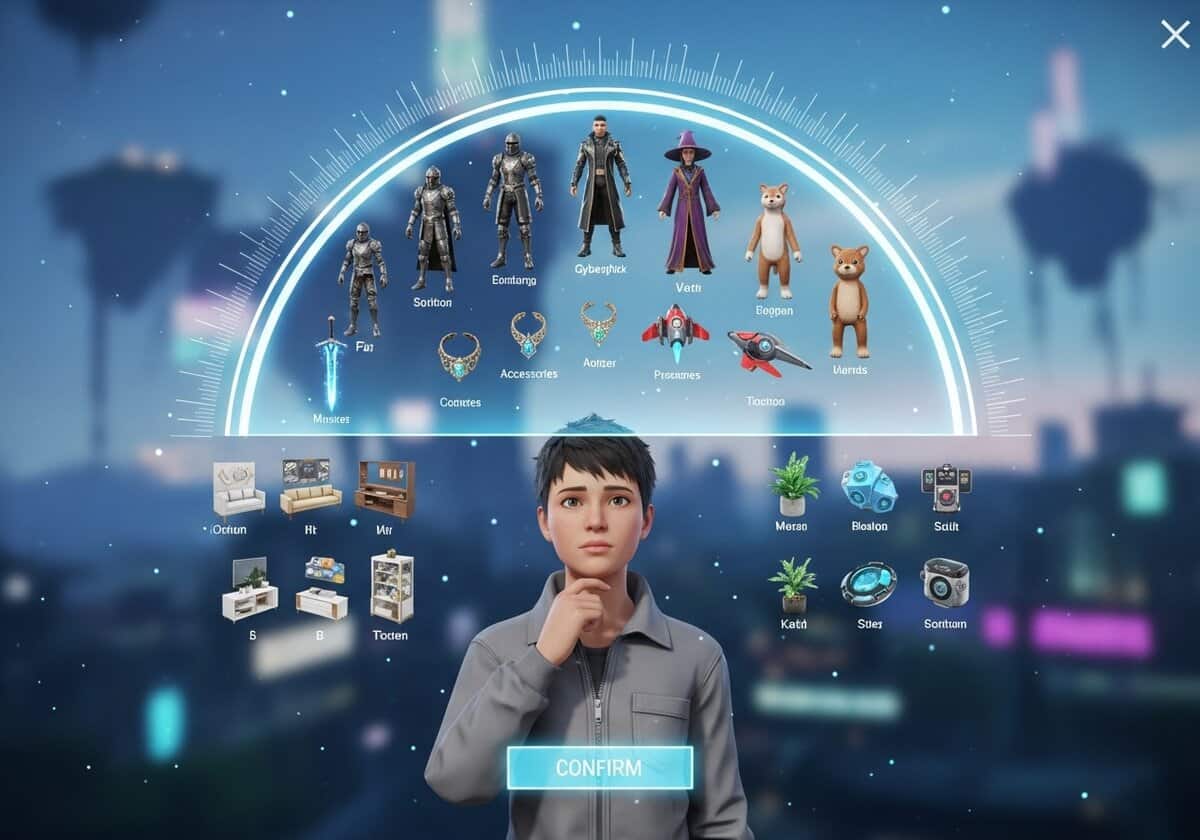
28. Customization and Self-Expression
Free or paid, allowing players to customize their appearance, gear, or home taps into the need for individuality and self-expression. When a player invests time in creating a unique look or designing a personal space, they are projecting their own identity into the game world. This creates a much deeper and more personal emotional connection to their character and the game itself, increasing their sense of belonging and investment.
This requires a flexible data structure on the backend to store a wide array of customization choices for each character or object. For example, a character’s database entry would have fields for hair style, hair color, face markings, armor tints, etc. The game client contains the 3D models and textures, and it assembles the final appearance of the character in real-time based on the specific combination of data it retrieves from the server for that player.
Game application: in a social simulation game, players are given a blank apartment. They can spend in-game currency to buy hundreds of different furniture items, change the wallpaper, and position everything exactly as they wish. Players spend hours designing their unique space and visiting the apartments of others. This deep investment in their personalized home becomes a primary reason they continue to play.
29. Mystery and Unpredictability

The human brain is wired to seek out patterns and solve puzzles. By introducing elements of mystery, an unfolding story, or unpredictable events, a game can create a powerful sense of curiosity and wonder. Not knowing what will happen next or what a strange discovery means is a powerful hook that drives exploration and keeps players engaged, as they are motivated by the intrinsic desire to find answers and resolve the unknown.
This is implemented through narrative design and event triggers. A mysterious object might be placed in the world with no initial explanation. Its purpose is only revealed chapters later in the main story, a connection stored in the game’s quest logic. Unpredictable events, like a sudden “meteor shower” that drops rare resources on a random part of the map, are triggered by a server-side event scheduler with a random time and location component, making the world feel dynamic and surprising.
Game application: in a survival-crafting game, players occasionally find ancient, sealed stone tablets with unreadable symbols. They have no immediate gameplay function. This creates a community-wide mystery. Months later, a game update introduces a “Sage” character who can decipher the tablets, finally revealing clues to a hidden location, rewarding the players who had been collecting and speculating about them for months.
30. Escapism

Escapism provides a temporary psychological retreat from the stresses and constraints of the real world. A well-crafted game world offers a clear set of rules, achievable goals, and a sense of power or agency that might be lacking in a person’s daily life.
This ability to inhabit a different reality where one’s actions have clear and immediate meaning is a fundamental and powerful draw of video games.
The technical creation of a compelling world is the sum of all game development disciplines. It requires high-fidelity graphics and art to create a visually distinct place. It needs sound design and music to establish a mood. It needs robust network code to create a stable and persistent online world. The servers must store the state of this world, from the position of monsters to the ownership of player housing, creating a consistent alternate reality that players can step into.
Game Application: a player has a stressful, monotonous office job with little autonomy. In the evening, they log into a fantasy RPG where they are a legendary hero. In this world, they make important decisions, explore a vast and beautiful landscape, and are a powerful, respected figure. This provides a nightly escape from their real-world frustrations and a sense of accomplishment and power.
31. Endowed Progress
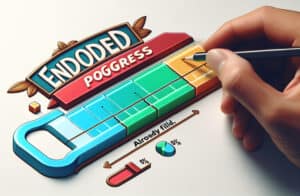
This leverages the psychological goal-gradient effect, which suggests that people are more motivated as they get closer to a goal.
By starting a player partway through a task (e.g., a progress bar that is already 20% full), the game makes the goal seem less daunting and more achievable. This initial “endowment” of progress provides immediate momentum and makes the player more likely to commit to completing the rest of the task.
The implementation is a simple matter of state management. When a quest or task is initiated for a player, the server, instead of setting their progress value to 0, sets it to a predefined starting value. For a quest to “Collect 10 Bear Pelts,” the server might automatically grant the first 3 to the player upon accepting the quest. The UI then fetches this initial state and displays the progress as “3/10,” immediately motivating the player.
Game application: in a shooter with a battle pass system, the first tier is unlocked automatically upon purchase. Instead of starting at “Tier 1, 0 XP,” the player starts at “Tier 2, 0 XP.” This endowed progress immediately makes the goal of reaching the final tier seem closer and more manageable, encouraging them to start grinding for the next level.
32. Reciprocity

Reciprocity is a strong social norm where individuals feel an obligation to return favors. By building systems that allow players to easily give gifts or help one another, games create a web of positive social obligation.
When a player receives an unsolicited gift of energy or a helpful boost from a friend, they feel a social pressure to both thank that friend and return the favor in the future, strengthening social bonds and retention.
The technical system requires a social graph (a friend list) and an event system for gifting. When Player A sends a gift to Player B, the server logs this action. Player B receives a notification, often with Player A’s avatar attached (“Player A sent you 10 Energy!”). The system also includes a “Send Gift Back” button, which simplifies the act of reciprocation, turning a complex social interaction into a single, easy click.
Game application: in a mobile puzzle game, players can get stuck on a hard level. They can request extra lives from friends. When a friend grants them lives, they are able to continue playing. This creates a feeling of gratitude and a social obligation to grant lives to others in return, fostering a cooperative community ecosystem.
33. Cognitive Dissonance
This describes the mental discomfort of holding contradictory beliefs. Games can induce this to influence purchasing behavior.
A player might strongly identify as a “free-to-play” user (Belief 1) but be consistently failing at a level (Belief 2: “I am not skilled enough”). The game then offers a very cheap, powerful item for $0.99. Buying it conflicts with their “free-to-play” identity, creating dissonance. To resolve this, the player may rationalize the purchase (“It’s just a one-time thing”) and, in doing so, lower their barrier for future spending.
This is not a direct technical system but is enabled by game and economic design. The system requires analytics to identify player “stuck points”—levels with abnormally high failure rates. The monetization system is then programmed to detect when a player is stuck at such a point and trigger a highly targeted, low-cost offer designed to solve that specific problem. This creates the exact conditions for cognitive dissonance to occur.
Game application: a player in a base-building strategy game who prides themselves on never spending money has their base repeatedly destroyed by a specific high-level dragon. After the fifth consecutive defeat, a one-time offer appears: “Dragon Slayer Pack: Anti-air missile launcher for $0.99.” The player, frustrated and wanting to progress, makes the small purchase, resolving their dissonance by slightly altering their self-identity.
34. The Illusion of Control

This cognitive bias causes people to overestimate their ability to influence events that are actually determined by chance. Giving the player a choice in a random process, even if that choice has no bearing on the outcome, makes them feel more invested and responsible for the result. This transforms them from a passive observer of randomness into an active participant.
This is a trick of user interface design layered on top of a server-side RNG. For example, a game might present three treasure chests. The server has already decided that the player will receive 100 gold. When the player clicks a chest, the client simply plays an animation of that specific chest opening and displays the pre-determined reward. The player’s choice was purely cosmetic, but it creates the powerful illusion that they chose the “right” chest.
Game application: in a character-collection gacha game, during a “Summon” event, the player taps a crystal. The server has already determined which character they will receive. However, the client could ask the player to trace a symbol on the screen to “focus the energy.” This meaningless action gives the player an illusion of control over the random summon, making them more invested in the outcome.
35. The Gambler’s Fallacy

This is the mistaken belief that past random events influence future random events. If a coin lands on heads five times in a row, a person exhibiting this fallacy believes it is “due” to land on tails next.
Games can implicitly encourage this thinking. After a long string of receiving only common items from a loot box, a player may feel that a rare item is “due,” compelling them to perform the action one more time.
This is not something developers program directly, but rather a player psychology that emerges from any system with low-probability random outcomes. The key technical component is the RNG. To be fair, the math of the RNG must ensure each event is statistically independent. However, the UI can be designed to display a “history” of recent rewards, which can inadvertently encourage the gambler’s fallacy by making it easy for players to see their “losing streak.”
Game application: in a sports team-building game with player packs, a player opens 10 packs and receives no high-rated players. Believing their luck is “due for a turn,” they decide to buy one more pack, incorrectly assuming their previous bad luck has increased the probability of getting a good player in the next one. The probability remains unchanged, but their belief drives the purchase.
36. Flow State
Flow is a state of deep immersion where a person is fully absorbed in an activity, and the sense of time is distorted. It is achieved when the perceived challenge of a task is in perfect balance with the person’s skill level. Games are exceptionally good at creating and maintaining this state by carefully managing difficulty, providing clear goals, and giving immediate feedback on actions.
Technically, achieving flow is the goal of systems like Dynamic Difficulty Adjustment (DDA). The game constantly collects metrics about player performance (accuracy, speed, success rate). The game’s logic then uses these metrics to subtly modulate the challenge. If the player’s skill increases, the difficulty ramps up to match it. If they start to struggle, it eases off. This constant, data-driven balancing is designed to keep the player within the narrow, highly engaging “flow channel.”
Game application: in a rhythm game, as the player successfully hits a long string of notes, their “rock meter” goes up, and the song continues. If they start missing notes, the meter drops, and the crowd starts booing. To maintain the flow state, the game’s difficulty curve is designed so that new note patterns are introduced just as the player masters the previous ones, keeping them constantly challenged but not overwhelmed.
37. Self-Determination Theory
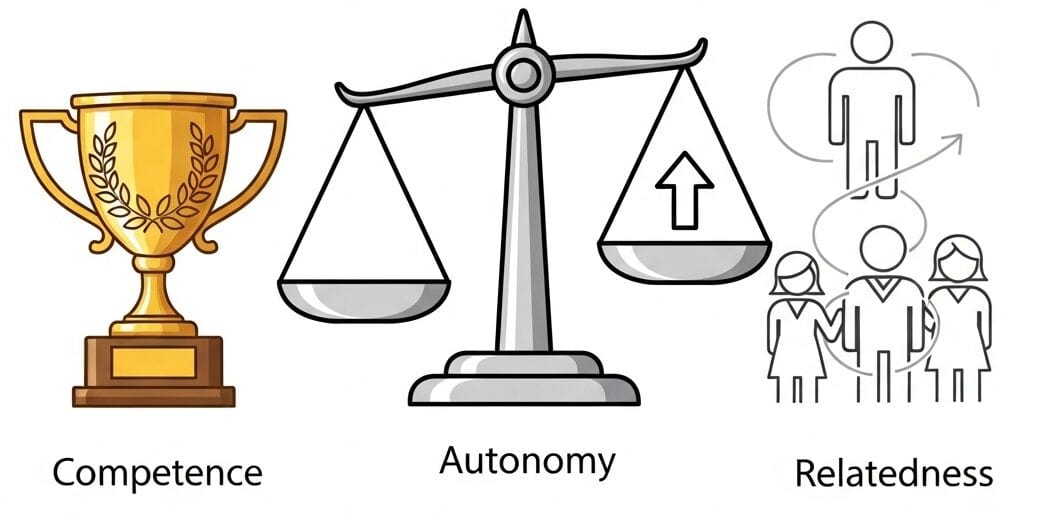
This psychological theory suggests that well-being and motivation are driven by three innate needs:
- Autonomy (the feeling of choice),
- Competence (the feeling of mastery),
- Relatedness (the feeling of connection to others).
Games that satisfy these three needs are highly engaging. They provide meaningful choices (Autonomy), systems to master and clear feedback on progress (Competence), and social features like guilds and teams (Relatedness).
The technical implementation involves providing variety and choice in the game’s core systems. Autonomy is supported by offering branching quests or multiple viable character builds. Competence is supported by clear UI feedback, like leveling up, achievement notifications, and damage numbers. Relatedness is supported by network features like chat systems, group finders, and shared guild objectives, all requiring complex database and real-time communication infrastructure.
Game application: in a science-fiction RPG, the player is given Autonomy through dialogue wheels that let them shape their character’s personality. They gain Competence by leveling up their skills and acquiring better gear, making them more effective in combat. They feel Relatedness through the deep relationships they build with their companion characters, who react to their choices.
38. Chunking

Chunking is a cognitive principle where information is broken down into smaller, manageable units.
The human brain can only process a limited amount of new information at once. By introducing complex mechanics one piece at a time (chunking them), games avoid overwhelming the player. A complex combat system is not explained in a 10-page text wall, but is taught through a series of small, interactive tutorial steps.
This is a core principle of user experience (UX) design and is implemented via a scripted tutorial system. The system locks out most of the game’s features at the start. It then guides the player through one concept at a time. For example, Step 1 teaches movement. Once that is demonstrated, Step 2 unlocks and teaches the basic attack. Step 3 teaches a special ability. This sequential unlocking, managed by player state flags, ensures a smooth learning curve.
Game application: a complex turn-based strategy game is immensely complex. A new player is not presented with all 50 game concepts at once. The first few turns focus only on the “chunk” of moving a warrior and founding a city. The concept of “research” is then introduced. After that, the “chunk” of “city production” is explained. This step-by-step reveal makes the game approachable.
39. Curiosity Gap
The curiosity gap is the space between what we know and what we want to know. Humans are naturally motivated to fill this gap. Games create curiosity by showing players things they cannot yet access or understand. This could be a locked door, a grayed-out area on the world map, or a mysterious piece of story lore. This creates a powerful intrinsic motivation for the player to continue playing in order to find the key, explore that region, or uncover the truth.
This is implemented through level design and state management. A high-level area might be visible to a new player, but the enemies are programmed to be impossibly difficult, physically barring access until the player is stronger. The UI might show a “weapon enchanting” feature that is grayed out with the text “Unlocks at Level 20.” These teasers are logged in the player’s mind as goals to be achieved.
Game application: in an open-world action-RPG, a player might see a massive, inaccessible castle high on a cliff early in their journey. There is no obvious path to it. The mystery of “How do I get there?” creates a powerful curiosity gap. Hours later, discovering a hidden path or a teleporter that finally leads to the castle provides a profound sense of satisfaction.
40. Anticipation

Anticipation of a reward can be more psychologically stimulating than the reward itself. The brain’s dopamine system is highly active during the period of waiting and expectation.
Games deliberately build anticipation through timers, slow-opening animations for loot boxes, and progress bars for long-term goals. This delay makes the final reward feel more significant and earned.
This is implemented through client-side animation timing and server-side time gates. When a player opens a loot box, the server may instantly determine the reward, but the client is instructed to play a 5-second animation. The animation shows the box shaking, glowing, and slowly opening, all designed to build anticipation before the final reveal. Countdown timers for events or upgrades serve the same purpose over a longer time frame.
Game application: in a digital card game, when a player earns a new card pack, opening it is a multi-stage process. They must drag the pack to the center of the screen. It shakes and glows. When they tap it, the cards burst out and land face down. The player must then click on each card individually to reveal it, building a small moment of anticipation for each one.
41. Powermongering
This leverages the player’s desire for power, control, and dominance. Games provide a safe and ethical (?) outlet for this desire by allowing players to become immensely powerful within the game’s universe. This can be achieved through devastating abilities that wipe out hordes of enemies, high-level gear that makes them nearly invincible, or a top rank on a competitive leaderboard that signals their superiority to others.
The feeling of power is delivered through mathematical scaling. As a player levels up, their character’s stats (health, damage, etc.) do not increase linearly, but often exponentially. An ability at level 1 might do 10 damage, but at level 50 it does 10,000 damage. The technical systems must support these large numbers. Visual and sound effects are also scaled up to match the numbers, making a high-level ability look and sound far more impactful than a low-level one.
Game application: in an action game, the player character is a heroic general who can single-handedly defeat thousands of enemy soldiers. The core gameplay loop is built around the fantasy of being an unstoppable force of nature. The satisfaction comes directly from this powermongering, from the visual and statistical feedback of being overwhelmingly superior to the enemies.
42. Anchoring
Anchoring is a cognitive bias where people depend too heavily on the first piece of information offered (the “anchor”) when making decisions. In-game shops use this by showing an extremely expensive item or bundle first. This high price sets a mental anchor. Subsequent items, even if objectively expensive, seem reasonably priced in comparison to the initial anchor, making them more likely to be purchased.
This is a monetization and UI design strategy. The data structure for the in-game shop is deliberately sorted on the server before being sent to the client.
Game application: the shop in a mobile character-collection game often opens with a “$99.99” character offer as the most prominent, leftmost item. As the player scrolls to the right, they see smaller offers for $19.99 or $4.99. The initial anchor of $99.99 makes the subsequent, smaller purchases feel like a bargain.
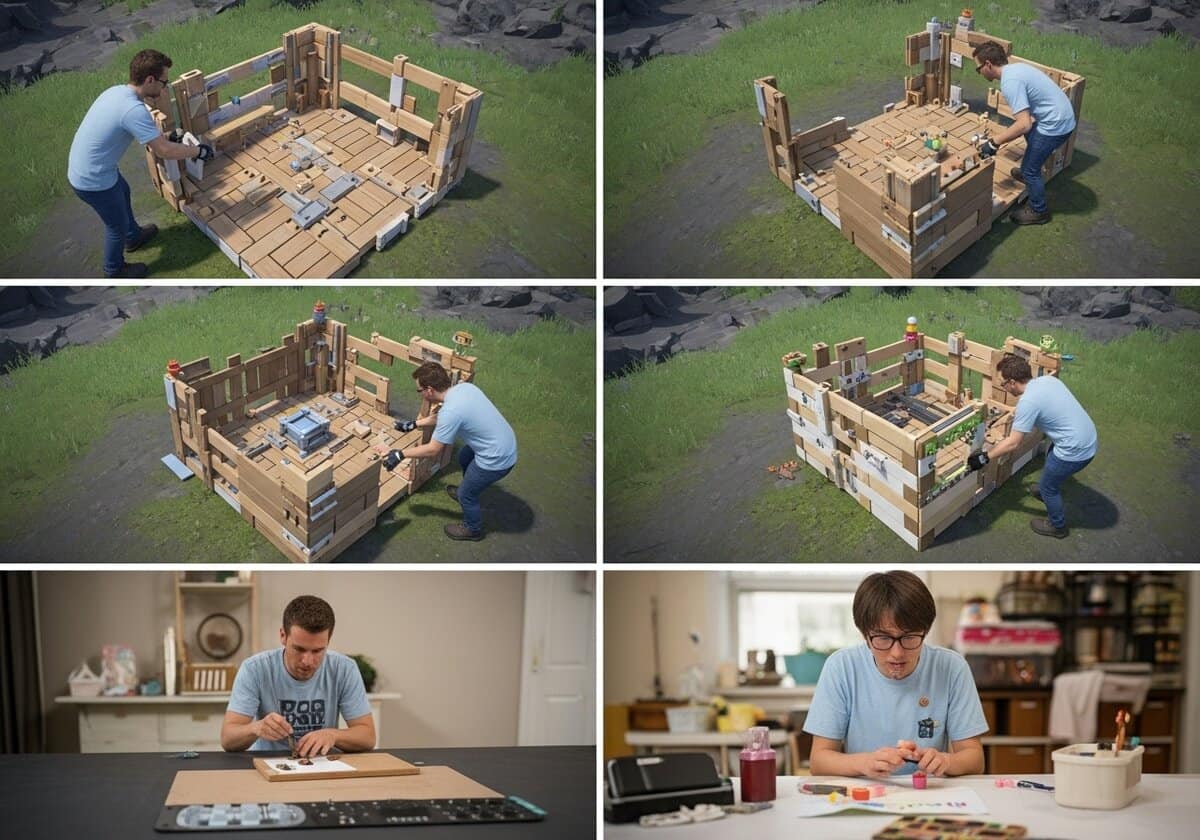
43. The “IKEA Effect”
This cognitive bias leads people to place a disproportionately high value on things they have partially created themselves. By having players invest effort into building or assembling an item or base, games can trigger this effect. The player feels a greater sense of ownership and pride in the final product because of their own labor, making them more attached to it than to a pre-made, gifted item of equal or greater value.
The game’s systems must provide a framework for creation. This can include crafting systems, where players gather raw materials and follow a recipe. It can also include base-building systems with a modular set of pieces that players can arrange. The server must store the state of these user-generated creations, preserving the player’s effort and the object of their attachment.
Game application: in a sandbox survival game, a player could easily build a functional dirt hut in five minutes. Instead, they spend 20 hours gathering rare wood and stone, crafting decorative elements, and meticulously constructing a grand castle. The IKEA effect means this self-built castle, a product of their own effort and creativity, feels infinitely more valuable to them than any pre-built structure the game could have provided.
44. Delayed Gratification

While many games rely on instant rewards, delaying gratification can create a more profound sense of accomplishment and investment. By setting long-term goals that may take weeks or months to achieve, a game encourages persistence and long-term planning. The final reward, when it is finally achieved after a long period of effort, provides a massive psychological payoff that reinforces the player’s dedication to the game.
This requires robust long-term tracking systems. The server must track progress on objectives that require thousands of actions or weeks of daily logins. The UI plays a critical role by visualizing this long road with extended progress bars or multi-stage collection quests. This constant visual reminder of the far-off goal keeps the player oriented and motivated over a long period.
Game application: in an online role-playing game, acquiring a legendary weapon can be an epic, multi-month quest chain. It involves completing dozens of difficult steps, collecting rare materials from all over the world, and defeating powerful bosses. The final moment of forging the weapon after months of effort provides an immense sense of accomplishment.
45. Social Recovery
Social Recovery is a player retention mechanic where an inactive player can be “revived” by their active friends. It leverages the power of social obligation listed above and connection to bring lapsed users back into the game. An active player may receive a prompt to “Bring a friend back and get a reward,” which turns the game’s retention problem into a quest for the active player.
This system links the churn prediction model with the social graph. When the system flags Player A as “churned,” it can check Player A’s friend list. If their friend, Player B, is still highly active, the system can trigger an in-game event for Player B. This event might be a quest titled “Rescue Your Friend!” that, upon completion, sends an email or push notification to Player A with a reward, attributed to their friend Player B.
Game application: in a hero-collection RPG, there is a “Recall a Friend” event. An active player can select an inactive friend from their list. The system then sends an email to the inactive friend saying, “Your friend [Player Name] has sent you a 5-Star Hero Summon Ticket! Return to the game to claim your hero!” This uses the social connection to deliver a powerful re-engagement incentive.
Conclusion
In modern product design, innovation, game industry and marketing, the process of “hooking” a customer has evolved into a scientific discipline, fusing psychological principles with large-scale data analysis. Science provides the foundational blueprint, leveraging established behavioral and cognitive theories—such as intermittent rewards, loss aversion, and social proof—to design experiences that tap directly into predictable human motivations and biases. Data analysis then acts as the engineering and validation engine, using techniques like A/B testing, predictive modeling, and user segmentation to measure the precise impact of these psychological triggers in real-time. This powerful combination allows marketers to move beyond intuition, creating highly optimized and personalized systems that methodically build user habits, foster deep engagement, and guide purchasing behavior with statistical precision
Glossary of Terms Used
User experience (UX): the overall satisfaction and perception of a user when interacting with a product, system, or service, encompassing usability, accessibility, design, and emotional response throughout the entire interaction process.
User Interface (UI): a system that enables interaction between users and software applications, encompassing visual elements, controls, and overall layout to facilitate user tasks and enhance experience.