Product Design, Manufacturing & Innovation Resources
Home » User-Centered Design (UCD)

User-Centered Design (UCD)

1986
  • Donald Norman
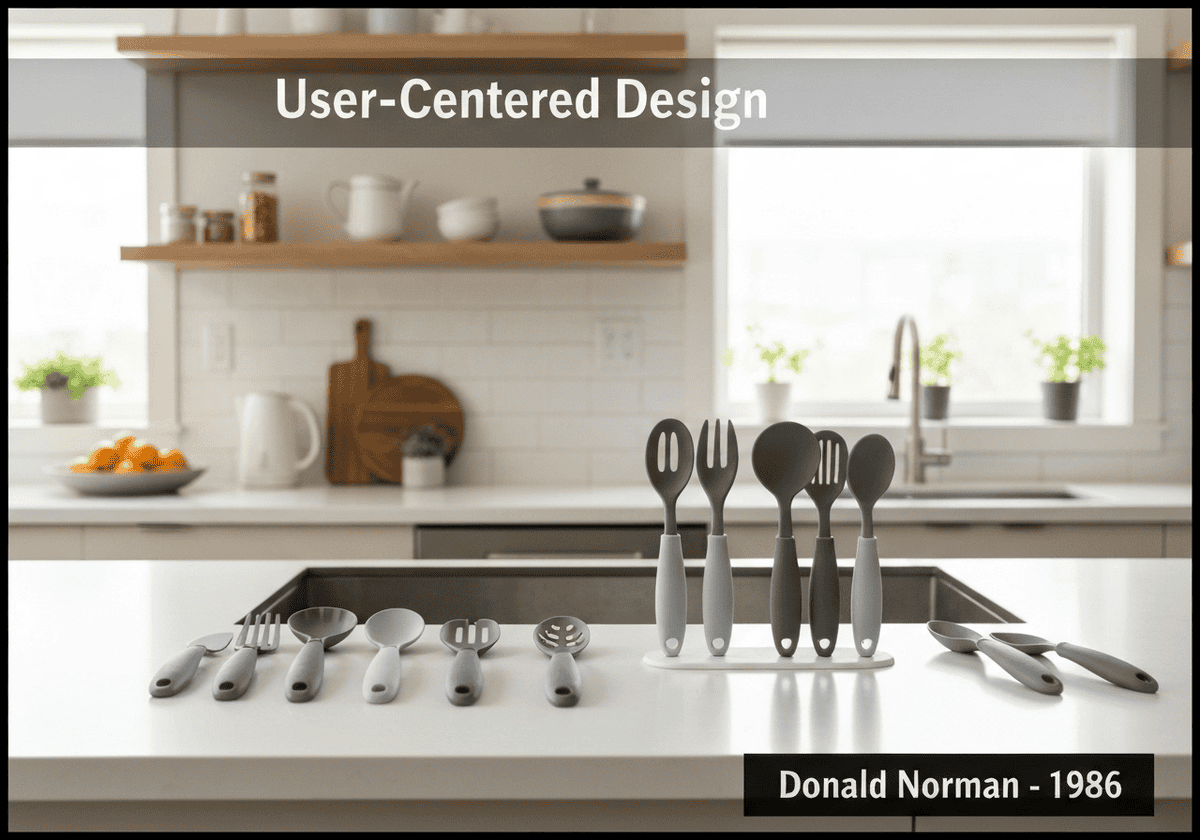
Ergonomic kitchen workspace featuring user-centered design utensils by OXO Good Grips.

(generated image for illustration only)

A design philosophy and iterative process where the needs, wants, and limitations of end-users are given extensive attention at each stage of the design process. UCD aims to create products that are highly usable and accessible by involving users throughout the design cycle through research, testing, and feedback, rather than relying solely on designer assumptions. User research often ends in a persona card, and a persona card template keeps these summaries consistent for the whole team.


User-Centered Design (UCD) fundamentally shifts the focus of product development from the technical capabilities of the system to the experience of the person using it. The process is built on an explicit understanding of users, tasks, and environments. It begins with extensive user research to build empathy and gather insights, often creating ‘personas’—fictional characters representing key user types—and mapping out ‘user journeys’ to understand their interactions with a product in context. Throughout the design process, UCD employs a variety of methods to keep the user involved. These include usability testing, where users are observed performing tasks with a prototype, A/B testing to compare different design variations, and participatory design sessions where users are invited to contribute ideas directly. The core principle is iteration: design, prototype, test, and repeat. Feedback from each testing round directly informs the next design iteration, ensuring the product evolves based on real user data rather than internal opinions. This approach significantly reduces the risk of creating a product that is difficult to use or fails to solve a genuine user problem, ultimately leading to higher user satisfaction and adoption rates.

UNESCO Nomenclature: 6106
– Ergonomics

Type

Abstract System

Disruption

Revolutionary

Usage

Widespread Use

Precursors

  • the field of ergonomics and human factors
  • cognitive psychology research on human perception and problem-solving
  • the development of graphical user interfaces (guis)
  • industrial design’s focus on form and function

Applications

  • the user interface of the apple iphone
  • google’s search engine interface
  • ergonomic kitchen utensils by OXO Good Grips
  • accessibility features in modern operating systems like windows and macOS

Patents:

NA

Potential Innovations Ideas

  • an ai system that generates personalized user interfaces based on an individual’s cognitive and physical abilities
  • a neuro-feedback loop for software that adjusts its complexity in real-time based on the user’s cognitive load
  • a ‘ucd-as-a-service’ platform providing on-demand user testing with diverse global demographics
  • smart home devices that learn and adapt their functionality based on the household’s routines and preferences
  • educational software that customizes lesson plans based on a student’s learning style and progress
  • wearable technology that provides haptic feedback to guide users through complex physical tasks
  • a public policy design framework that uses ucd principles to create more effective and accessible government services
  • a vehicle dashboard that reconfigures its layout based on driving conditions and driver focus
Related to: user-centered design, UCD, human-computer interaction, usability, user experience, donald norman, ergonomics, accessibility.

Historical Context

1941
1986
1990
2000
1950
1990
1990

(if date is unknown or not relevant, e.g. "fluid mechanics", a rounded estimation of its notable emergence is provided)

10th year anniversary

Full size images and downloads are only available, 100% free, for registered members.

> Login <





















