

In games and marketing, the application of psychological theory is measured, refined, and amplified through data and stats analysis. The behavioral patterns of millions of users are collected and processed, allowing for the statistical validation of design choices. Techniques like A/B testing provide empirical proof of which stimuli most effectively drive user action, while player segmentation allows for the delivery of personalized content that resonates with specific behavioral profiles.
Predictive analytics and machine learning models can identify when a player is likely to quit or make a purchase, enabling proactive, automated interventions. This fusion of social science with data-driven validation creates a powerful cycle where psychological hypotheses are tested at scale, and the resulting insights are used to continuously optimize game systems for player retention and monetization.
This article is the 1st of a 3-parts:
- Data-Driven and Statistical Tricks for Games and Marketing
- Cognitive Science Tricks for Games and Marketing
- More Cognitive Science Tricks for Games and Marketing
Part #1: Data-Driven and Statistical Tricks for Games and Marketing
1. A/B Testing
This method relies on controlled experimentation to observe user behavior directly, removing developer bias from design decisions. The psychological mechanism at play is the measurement of subconscious preference. Users might not consciously know why they prefer one design over another, but their actions reveal a more favorable response to a specific stimulus, whether it is a color, shape, or price point. This provides empirical evidence of what design choices lead to higher engagement or conversion.
The execution requires a robust IT backend capable of segmenting the live player base into distinct groups (Group A, Group B, etc.) and serving them different versions of a game element. Statistical analysis is then applied to the data collected from these groups. This involves calculating metrics like conversion rates, engagement time, or retention, and using statistical significance tests (like chi-squared tests or t-tests) to confirm that the observed differences are not due to random chance. This data processing happens on servers that collect and aggregate event logs from millions of game clients.
Game Application: in a mobile puzzle game, developers want to increase the usage of a “bomb” power-up. They test two icons: one is a classic black sphere with a fuse, the other is a pulsing, arcane crystal. For one week, 50% of new players see the sphere (A) and 50% see the crystal (B). The server logs the usage rate per player, and statistical analysis shows the arcane crystal is used 15% more frequently, prompting its permanent implementation.
You can find a full review on the A/B testing methodology:

2. Player Segmentation

Player segmentation works by appealing to an individual’s identity and play style. By grouping users, the game can present content that aligns with their intrinsic motivations. A player categorized as an “Explorer” will respond positively to missions involving discovery, while a “Competitor” will be more engaged by leaderboards and player-vs-player content. This personalization creates a feeling that the game understands and caters to the user, strengthening their connection to it.
This process is data-intensive, beginning with the collection of vast amounts of player actions, such as time spent in different game modes, purchase history, and social interactions. Machine learning algorithms, specifically clustering algorithms like K-Means, are then used to identify patterns in this data and group players into distinct segments. The network infrastructure must support real-time data tagging and retrieval so that the game client can request and display the appropriate content or offers for a player’s specific segment.
Game Application: A space simulation game collects data on player activities. It identifies a “Trader” segment that frequently uses the market and flies transport ships. This segment then receives personalized in-game news feeds about commodity price shifts and exclusive missions to transport rare goods, content that is not shown to players in the “Fighter Pilot” segment.
3. Funnel Analysis
The psychological impact of funnel analysis is rooted in optimizing the user’s journey and minimizing friction. By identifying points where large numbers of users stop progressing (drop-off points), developers can address the underlying cause, which is often frustration, confusion, or boredom. Smoothing out these rough patches in the user experience prevents the negative emotions that lead to abandonment and maintains a state of forward momentum and engagement for the player.
Mathematically, a funnel is a visualization of user flow percentages from one step to the next. For instance,
- Step 1 (Completed Tutorial) might have 100% of users,
- Step 2 (Reached Level 5) might have 80%,
- Step 3 (Made First Purchase) might have 5%.
The IT infrastructure’s role is to log the completion of each predefined key event for every single user. Data analysis platforms then query this massive dataset to calculate the conversion rates between each sequential step, visualizing the funnel and highlighting the largest percentage drops.
Game Application: a city-building game notices a massive 70% player drop-off after the “Build a Power Plant” tutorial quest. By analyzing the funnel, they hypothesize the step is too complex for new users. They break the quest into three smaller, simpler quests: “Build a Wind Turbine,” “Connect a Power Line,” and “Power a Building.” After the change, the drop-off at that stage decreases to 20%.
4. Heatmaps

Heatmaps translate aggregate player behavior into an intuitive visual format, which exploits the human brain’s proficiency in pattern recognition. Seeing a “hot” red area on a map where players frequently die immediately communicates a design problem without needing to read complex charts. This allows designers to empathize with the collective player experience of frustration or difficulty in a specific area, prompting a more targeted and effective design change.
Technically, heatmaps are generated by capturing the X, Y (and sometimes Z) coordinates of specific player events, such as deaths, clicks, or ability usage, and storing them in a database. This can generate millions of data points per day. A rendering layer then aggregates these coordinates into a 2D or 3D grid. Statistical density functions are applied to this grid, assigning a color value (e.g., from blue for low density to red for high density) to each cell based on the number of events it contains. This visualization is then overlaid onto the game map for analysis.
Game Application: in a first-person shooter, a level designer reviews a heatmap of player deaths on a warehouse map. They see a bright red spot in a long hallway, indicating an unusually high number of deaths. They realize a single sniper position has an unfair line of sight. They add a large crate to the middle of the hallway to provide cover, and subsequent heatmaps show the death concentration has dissipated.

5. Predictive Analytics
This technique leverages the psychological principle of proactive intervention. By identifying a player’s likely future behavior, the system can act to reinforce positive outcomes or prevent negative ones. For a player predicted to make a purchase, presenting a relevant offer feels like a serendipitous and valuable opportunity. For a player predicted to churn (quit the game), receiving a special bonus or a message from a “friend” can re-engage them by creating a renewed sense of value or social obligation.
Predictive analytics is built on machine learning models, particularly classification and regression models. These models are trained on historical data from thousands of players who have already churned or made purchases. The models identify complex patterns in gameplay metrics (e.g., session length decrease, social interaction drop) that are statistically correlated with those outcomes. The IT system then runs these models on the data of the current player base in near-real-time to assign a “churn probability” or “purchase propensity” score to each user, triggering automated in-game actions when a score crosses a certain threshold.
Game example: a monster-collection game uses a model that predicts player churn. When a player’s churn probability score exceeds 75%, the system automatically triggers a “special event” for them: an in-game character sends them a message saying, “We miss you! Here is a rare Incubator to help you hatch your next creature.” This targeted incentive aims to prevent the player from leaving the game.
6. Dynamic Difficulty Adjustment

Dynamic difficulty adjustment (DDA) targets the psychological state of “flow,” where a player is fully immersed and the challenge level perfectly matches their skill. If a game is too hard, it causes frustration; if it’s too easy, it leads to boredom. DDA seeks to keep the player in that optimal channel of engagement by subtly increasing or decreasing the challenge, making the player feel competent and constantly stimulated without becoming overwhelmed.
The system works by defining and tracking key performance metrics (KPMs) for a player, such as accuracy percentage, level completion time, or resource collection rate. A statistical algorithm, often a simple rule-based system or a more complex Bayesian model, compares the player’s current KPMs against a pre-defined “ideal performance” baseline. If the player is performing too well, the system might increase enemy health or decrease resource availability. The network ensures these adjustments are made seamlessly from the server without interrupting gameplay.
Game application: in a racing game, if a player wins three races in a row by more than 10 seconds each, the DDA system subtly increases the AI opponents’ top speed and cornering ability in the next race. Conversely, if a player loses three consecutive races, the system might slightly decrease the opponents’ aggression, keeping the races competitive and engaging.
7. Personalized In-Game Offers

Personalization taps into the “relevance” principle; an offer is more likely to be accepted if it aligns with the individual’s existing behaviors and preferences. Seeing an offer for a sword a player has inspected multiple times in the past creates a feeling of being understood and catered to. This reduces the perceived “spamminess” of monetization and frames the purchase as a logical next step in their personal game journey.
This is achieved by creating a detailed profile of each player’s in-game behavior, stored in a server-side database. This includes data on items they have used, characters they play, and even items they have previewed but not bought. When an offer opportunity arises, a server-side script queries this profile. Using simple rule-based logic or a machine learning recommendation engine, it selects the most relevant offer from a catalog of possibilities to present to the player via the game’s user interface.
Game application: a role-playing game tracks that a player almost exclusively plays as a Mage character. When a weekend sale begins, instead of showing a generic “50% Off” banner, the game presents that player with a specific offer: “50% Off the Archmage’s Robe of Power,” an item directly relevant to their playstyle, increasing the chance of a purchase.
8. Churn Prediction and Prevention
This leverages loss aversion, the psychological idea that people are more motivated to avoid a loss than to acquire a gain.

When the system predicts a player is about to churn, it can intervene. The intervention—a bonus, a new challenge, a message—frames continued play as avoiding the loss of progress, community standing, or a special opportunity. This can be more powerful than a simple reward, as it reframes the decision to quit as an active loss.
The technical implementation is nearly identical to predictive analytics but is specifically focused on the “churn” outcome. Machine learning models are trained on historical data of players who have quit, identifying leading indicators such as declining session frequency, shorter session durations, or reduced social interaction. The IT system assigns a churn risk score to each active player. An automated marketing or content delivery system is configured to trigger specific retention campaigns (e.g., push notifications, in-game mail with gifts) for players whose risk score crosses a critical threshold.
Game application: in a social farming game, the system flags a high-level player whose login frequency has dropped from daily to once a week. The system automatically sends a push notification to their phone: “Your friend Beatrice just sent you a ‘Golden Tractor Fuel’ gift! Log in within 24 hours to claim it before it expires.” This combines a gift with social pressure and urgency to prevent churn.
9. Time Series Analysis

Time series analysis allows developers to understand the rhythm and pulse of their game community, tapping into the collective behavior of the player base. By identifying weekly or seasonal patterns, they can align game events with times of naturally high engagement to maximize participation. This creates a sense of a living world that has its own tempo, encouraging players to align their own schedules with the game’s, for example, by logging in on weekends for special events.
This is a purely statistical technique that models time-stamped data points to identify trends, seasonality, and cyclical patterns. Data such as daily active users, revenue, or logins per hour are plotted over time. Mathematical models like ARIMA (AutoRegressive Integrated Moving Average) can then be applied to this data to forecast future behavior. This requires a robust data warehousing solution capable of storing and processing massive volumes of historical, time-stamped event data.
Game application: the developers of an online multiplayer game use time series analysis on their player login data. They discover that logins peak every Saturday at 8 PM UTC. To capitalize on this, they schedule their most important weekly world boss event to begin every Saturday at 8:15 PM UTC, ensuring maximum player participation and excitement.
10. Cohort Analysis
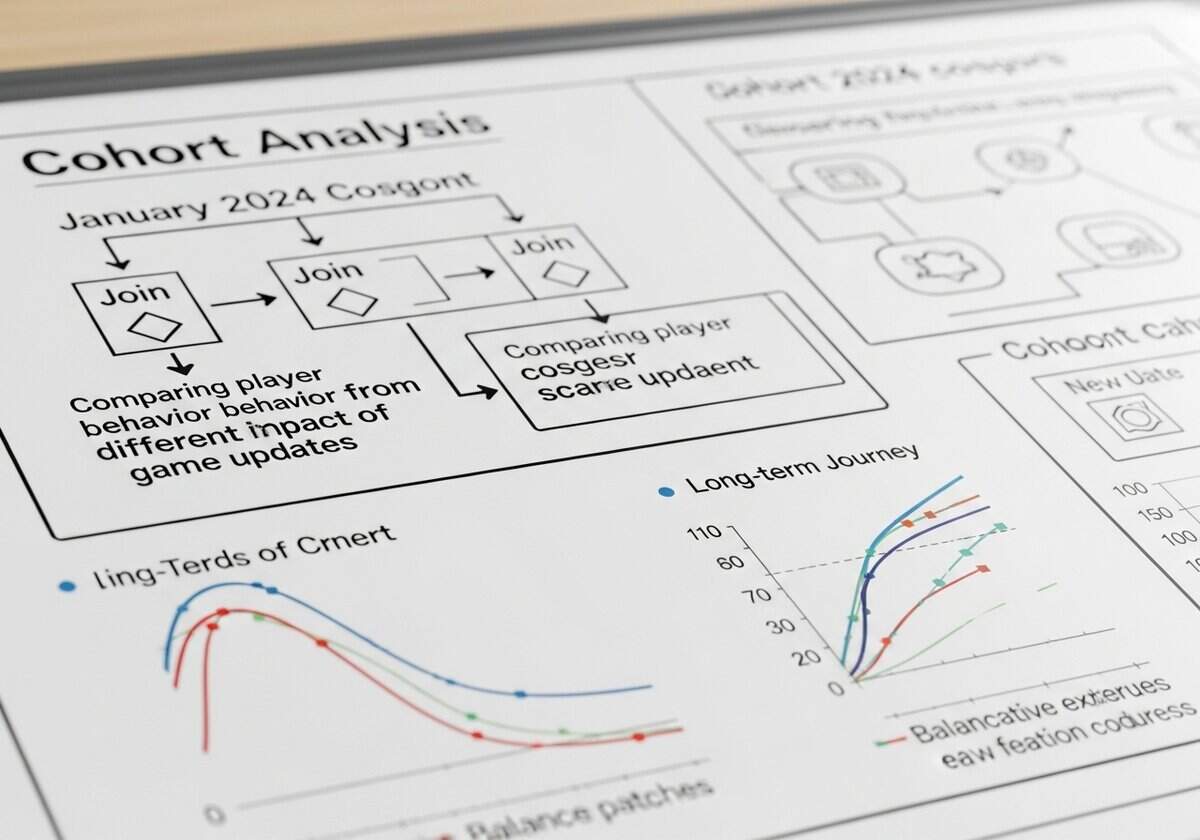
Cohort analysis works by framing player behavior in the context of a shared starting experience. By comparing the “Week 1” players from January with the “Week 1” players from February, developers can isolate the impact of game updates. This allows them to understand how specific changes affect the long-term journey of a new user. Psychologically, it helps developers build empathy for the “new player experience” of a specific era, understanding how a particular balance patch or new feature shaped that group’s collective journey.
The method involves grouping users based on a shared characteristic, most often their join date (e.g., the “January 2024 cohort”).
The IT infrastructure must tag every user with their cohort identifier upon creation. Then, a database can be queried to track the behavior of these specific groups over time. For example, a query might calculate the percentage of the January cohort that was still active after 30, 60, and 90 days, and compare those retention curves to the February cohort’s.
Game application: a fantasy role-playing game released a major “pets” update on March 1st. Using cohort analysis, they compare the 30-day retention of the “February Cohort” (who leveled without pets) to the “March Cohort” (who leveled with pets). They find the March Cohort’s retention is 10% higher, validating that the new pet system has a positive long-term impact on player engagement.
This post continues with Part #2: cognitive science tricks for games and marketing

Glossary of Terms Used
Conversion Rate (CR): the percentage of visitors to a website or landing page who complete a desired action, such as making a purchase or signing up for a newsletter, calculated by dividing the number of conversions by the total number of visitors.
User experience (UX): the overall satisfaction and perception of a user when interacting with a product, system, or service, encompassing usability, accessibility, design, and emotional response throughout the entire interaction process.
User Interface (UI): a system that enables interaction between users and software applications, encompassing visual elements, controls, and overall layout to facilitate user tasks and enhance experience.