
By mid-2026, humanoid robotics has become one of the most heavily capitalized categories in hardware, and one of the least examined on engineering merit. Set investors numbers against actual deployment: Bank of America Global Research puts total humanoid robot shipments in 2025 at roughly 18,000 units worldwide. Morgan Stanley’s long-range forecast projects a billion humanoids in service by 2050. That gap — nearly five orders of magnitude between where the category stands today and where its most bullish backers expect it to land — is worth holding onto as a baseline before evaluating any single company’s roadmap, or any single design decision.
This article is not an argument against humanoid robots. It is an argument against choosing a robot’s body the way the current market mostly chooses it: first, by assumption or by fundability, with the function worked out afterward, just to follow sci-movies or clichés.
Form-follows-function is an old, simple discipline, and robotics keeps skipping it.
What follows works through where the humanoid form genuinely earns its place, where it does not, and how to tell the difference before committing a design.
As introduction’s final thought, already in 2014, the movie “Ex Machina” by Alex Garland explored, among other AI topics, the robot extreme human appearance:
The Current State of Humanoid Robotics: Numbers vs. Narrative
Disclaimer: fast evolving topic & on-going new communication! Verify and update all figures before using them.
The one company with a genuine, contracted commercial deployment — not a pilot funded by the robot maker, not a demo — is Agility Robotics. Its Digit robot runs under a multi-year robots-as-a-service agreement with logistics operator GXO, and passed 100,000 totes handled in live warehouse operation in November 2025. Tesla, despite the largest capital commitment in the category — Q2 2026 capex of $5.79 billion, up 142% year over year, against negative free cash flow — had shipped zero commercial Optimus units as of mid-2026. The first units off its production line went to an internal R&D program or demos, not to customers.
What a humanoid actually costs to build
Component-level teardowns explain a large part of the gap between ambition and shipping product. Actuators — the linear and rotary motors that drive joints — account for over half of total bill-of-materials cost in current designs. At low volume, individual high-torque actuators run $500 to $2,000 each; a full-body humanoid needs 20 to 40 of them. Tesla’s public target of $100 to $300 per actuator at scale has not been demonstrated by any company in production (so far; but that, with our value analyse experience, we would believe it … if enough rare-metals can be found for magnets).
| Platform | Maker | List / est. price | Payload | Deployment status, mid-2026 |
|---|---|---|---|---|
| Optimus | Tesla | Not sold; internal only | ~20 kg (claimed) | Zero commercial units shipped |
| Figure 03 | Figure AI | Not sold; leased to partners | 20 kg (total) | Pilot fleet at BMW Spartanburg |
| Neo | 1X Technologies | ~$20,000 (consumer) | Not published | Pivoted from home to industrial use (EQT deal, up to 10,000 units) |
| Digit | Agility Robotics | RaaS, not sold outright | 16 kg | Multi-year commercial contract with GXO |
| Atlas (electric) | Boston Dynamics / Hyundai | Not sold; R&D and pilots | Not published | Factory deployment targeted for 2028 |
| Apollo | Apptronik | Not sold; pilots | 25 kg | Piloting inside Mercedes-Benz plants |
| G1 | Unitree | $13,500–$74,000 by tier | 2–3 kg | Shipping to developers and researchers |
Pro tip: when a vendor cites a “deployment,” ask three questions before treating it as evidence of maturity. Is it a paid commercial contract or a pilot funded by the robot maker? Is the runtime and uptime figure independently logged? What fraction of the demonstrated task was teleoperated rather than autonomous? Figure’s 81-hour livestream sorting packages is a genuine engineering result — continuous single-task operation at roughly one pick every three seconds — but a fair reading of it shows reliability on one narrow task, not general-purpose competence, and independent audit of the intervention logs is still warranted before drawing broader conclusions.
Form Follows Function: The Principle Robotics Keeps Skipping
“Form ever follows function” is Louis Sullivan’s 1896 dictum for architecture, later adopted — and frequently flattened into dogma — across industrial and product design. The useful version of the principle is not “form is irrelevant” or “the most efficient shape always wins.” It is narrower and more disciplined: form should be derived from a clearly specified function, not assumed in advance and justified afterward.
Most of the current humanoid robotics category gets this backward: the body plan is fixed first, because it is fundable and because “general-purpose humanoid” is a category investors already understand, and the function is worked out later, project by project, task by task.
Applying the principle correctly to a robot means specifying function at more than one level before choosing a body:
- Task function — the physical work to be done: payload, precision, reach, speed, duty cycle.
- Environment function — the physical space the robot must operate in, and whether that space can be redesigned around the robot or must be taken as fixed: stairs, doorways, aisle widths, tool sizes, vehicle controls.
- Data and control function — how the robot will be taught to do its job, and whether the training pipeline depends on matching human morphology through teleoperation or imitation learning.
- Interaction function — whether the robot needs to be legible, trustworthy, or socially acceptable to the people working alongside or being served by it, and in which specific context.
- Economic function — target unit cost, maintenance burden, and required uptime at the volume the business case actually needs.
A body plan that scores well against one of these functions and poorly against the rest is a design compromise being sold as a design choice.
A more rigorous academic framework is worth borrowing here: morphological computation, developed by Rolf Pfeifer and Josh Bongard and now standard in embodied-AI research, holds that an agent’s physical body performs part of the computational work needed for intelligent behavior, not just its control software. Under this framing, copying human morphology is not automatically a mistake — it can be a legitimate way to inherit, for free, an enormous amount of physical and behavioral structure that evolution and centuries of built infrastructure have already optimized for a body shaped like ours. The error is treating that inheritance as automatic rather than earned: assuming the benefit applies to your task without checking.
Tip: write function as a five-line spec — task, environment, data pipeline, interaction, economics — before a single mechanical design review happens. If environment and interaction both score weak or irrelevant to the job, you are very likely looking at a task-specific robot, not a humanoid, no matter how the rest of the spec reads.
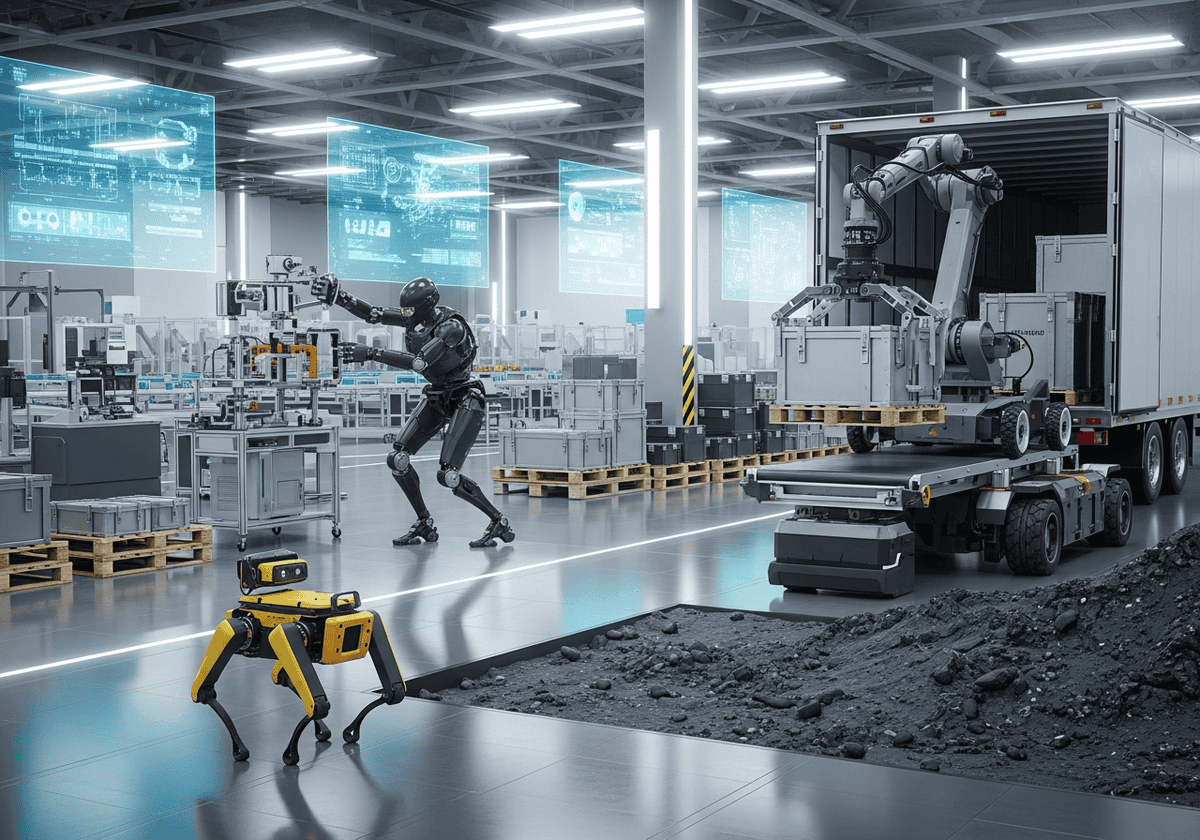
Example: Boston Dynamics did not converge on one body plan:
- Spot, a quadruped, was built for inspection work on uneven industrial terrain, where legs beat wheels and four legs beat two for static stability.
- Stretch, a wheeled robotic arm, was built specifically because a humanoid form was judged wrong for unloading shipping trailers — a repetitive, fixed-geometry task that rewards a large stable base and one purpose-built gripper over general-purpose mobility.
- Atlas, a biped, exists for a different function again: dynamic, general-purpose manipulation research, where legs unlock capabilities wheels structurally cannot.
Three functions, three bodies, from one company with the engineering depth to build any of them.
The Engineering Case Against Default Humanoid Form
For a large share of the jobs currently being pitched to humanoid robots — fixed-position manufacturing tasks, high-throughput picking, palletizing — the comparison to existing task-specific hardware is not close.
| Metric | Industrial robot arm | Current humanoid robot |
|---|---|---|
| Payload | 3–800 kg | 5–20 kg per arm |
| Tool-center-point speed | Up to 15 m/s | 0.5–2 m/s (whole-body) |
| Repeatability | ±0.02–0.05 mm | ±1–5 mm |
| System cost | $20,000–$300,000+ | $50,000–$250,000+ |
Industrial arms deliver 40 to 160 times the payload, 7 to 30 times the speed, and 20 to 250 times the repeatability of a current humanoid, at comparable or lower system cost. For a task an industrial arm has already solved — and most fixed-position manufacturing tasks fall in this category — a humanoid is not a more advanced answer. It is a more expensive, less precise, less reliable one wearing a more expensive form factor.
Balance is not a free featureA wheeled base is statically stable by construction: remove power, and it does not fall over. A bipedal robot’s stability is dynamic and computed continuously — classical zero-moment-point control, or the reinforcement-learning-based whole-body controllers that have taken over in recent years. MIT’s Sangbae Kim has made the point plainly: reinforcement learning solved much of bipedal locomotion, but the hardware — high-bandwidth proprioceptive actuation — had to exist first for the algorithms to have anything to work with. That is a decade-plus of hard-won control engineering that a wheeled or quadruped platform simply does not need to carry, and it shows up directly in reliability, in fall-recovery design burden, and in the safety-certification pathway a legged robot must go through that a statically stable AMR does not. | The uptime barManufacturing customers commonly require 99.99% uptime from production equipment, because line stoppages cost tens of thousands of dollars per minute. Legged platforms are not there yet for general-purpose tasks. Agility’s Digit runs roughly 90 minutes on a charge with a 9-minute hot-swap and a mandatory 60-minute reserve built in specifically to avoid mid-task power failure — a tacit admission that runtime is a binding constraint, not a rounding error, for a bipedal design. Boston Dynamics’ wheeled Stretch, by contrast, runs 16 hours on one charge: over four times the endurance, because it is not spending energy budget on continuous balance computation and does not carry the same actuator count. |
The throughput math often cited backward
Hourly cost comparisons between humanoid robots and human labor look favorable at first glance: roughly $9–10 per hour amortized cost for a robot against $22–45 per hour fully loaded human labor in the US. A fair comparison has to include throughput, not just hourly rate. A human warehouse worker typically moves 60–80 totes an hour; current humanoid pilots manage 30–50. Once throughput is factored in, the effective cost-per-tote advantage shrinks substantially, and at current $150,000–$250,000 unit pricing it can flip the other way entirely.
Tip: before specifying a bipedal or humanoid platform, run what is effectively a wheels-first test. Model the same task on a wheeled or fixed-base alternative, quantify the payload, speed, precision, cost, and uptime delta, and require the humanoid to win against that spec, rather than simply being technically capable of doing the job.
While some impressive demos and new “robot-Olympic games” or similar are becoming popular, the 2015 DARPA Robotics Challenge remains a rigorous public post-mortem on humanoid reliability under real conditions. Teams’ own published lessons include: robots routinely failed to use nearby physical supports that would have prevented falls; fall recovery had to be designed in from the start because top-heavy builds made unassisted recovery unreliable; and network dropouts, deliberately included in the finals, had to be planned for as a normal operating condition rather than an edge case. The teams’ overarching conclusion — that the field needed far more emphasis on reliability under uncontrolled conditions relative to demos and simulation — is now over a decade old and remains a fair benchmark for how much has genuinely changed since.
Alternative Designs: What Else Besides Legs
“Humanoid or not” is too narrow a framing on its own. Bipeds and quadrupeds are two branches of a much larger design space, and most of that space is mechanically simpler, cheaper, and already proven in production. Before defaulting to legs of any count, it is worth cataloging what else is available and where each option actually wins:
| Design | Mechanism | Where it wins | Trade-off vs. legs | Real-world example |
|---|---|---|---|---|
| Wheeled base | Differential drive or omnidirectional (mecanum) wheels | Flat or ramped floors: warehouses, hospitals, offices, factory aisles | Cannot climb stairs or tall curbs without infrastructure changes | Boston Dynamics Stretch; most warehouse AMRs (Locus Robotics, 6 River Systems) |
| Tracked / tank-tread | Continuous track distributes load over a large contact area | Rubble, mud, sand, snow, demolition and disaster sites | Slower top speed, higher energy cost per meter, track wear | PackBot and TALON explosive-ordnance-disposal robots; tracked construction equipment |
| Wheel-leg hybrid | Wheels mounted at the end of articulated legs | Mixed terrain: rolls on flat ground, lifts a wheel to step over an obstacle | Mechanically complex; often still needs active balance control | ANYmal on wheels (ANYbotics); Handle (Boston Dynamics research platform) |
| Rocker-bogie suspension | Passive mechanical linkage keeps all wheels on the ground without active balancing | Unstructured, rocky terrain where no real-time balance computation is available or affordable | Limited obstacle height, low speed | NASA’s Curiosity and Perseverance Mars rovers |
| Fixed-base arm or gantry | Stationary or rail-mounted manipulator, no locomotion at all | Fixed-position repetitive tasks: welding, assembly, palletizing | Zero mobility; work must be brought to the robot by a conveyor or separate AGV | Standard six-axis industrial arms; overhead gantry robots on production lines |
| Cable-driven / parallel robot | Motorized cables position an end-effector across a large working volume | Large-scale, moderate-payload tasks over a wide area: warehouse retrieval, large-format printing | Poor for heavy loads or fine force control; needs a rigid supporting frame | Ocado’s grid-and-robot grocery fulfillment system |
| Hexapod / multi-leg (6 or more) | More legs than a quadruped, always at least three in ground contact | Extreme unstructured terrain requiring inherent static stability at low speed, such as pipe or hull inspection | Slow, more actuators and mass than a quadruped | NASA’s ATHLETE research platform; industrial hexapod pipe-crawlers |
| Soft or continuum “snake” robot | No rigid skeleton; the body itself bends and elongates | Confined or irregular voids: pipes, collapsed structures, minimally invasive medical access | Very low payload and speed | Search-and-rescue snake robots (Carnegie Mellon Robotics Institute); medical continuum robots |
| Aerial (multirotor or fixed-wing) | Thrust-based flight, no ground contact | Inspection, mapping, and delivery over distance or unreachable heights | Very limited payload and runtime; no meaningful manipulation capability | Drone-based flare-stack, tower, and power-line inspection |
| Underwater ROV / AUV | Thruster-driven, buoyancy-controlled | Subsea inspection, pipeline and hull maintenance | Different operating domain entirely; not a land alternative | Subsea pipeline-inspection ROVs |
| Worn exoskeleton | No autonomous robot body; augments a human operator’s own body | Tasks needing human judgment plus added strength or endurance: heavy lifting, prolonged overhead work | Requires a human operator present at all times; not a labor-availability solution | Sarcos Guardian XO; Ekso Bionics industrial exoskeletons |
Static stability wins by defaultEvery wheeled or tracked design in this list shares one advantage that is easy to undervalue because it costs nothing to obtain: static stability. A wheeled or tracked base does not compute anything to avoid falling over; it simply cannot fall over under normal operation. That eliminates an entire category of control software, an entire category of failure mode, and, in most jurisdictions, an entire category of safety certification that legged robots still have to earn. Where the ground is flat or can reasonably be made flat, this advantage alone is usually enough to settle the design question before payload, speed, or cost are even compared. | Hybrid designs exist for a reasonWheel-leg hybrids and rocker-bogie suspensions occupy the middle ground for a specific reason: some environments are mostly flat with occasional obstacles, or too unstructured for real-time active balance but not so unstructured that passive mechanics cannot handle them. A planetary rover cannot rely on continuous radio-linked balance computation and cannot afford the mass of a full active suspension, so a passive rocker-bogie linkage does the job with no electronics involved. A warehouse robot that occasionally meets a loading-dock lip or a low curb does not need bipedal locomotion to clear it; a wheel that can also lift and step is a much smaller engineering bet. |
Sometimes the answer is no mobility, or no robot at all
Two entries in the table above are easy to overlook precisely because they are unglamorous. As highlighted in the previous chapter, a fixed-base arm or gantry is frequently the correct answer for a repetitive, fixed-position task, and the mobility problem gets solved separately, and more cheaply, by bringing the work to the robot on a conveyor or a simple AGV rather than building mobility into the manipulator itself. And a worn exoskeleton is a legitimate alternative to building a robot at all: it solves a strength or endurance limitation while keeping a human’s judgment, dexterity, and situational awareness in the loop, at a fraction of the engineering cost of an autonomous platform. Neither belongs on a mood board next to a humanoid, but both routinely out-compete one on cost, reliability, and time to deployment for the specific job they target.
Tip: before evaluating leg count at all, run the environment through a simple static-stability test: can the operating surface be reasonably flattened or ramped? If yes, a wheeled or tracked design should be the default hypothesis, and legs of any count need to justify themselves against it. Reserve legged designs for terrain that genuinely cannot be flattened, ramped, or otherwise engineered around, which is a smaller set of environments than most humanoid pitches assume.
Examples: Amazon’s warehouse fleet runs on wheeled AMRs and fixed-position arms, not legs, because its facilities are purpose-built with flat floors and can be laid out around the robots rather than the other way around. NASA’s Mars rovers use passive rocker-bogie suspensions rather than legs or wheel-leg hybrids because the mission cannot afford the mass, power draw, or failure surface of active balance control millions of kilometers from a repair technician. Both are cases where the terrain and the mission constraints, not aesthetics, dictated a non-legged answer well before a humanoid or quadruped was ever seriously considered.
The Psychology of Anthropomorphism: What the Research Actually Shows
The intuitive case for humanoid form in human-facing roles is that people trust and relate to something that looks like them. The human-robot interaction literature does not support that as a general rule. It supports something narrower and more useful: the effect of humanoid appearance on trust and acceptance is context-dependent, task-dependent, and interacts with the robot’s actual behavior over time — not a fixed dial that turns up with a face.
Masahiro Mori’s uncanny valley hypothesis — that affinity for a robot rises with human-likeness up to a point, then drops sharply as near-human appearance triggers discomfort, before recovering only at true indistinguishability — remains the foundational model, and recent meta-analyses of user-response studies continue to find empirical support for it. More recent work extends this to a “two uncanny valleys” model, distinguishing reactions to human-like appearance from reactions to human-like motion, which matters more now that near-photorealistic androids exist commercially, not just in labs.
Findings in specific service contexts are genuinely mixed rather than one-directional. Studies comparing humanoid and non-humanoid service robots in hospitality settings find consumer response is condition-dependent, sometimes favoring the humanoid option and sometimes not, depending on the specific service and framing. Eldercare research is, if anything, more cautionary: a 2025 scoping review of older adults’ experience with social robots identifies fear and discomfort as first-class findings, not edge cases, complicating any assumption that a humanoid caregiving robot is automatically more comforting than a non-humanoid one. Domestic-robot research has found that user trust preferences sometimes favor more machine-like, less anthropomorphic designs — the opposite of what a naive “people like robots that look like them” assumption would predict.
One robust and practically important finding across this literature: appearance effects interact with behavior over repeated exposure. A highly humanoid robot that performs reliably can overcome initial uncanny-valley discomfort; a highly humanoid robot that glitches, stumbles, or breaks character reads as far more unsettling than a mechanical-looking robot doing the same thing, because human-like appearance sets an implicit expectation of human-like competence that the failure then violates.
Tip: test appearance and behavior as separate variables in user research rather than as one bundled “robot design.” If a platform will be highly anthropomorphic, budget for a correspondingly higher reliability bar in that specific interaction — the psychological cost of a visible failure scales with how human the robot looks, not with the failure’s actual severity.
In November 2025, Xpeng’s Iron robot drew a wave of speculation on Chinese social media that it was secretly a person in a suit. The demonstration was convincing enough that founder He Xiaopeng had the robot’s torso opened on stage to show the mechanics underneath and prove otherwise. That is anthropomorphism succeeding so well it became a credibility liability rather than a trust asset — a reminder that the goal in human-facing design is legible trustworthiness, not maximum realism.
When Humanoid Form *Is* the Correct Engineering Answer
None of the above is an argument that humanoid form is always wrong. It is an argument that it needs to be earned against a function spec, the same as any other design choice. There are specific, well-defined conditions under which a humanoid body plan is genuinely the better engineering answer.
Operating in infrastructure built for human bodies

Gill Pratt, former DARPA Robotics Challenge program manager and now at Toyota Research Institute, frames this precisely:
the built environment has physical affordances designed around the human body, and a robot that shares that body plan can use those affordances directly rather than requiring the environment to be redesigned around it.
Stairs, doorways, ladders, hand tools, vehicle controls, and valve wheels are all sized and shaped for human hands, feet, and reach. A wheeled robot cannot climb a flight of stairs; a robot without human-scale hands cannot pick up a standard power drill.
This is the same rationale behind NASA’s Valkyrie, developed for the 2013 DARPA Robotics Challenge on the explicit premise that disaster-response environments — a damaged nuclear facility, for instance — are built for human occupants and equipped with human tools, and that operating in them without extensive re-engineering requires a human-compatible body. It is one of the few cases in the field where the choice of humanoid form is backed by a documented requirements analysis rather than a fundraising narrative, and it predates the current investment cycle by a decade.
Pratt’s own caveat is worth keeping alongside the argument: he has also pointed out how strange it is that so much current humanoid development targets flat, purpose-built factory floors — environments perfectly suited to wheels — rather than the genuinely human-built, human-tooled environments where the infrastructure argument actually applies.
Leverage from human demonstration data

A second, more recent argument concerns how these robots are trained rather than where they operate.
Teleoperation and imitation-learning pipelines, where a human operator’s movements are captured and used to train a robot’s control policy, transfer more directly to a robot whose kinematics resemble the human demonstrator’s. Several current research systems are built specifically around this premise: less retargeting between demonstration and robot body means less data needed to reach a given level of competence. This is a real, active research direction, not marketing. It is also not yet proven at scale — whether morphology-matched imitation actually generalizes better than well-retargeted demonstrations from non-humanoid platforms remains an open empirical question, and should be treated as a hypothesis a program is testing, not a settled result to design around.
The one-platform economics argument
The clearest articulation of why investors want humanoid form specifically, independent of any single task, is what one institutional analysis calls “convexity”: a single robot platform deployable across picking, kitting, machine tending, inspection, and general material handling without redesigning the facility around each task. That is a genuine economic argument, but it is conditional, not automatic. It depends on manipulation capability improving quickly, teleoperation data pipelines actually producing generalizable skill, and unit costs falling fast enough to compete. Where those conditions are not yet met, task-specific robots win on a more mundane but currently decisive set of metrics: commissioning time measured in days or weeks rather than months, lower capital intensity, and a lower ongoing service burden.
Tip: the strongest legitimate case for a humanoid platform sits at the intersection of two conditions: infrastructure that is genuinely fixed and human-scaled, not just a factory floor that happens to have people walking on it, and a real requirement for one platform to cover many different, changing tasks rather than one high-volume repetitive job. If a project has only one of the two, a specialized form factor will usually outperform a humanoid on cost, reliability, and time to deployment.
Example: Valkyrie’s design brief — operate valves, climb stairs, use human hand tools, navigate a facility never designed for robots — is a textbook case of the infrastructure condition being met. A single-task warehouse picking cell with a fixed conveyor and a defined bin geometry is a textbook case of it not being met, no matter how “human” the environment around that cell looks at a glance.
A Decision Framework for Choosing Robot Morphology
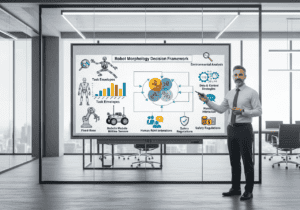
The question “should this robot be humanoid” is answerable with the same rigor as a material selection or an actuator sizing decision, provided it is asked before the mechanical design starts, rather than used to justify a body plan chosen for other reasons.
- Environment analysis. Is the operating environment genuinely fixed and built around human bodies — stairs, doorways, hand tools, vehicles — and effectively impossible or uneconomical to redesign around the robot? Or is it a purpose-built space that could just as easily be built or modified around a wheeled or fixed-base platform?
- Task envelope. What payload, precision, speed, and reach does the task actually require, and how does a specialized mechanism — an arm, a gantry, an autonomous mobile robot — compare on those same metrics? Specialized hardware wins this comparison in the large majority of fixed-position industrial tasks today.
- Data and control strategy. Will the robot be trained primarily from human teleoperation or motion-capture demonstration, and is there evidence, not just a hypothesis, that morphology-matching materially improves sample efficiency for this specific task, versus well-engineered retargeting from a non-humanoid platform?
- Interaction context. Does the robot operate in view of, or in physical contact with, people in a role where perceived trust or social acceptance matters, and what does the human-robot interaction evidence say for that specific context, rather than for anthropomorphic robots in general?
- Economics at target volume. What is the total cost of ownership, including uptime requirements, maintenance, and service burden, at the volume the business case actually needs, compared to the task-specific alternative? Favorable hourly labor-cost comparisons must be adjusted for throughput, not read at face value.
- Regulatory and safety pathway. Does a legged, dynamically balanced platform trigger a different, less mature safety-certification pathway than a statically stable wheeled robot would for the same task, and has that cost and timeline been budgeted?
Tip: score each of the six axes on a simple scale before committing to a body plan. In practice, humanoid form only wins decisively when environment analysis and economics-at-target-volume score high together: a genuinely fixed, human-built environment combined with a real need for one platform across many changing tasks. Any other combination usually favors a specialized form factor, and defaulting to the humanoid option reverses the burden of proof that good engineering practice requires.
Usage example: run the framework against a common pitch — a humanoid for warehouse tote picking. Environment analysis: weak, most modern warehouses are purpose-built and already accommodate mobile robots. Task envelope: a wheeled arm or gantry outperforms current humanoids on payload, speed, and precision for this task. Data strategy: marginal benefit, tote picking is a narrow, well-specified task that does not obviously benefit from human-morphology imitation learning. Interaction context: negligible, no human-facing social function. Economics: current humanoid throughput and unit cost compare unfavorably to specialized picking robots at scale. The framework returns a clear answer, and it is not the humanoid — which is exactly why Boston Dynamics built Stretch instead of pointing Atlas at the same job.
Choosing a Robot Body Is a Design Decision, Not a Default

The humanoid form is not a mistake. NASA’s Valkyrie, Agility’s Digit, and the imitation-learning research pushing toward general-purpose manipulation are all legitimate, well-reasoned uses of it.
Some of these challenges look unsolved only because of how they are framed, which is the lesson of the Dantzig effect: a hard problem may be solved by someone unaware that it was supposed to be impossible.
The mistake is treating the human body as the default answer to what a robot should look like, when it is in fact one design solution among several, correct only under a specific, checkable combination of conditions:
infrastructure genuinely built around human bodies that cannot be economically changed, and a real requirement for one platform to cover many different tasks rather than one high-volume repetitive job.
For most of the tasks currently being pitched to humanoid robots — fixed-position manufacturing, high-throughput picking, single-purpose material handling — that combination does not hold, and the engineering data is unambiguous about it: existing task-specific hardware wins on payload, precision, speed, cost, and reliability, often by more than an order of magnitude. The category’s valuations currently run several orders of magnitude ahead of its shipped, contracted, commercially deployed units, and that gap is a market signal worth weighing alongside any technical spec.
The engineers who get the most out of this category over the next decade will not be the ones betting on humanoid form because it is the most fundable story. They will be the ones who run environment, task, data, interaction, economics, and regulatory pathway through the same rigor they would apply to choosing a motor or a material, and who are equally willing to specify a wheel, a gantry, or four legs when the answer comes out that way.
FAQ
What’s the actual difference between a “humanoid” and an “android”?
A humanoid robot is any robot with a broadly human-like body plan — a torso, two arms, typically two legs or a leg-equivalent base — built for function, not appearance. An android goes further, aiming for visual and behavioral indistinguishability from a human, which is a cosmetic and materials-science problem (skin, facial actuation, micro-expressions) layered on top of the mechanical one. Most current commercial platforms, including Optimus, Digit, and Atlas, are humanoids without android ambitions; Xpeng’s Iron is one of the few pushing toward android-level realism, which is precisely what triggered its credibility controversy.
Why are robotic hands consistently harder to engineer than legs?
A human hand has roughly 27 degrees of freedom in a package that fits in a closed fist, packed with tactile sensing and capable of both power grips and sub-millimeter precision grips. Replicating even a fraction of that functionally means fitting many small, high-torque actuators, tendons or gears, and force sensors into a tiny, low-mass enclosure — a packaging problem far more constrained than a leg, which has more room and fewer simultaneous contact points to manage. This is why most humanoid platforms still ship with underactuated grippers or simplified hands well behind their leg sophistication.
How is a humanoid robot actually taught to perform a task?
Two pipelines dominate: reinforcement learning in simulation, where a policy is trained on millions of virtual trials and then transferred to hardware, and imitation learning from teleoperated or motion-captured human demonstrations, where a human operator performs the task and the robot’s policy learns to reproduce it. Most serious programs blend both — simulation for locomotion and balance, teleoperation data for manipulation — because neither pipeline alone currently produces reliable general-purpose behavior.
What is the “sim-to-real gap” and why does it hit legged robots especially hard?
It’s the performance drop that occurs when a policy trained in simulation meets the real world’s unmodeled friction, actuator backlash, sensor noise, and contact dynamics. Legged locomotion is unusually sensitive to this because balance depends on precise, fast-changing ground-contact forces that are notoriously difficult to simulate accurately — a small mismatch in modeled foot friction can be the difference between a stable gait and a fall that never showed up in training.
Do any safety standards or certification bodies specifically cover humanoid robots yet?
Not comprehensively. Industrial robot arms are covered by mature standards like ISO 10218 and the collaborative-robot standard ISO/TS 15066, and wheeled AMRs fall under ISO 3691-4, but mobile, dynamically balanced, human-scale bipeds occupy a regulatory gap that standards bodies are actively working to fill. Several manufacturers are effectively writing de facto safety practice through pilot deployments before a dedicated standard catches up, which is itself a commercial risk for early industrial adopters.
Who is legally liable if an autonomous humanoid robot injures a worker?
This is genuinely unsettled and varies by jurisdiction, but liability typically gets apportioned across the equipment manufacturer, the software or AI provider (if distinct from the manufacturer), the systems integrator who deployed it, and the operating facility, depending on whether the failure traces to a design defect, a software error, or inadequate site safety procedures. The absence of a mature legal precedent is itself a reason large industrial buyers are moving cautiously and favoring vendors offering contractual indemnification.
What sensors does a humanoid robot need beyond cameras?
A functioning humanoid needs proprioception (joint position and torque sensing at every actuator), an inertial measurement unit for balance, force/torque sensors at the wrists or feet to detect contact events, and increasingly tactile sensing in the hands. Vision gets most of the public attention because it drives the AI narrative, but the proprioceptive and force-sensing stack is what actually keeps the robot upright and prevents it from crushing whatever it’s handling.
How much does a humanoid robot actually weigh, and why does that matter so much?
Current platforms run roughly 35 to 80 kilograms, and mass matters disproportionately in a legged design because every kilogram above the ankles has to be actively balanced, accelerated, and decelerated with every step — unlike a wheeled robot, where added mass mostly just needs more torque to move, not more control bandwidth to avoid falling. This is why lightweighting in humanoid design is a stability requirement as much as an efficiency one.
In concrete numbers, how much more power does walking cost versus rolling?
Legged locomotion typically costs several times more energy per kilogram-meter than wheeled locomotion, because continuous balance correction and the up-and-down motion of walking both consume energy that a rolling wheel simply doesn’t spend — a wheel in contact with the ground converts motor torque almost directly into forward motion. This gap is the direct mechanical reason legged platforms have shorter runtimes than wheeled ones at comparable battery mass.
Is there a standard, comparable way to measure a robot’s “dexterity”?
Not yet, in the way that payload or repeatability are standardized for industrial arms. Researchers use benchmarks like block-stacking tasks, peg-in-hole insertion, and cloth or deformable-object manipulation to compare systems, but there is no industry-wide agreed metric equivalent to a datasheet spec, which makes vendor dexterity claims difficult to verify or compare directly — a gap worth pressing any vendor on during evaluation.
What do independent analysts expect for humanoid cost-competitiveness against task-specific automation, realistically?
Most serious forecasts put broad cost parity with specialized robots somewhere in the early-to-mid 2030s at the earliest, contingent on actuator costs falling roughly 50 to 70 percent from current levels and manipulation reliability improving substantially — both currently unproven at scale. Near-term commercial viability is expected to stay concentrated in the narrow set of tasks where the infrastructure-compatibility or one-platform arguments already apply today, not general-purpose labor substitution.
What happens when a legged robot loses power or has to emergency-stop mid-stride?
This is one of the harder unsolved problems in the field. An uncontrolled power loss during dynamic walking risks an uncontrolled fall, so most platforms implement a “safe stop” behavior that tries to reach a statically stable crouch or seated position before fully cutting power, and some research platforms are exploring passive mechanical fail-safes, such as lockable joints, as a backup. Wheeled and tracked robots don’t have this problem at all — losing power just means they stop where they are.
Could a networked humanoid robot be a meaningful cybersecurity risk?
Yes, and it’s a materially different risk profile than a stationary industrial arm behind a safety cage: a compromised humanoid is a mobile, physically capable actuator with cameras and microphones inside a facility, so a security breach isn’t just a data problem but a physical-safety and industrial-espionage one. Vendors deploying fleets connected to cloud-based fleet management and remote teleoperation channels are, in effect, extending a company’s cybersecurity perimeter onto the factory floor, which several industrial buyers are only beginning to account for in their risk assessments.
Related Concepts & Technologies
- Vision-Language-Action (VLA) models: a class of foundation models, such as RT-2 and Figure’s Helix, that map camera input and natural-language instructions directly to robot joint commands in a single network.
- Capture Point / Divergent Component of Motion: a balance-planning theory that tracks where a legged robot must place its next footstep to arrest its momentum, used as a faster alternative to pure zero-moment-point control.
- Model Predictive Control for legged locomotion: an optimization-based control approach that continuously re-solves a short-horizon dynamics problem at each timestep to keep a robot balanced while it walks or manipulates.
- Quasi-direct-drive actuators: a joint design using a low gear-reduction ratio to keep the motor mechanically close to the output, preserving backdrivability and force sensing that highly geared actuators lose.
- Series elastic actuators: joint actuators with an intentional spring element between motor and output, trading some positional precision for shock tolerance and inherent force measurement.
- Variable stiffness actuators: actuators that can adjust their own mechanical compliance in real time, letting a robot stay rigid for precision tasks and soft for safe human contact.
- Harmonic and cycloidal gear drives: two competing high-ratio, low-backlash gearbox architectures used to pack high torque into the compact joint housings a humanoid limb requires.
- Domain randomization: a simulation-training technique that deliberately varies physics parameters like friction and mass during training so a policy generalizes better when deployed on real hardware.
- Cross-embodiment learning: training a single control policy on demonstration data pooled across many different robot bodies, exemplified by the Open X-Embodiment dataset, to reduce the data needed per platform.
- Behavior cloning: the simplest form of imitation learning, where a policy is trained to directly reproduce recorded human or teleoperated action sequences without any reward signal.
- ROS 2: the dominant open-source middleware standard for robot software, providing the messaging and driver framework most humanoid and industrial robot stacks are built on top of.
- Tactile skin sensing: camera-based or capacitive sensor arrays, such as GelSight, that give a robotic hand distributed touch feedback closer to human fingertip sensitivity than force/torque sensors alone provide.
- Whole-arm manipulation: a manipulation strategy that uses a robot’s forearm or torso surfaces, not just its end effector, to stabilize or move large or awkward objects.
- Compliant and underactuated grippers: gripper designs that use fewer actuators than degrees of freedom, letting mechanical compliance passively conform to an object’s shape instead of requiring precise control.
- Robot-as-a-Service: a commercial model, used by Agility Robotics with GXO, where customers pay for robot uptime or throughput rather than purchasing hardware outright, shifting reliability risk onto the manufacturer.
- Speed-and-separation monitoring: a collaborative-robot safety technique that dynamically slows or stops a robot based on real-time sensed distance to nearby workers, rather than relying on fixed safety cages.
- Human-robot handover protocols: a dedicated HRI research area studying the timing, grip force, and motion cues needed for a robot to pass an object to or receive one from a person without a drop or collision.
- Swarm and modular robotics: an architectural alternative to a single general-purpose humanoid, using many simple, cheap, task-specific units that coordinate collectively instead of one platform doing everything.
External Links on humanoid robots
International Standards
(hover the link to see our description of the content)