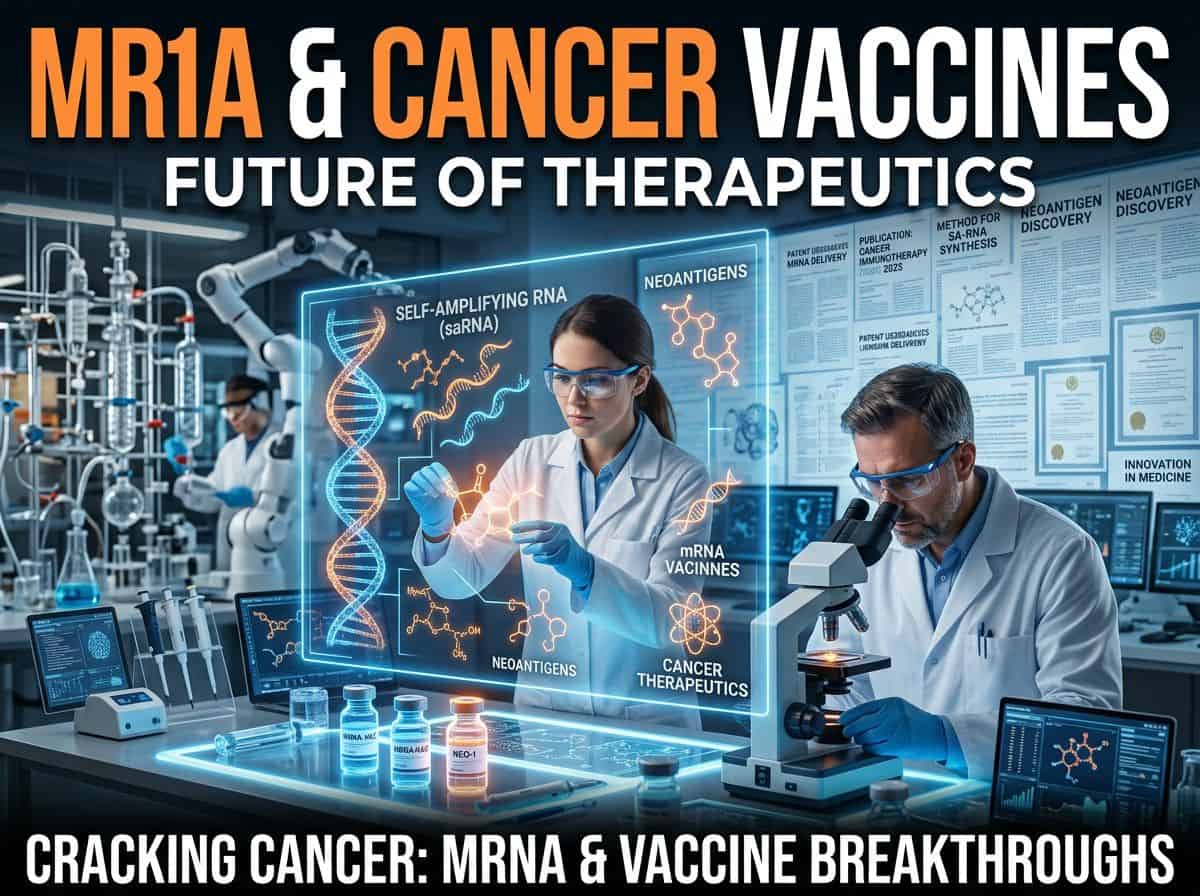

Messenger RNA therapeutics deliver the instructions for a protein instead of the protein itself. A synthetic transcript, made by in vitro transcription and carrying a cap, a poly(A) tail and modified nucleosides such as N1-methylpseudouridine, is packaged in a lipid nanoparticle. Cells then translate it for a short time. COVID-19 vaccines proved the platform at scale. Attention has moved to protein replacement, in vivo gene editing and personalized cancer vaccines.
A cancer vaccine starts with sequencing the tumor of a patient to find neoantigens. Algorithms then predict which mutations the immune system can recognize, and a matching mRNA is manufactured within weeks. Speed, cold chain storage and reactogenicity remain engineering problems. Self-amplifying RNA and circular RNA aim to extend expression with lower doses. Combination with checkpoint inhibitors is the most common clinical design. The patents and papers below cover constructs, delivery, manufacturing and clinical programs.
mRNA works only if it is delivered intact, which ties this page to exosome and nanoparticle delivery. Immune responses are on immunology and vaccinology, tumor targets on molecular oncology, and sequence design on bioinformatics. Manufacturing by cell-free or microbial routes is on precision fermentation.
This is our latest selection of worldwide publications and patents in english on mRNA Therapeutics and Cancer Vaccines, between many scientific online journals, classified and focused on mRNA vaccine, mRNA therapeutic, personalized cancer vaccine, neoantigen, neoantigen prediction, self-amplifying RNA, saRNA, modified nucleoside, N1-methylpseudouridine, in vitro transcription, cap analog, poly(A) tail, mRNA lipid nanoparticle, circular RNA, mRNA stability, codon-optimized mRNA, in vivo CAR-T, mRNA purification, tumor mutation and immune checkpoint combination.
Publication: no recent news on this particular topic. Please try the extensive manual search in the Publication Database linked just above.
Nucleic acid molecule comprising 5'-cyclopropylene modification
Patent published on the 2026-11-19 in US under Ref US20260366020 by INST OF SCIENCE TOKYO [JP] (Yokota Takanori [jp], Yoshioka Kotaro [jp], Kuroda Takayuki [jp], Obika Satoshi [jp], Yamaguchi Takao [jp])
Abstract: A problem to be addressed is to provide a novel nucleic acid molecule capable of simultaneously achieving both a high gene regulatory effect and reduced toxicity. Provided is a nucleic acid molecule having an antisense effect on a target gene or a transcriptional product thereof, comprising a base sequence complementary to at least part of the target gene or the transcriptional product thereof, wherein the nucleic acid molecule comprises: [1] a central region which comprises at least three conse[...]
Our summary: The invention provides a novel nucleic acid molecule with a 5 -cyclopropylene modification. This molecule aims to achieve high gene regulatory effects while minimizing toxicity. It features a central region with deoxyribonucleosides and non-natural nucleosides at both the 5′ and 3′ ends.
nucleic acid, gene regulation, antisense effect, cyclopropylene modification
Patent
Heteroclitic neoepitope vaccines
Patent published on the 2026-11-19 in US under Ref US20260364202 by UNIV JOHNS HOPKINS [US] (Huff Amanda [us], Jaffee Elizabeth A [us], Zaidi Neeha [us], Yarchoan Mark [us])
Abstract: Compositions of peptides modified to improve HLA binding or T cell recognition while conserving reactivity to the target neoepitope, enhance activation of neoantigen-specific T cells. Methods of use include treating cancer by administering one or more of these peptides generated by computer modeling.[...]
Our summary: Heteroclitic neoepitope vaccines enhance T cell activation. Peptides are modified to improve HLA binding while preserving target reactivity. These peptides are used in cancer treatment through computer modeling.
neoepitope vaccines, HLA binding, T cell recognition, cancer treatment
Patent
Method of identifying circular rna
Patent published on the 2026-11-19 in US under Ref US20260366068 by 10X GENOMICS INC [US] (Costa Justin [us])
Abstract: The present disclosure relates in some aspects to methods and compositions for analyzing a biological sample, comprising performing rolling circle amplification of a circRNA in situ in a biological sample, thereby generating an RCA product comprising multiple complementary copies of the circRNA and detecting the RCA product in situ at a spatially localized position in the biological sample.[...]
Our summary: This method identifies circular RNA by performing rolling circle amplification in a biological sample. It generates an RCA product with multiple copies of circRNA. The RCA product is detected in situ at a specific location within the sample.
circular RNA, rolling circle amplification, biological sample, in situ detection
Patent
Methods for predicting the usefulness of neoantigens for immunotherapy
Patent published on the 2026-11-18 in EP under Ref EP4841259 by BIONTECH SE [DE] (Vormehr Mathias [de], Sahin Ugur [de], Schrörs Barbara [de], Löwer Martin [de], Boegel Sebastian [de])
Abstract: The present invention relates to methods for predicting peptides or polypeptides such as T cell epitopes useful for immunotherapy such as for vaccination. In particular, the present invention relates to methods for predicting whether peptides or polypeptides such as tumor-associated antigens or epitopes, in particular tumor-associated neoantigens or neoepitopes, are immunogenic and, in particular, useful for immunotherapy such as for vaccination. The methods of the invention may be used, in part[...]
Our summary: The invention provides methods for predicting the immunogenicity of neoantigens for cancer immunotherapy. It focuses on identifying tumor-associated peptides useful for personalized vaccines. These methods aim to enhance the effectiveness of immunotherapy by tailoring vaccines to individual tumors.
neoantigens, immunotherapy, T cell epitopes, personalized vaccines
Patent
Identification of clonal neoantigens and uses thereof
Patent published on the 2026-11-12 in US under Ref US20260360495 by IOVANCE BIOTHERAPEUTICS INC [US] (Roth Andrew [gb], Salm-Horstmar Maximilian Prinz Zu [gb], Chan Fong Chun [gb])
Abstract: A method of treating a subject having been diagnosed as having cancer with an immunotherapy is described. The method comprises targeting one or more clonal neoantigens selected using a method comprising determining whether a tumour-specific mutation is likely to be clonal in a subject. The method comprises providing sequence data from one or more samples from the subject comprising tumour genetic material, the sequence data comprising for each of the one or more samples, and determining the like[...]
Our summary: This method identifies clonal neoantigens for cancer immunotherapy. It involves analyzing tumor genetic material to determine clonal mutations. The likelihood of these mutations being clonal is assessed using prior probabilities and sequence data.
neoantigens, immunotherapy, cancer treatment, tumor mutations
Patent
Using neural networks to predict peptide immunogenicity
Patent published on the 2026-11-12 in US under Ref US20260360471 by GENENTECH INC [US] (Liu Kai [us], Salem Milad [us], Thrift William John [us])
Abstract: Methods, systems, compositions, and computer program products are provided for accurately identifying candidate neoantigens that exhibit immunogenic properties. In some embodiments, a method provided herein includes receiving a set of candidate peptide sequences, each candidate peptide sequence in the set having a major histocompatibility complex (MHC) presentation score meeting a pre-set criterion. The method further includes identifying a corresponding MHC peptide sequence associated with each[...]
Our summary: This content discusses methods for predicting peptide immunogenicity using neural networks. It involves processing candidate peptide sequences and their corresponding MHC peptide sequences. The output includes predictions of immunogenicity for each candidate peptide sequence.
neural networks, peptide immunogenicity, neoantigens, MHC presentation
Patent