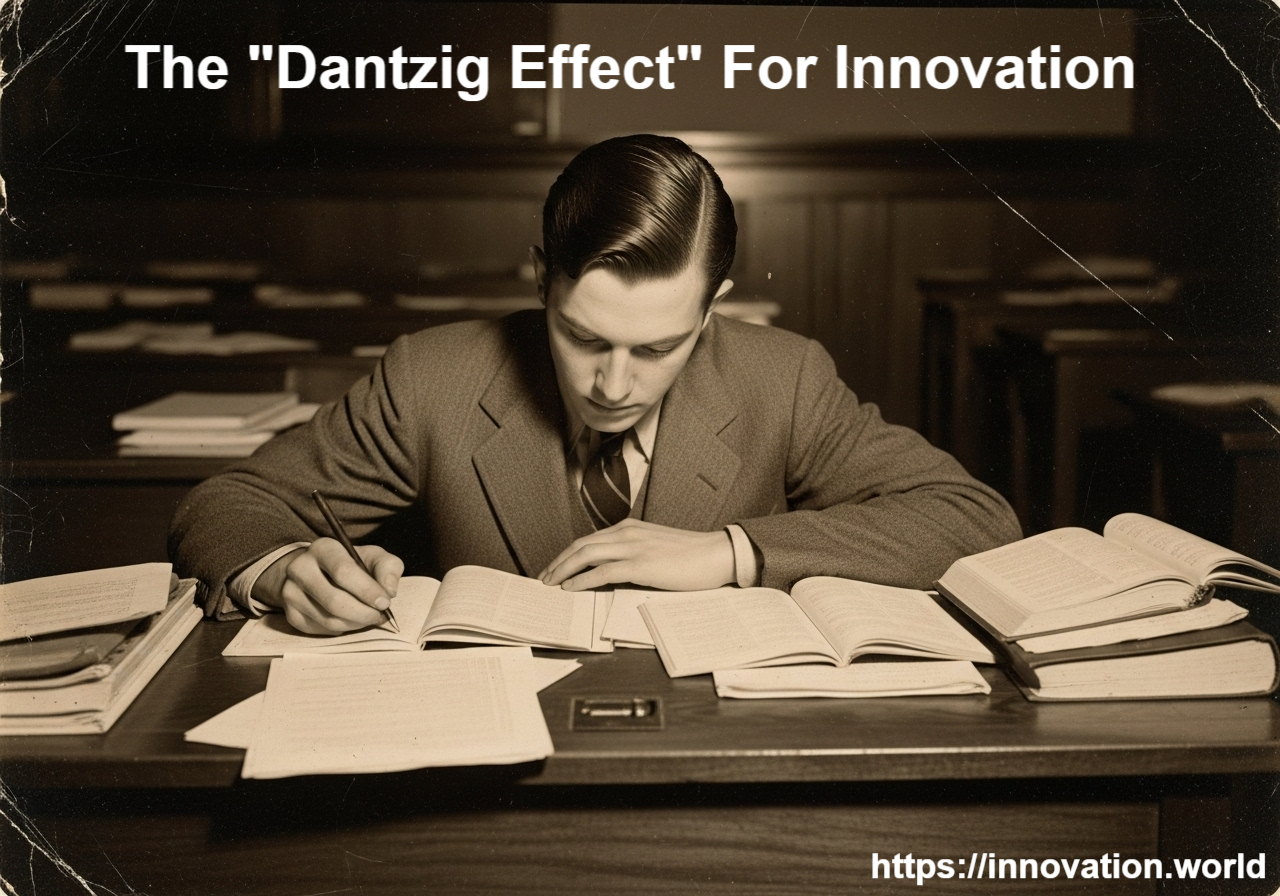
Innovation often blooms in unexpected mindsets, as exemplified by George Dantzig’s remarkable experience with two statistics problems famously deemed unsolvable in his time. When Dantzig mistakenly submitted solutions to these “impossible” homework assignments, he unknowingly altered the trajectory of statistical research and later the simplex algorithm. This episode underscores a profound truth: our perceptions can shape the limits of our capabilities. A 2018 study found that individuals with a “beginner’s mind” approach are 25% more likely to achieve creative breakthroughs (Kahn & Gülşen, 2018).
By examining the psychological underpinnings of Dantzig’s success and the broader implications for innovation management, this article will elucidate how reframing challenges can dismantle self-imposed barriers and spark extraordinary solutions in engineering and product design.
Key Takeaways

- Two famous unsolved statistics problems were mistaken tasks.
- George Dantzig viewed them merely as more difficult assignments.
- A mindset devoid of limits can lead to breakthroughs.
- A beginner’s viewpoint can inspire innovative solutions.
- Overcoming mental barriers enhances problem-solving capabilities.
The Anecdote of George Dantzig

The story
George Dantzig’s encounter with a seemingly impossible problem began in 1939 while he was a graduate student at the University of California, Berkeley. One evening, he arrived late to class and mistakenly believed he had been assigned two difficult homework problems. These problems were, unbeknownst to him, world-renowned unsolved challenges in the field of statistics. For Dantzig, they appeared merely as a set of ordinary exercises awaiting resolution, which directed his focus towards finding solutions rather than succumbing to any preconceived limitations associated with their difficulty.
Dantzig worked diligently on these problems for several days, applying his knowledge of linear programming. Upon completion, he submitted his solutions, which were initially viewed as just another graduate assignment. It was only after Dantzig’s professor, Jerzy Neyman, realized the significance of these “homework problems” that the true weight of Dantzig’s accomplishment was recognized.
This anecdote illustrates a profound truth about human cognition: Dantzig approached the problem without the shackles of prior knowledge regarding its impossibility. His ignorance of the prevailing challenges allowed him to employ creative reasoning and strategic thinking, paralleling elements highlighted in psychological theories … and maths genie.
The excellent movie “Good Will Hunting” (1997) by Gus Van Sant, was inspired by this anecdote as the starting point for revealing the capacities of Will Hunting (Matt Damon).
Tip: when confronting challenges, maintaining a mindset free of limitations can yield unexpected solutions. Encourage team brainstorming sessions where participants are urged to ignore any presupposed barriers, promoting an environment conducive to innovative thought.
The rest of this article is reserved for members
To limit scraping bots (currently 40,000 hits per day!),
we had to restrict access to full articles and tools to registered members only.
to access all the rest.
FAQ
What is the “Dantzig effect” in innovation?
The “Dantzig effect” refers to the phenomenon where individuals solve challenging problems simply because they are unaware of their perceived impossibility. This mindset allows for groundbreaking solutions without the limitations imposed by traditional beliefs.
What happened with George Dantzig’s homework problems?
George Dantzig mistook two unsolved statistics problems for homework assignments, leading him to develop solutions that astonished scholars. His successful resolutions emerged from a lack of knowledge about the problems’ complex nature.
How did Dantzig view the challenges he faced?
Dantzig perceived these problems as simply harder-than-usual homework assignments. This outlook shielded him from the preconceived notions that could have discouraged a typical student from attempting them.
What are the psychological implications of problem-solving without perceived limits?
Approaching challenges without preconceived limits can unlock creativity and innovation. This mindset allows problem solvers to envision solutions that might otherwise elude those burdened by self-doubt or fear of failure.
What does a “beginner’s mind” mean in the context of innovation?
A “beginner’s mind” refers to an attitude of openness and eagerness, free from assumptions. This mindset invites new perspectives and can significantly impact innovative thinking and problem-solving strategies.
What lessons can be learned about self-imposed limitations?
The story of Dantzig illustrates that recognizing and challenging self-imposed limitations can lead to remarkable achievements. Overcoming these mental barriers enables individuals to unleash their full potential in problem-solving.
What discoveries is George Dantzig known for?
Dantzig is particularly renowned for developing the simplex algorithm, a major advancement in optimization and operations research. His contributions have significantly influenced multiple fields, including innovation management and educational psychology.
Related Topics
- Creative problem solving techniques: systematic approaches that encourage innovative thinking to generate solutions.
- Design thinking methodology: a user-centered approach that emphasizes empathy and iterative testing in product development.
- Collaborative innovation: working with diverse teams to enhance creativity and generate breakthrough ideas.
- Case study analysis: evaluating previous innovations to extract lessons and methodologies applicable to new challenges.
- Systems thinking: understanding the interconnections within complex problems to identify holistic solutions.
- Critical thinking skills: enhancing logical reasoning capabilities to evaluate problems and solutions effectively.
- Mentorship programs: guidance from experienced professionals that encourages growth in problem-solving abilities.
- Interdisciplinary approaches: combining knowledge from different fields to approach problems with fresh insights.
- Quantitative vs. qualitative research: contrasting methods of data collection to inform decision-making and innovation.