Product Design, Manufacturing & Innovation Resources
Home » Frame-Dragging (Lense-Thirring Effect)

Frame-Dragging (Lense-Thirring Effect)

1918
  • Josef Lense
  • Hans Thirring
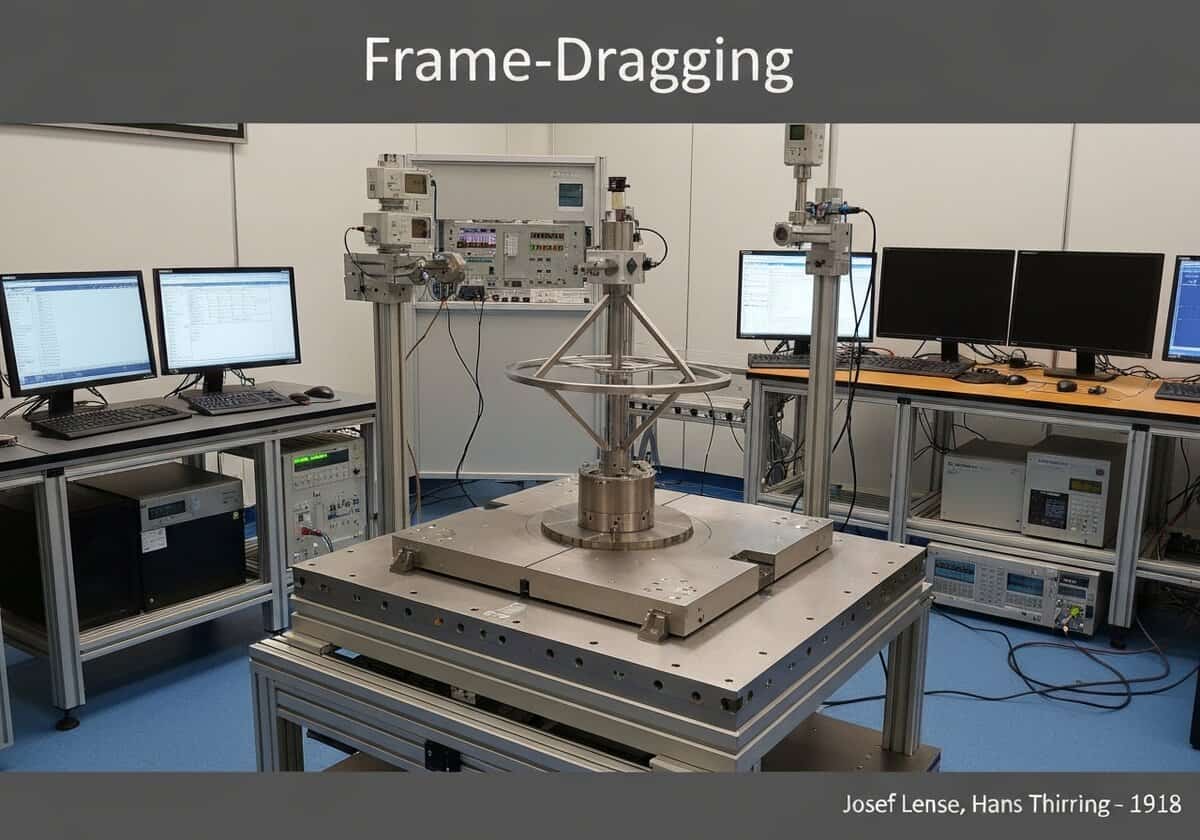
Laboratory gyroscope experiment demonstrating frame-dragging in relativity.

(generated image for illustration only)

General relativity predicts that a massive, rotating object should ‘drag’ the fabric of spacetime around with it, a phenomenon known as frame-dragging or the Lense-Thirring effect. This means a gyroscope orbiting the rotating body will precess, not because of any applied torque, but because spacetime itself is being twisted by the body’s rotation.
The Lense-Thirring effect is a subtle consequence of the Einstein Field Equations when applied to a rotating mass. While a non-rotating mass curves spacetime statically (described by the Schwarzschild metric), a rotating mass introduces a ‘twist’ to spacetime. This is analogous to a spinning ball in a viscous fluid like honey; the fluid near the ball is dragged by its rotation. In frame-dragging, spacetime itself is dragged. The effect is extremely weak. For Earth, the predicted precession of a gyroscope in a polar orbit is only about 42 milliarcseconds per year.

The most definitive confirmation came from the Gravity Probe B (GP-B) satellite mission, launched in 2004. GP-B used four ultra-precise gyroscopes in a polar orbit. After years of data analysis, the science team announced in 2011 that they had measured the frame-dragging effect to within 19% of the value predicted by general relativity. The effect is much more pronounced near rapidly rotating, extremely massive objects like black holes and neutron stars. Frame-dragging plays a crucial role in the astrophysics of these objects, influencing the behavior of accretion disks and potentially providing a mechanism for launching powerful relativistic jets from the poles of active galactic nuclei.

UNESCO Nomenclature: 2211
– Relativity

Type

Abstract System

Disruption

Substantial

Usage

Widespread Use

Precursors

  • Einstein Field Equations
  • Mach’s principle (as a conceptual influence)
  • Concept of angular momentum and rotation in classical mechanics

Applications

  • testing a fundamental prediction of general relativity with satellites like gravity probe b
  • measuring the spin of black holes
  • understanding the dynamics of accretion disks around massive objects
  • providing high-precision measurements of earth’s gravitational field

Patents:

NA

Potential Innovations Ideas

Due to scrapping bot traffic, currently more than 40k per day, this content is reserved to community members.
> Login < or > Register < (100% free) to access this, so as all other restricted content and tools.

Related to: frame-dragging, lense-thirring effect, general relativity, spacetime, gravity probe b, gyroscope, black hole spin, rotation.

Historical Context

Frame-Dragging (Lense-Thirring Effect)

1915
1915-11
1916
1918
1919-05-29
1920
1920
1913
1915
1916
1917
1918
1920
1920
1921

(if date is unknown or not relevant, e.g. "fluid mechanics", a rounded estimation of its notable emergence is provided)

Related Invention, Innovation & Technical Principles

Full size images and downloads are only available, 100% free, for registered members.

> Login <