Product Design, Manufacturing & Innovation Resources
Home » Perihelion Precession of Mercury

Perihelion Precession of Mercury

1915
  • Urbain Le Verrier
  • Albert Einstein
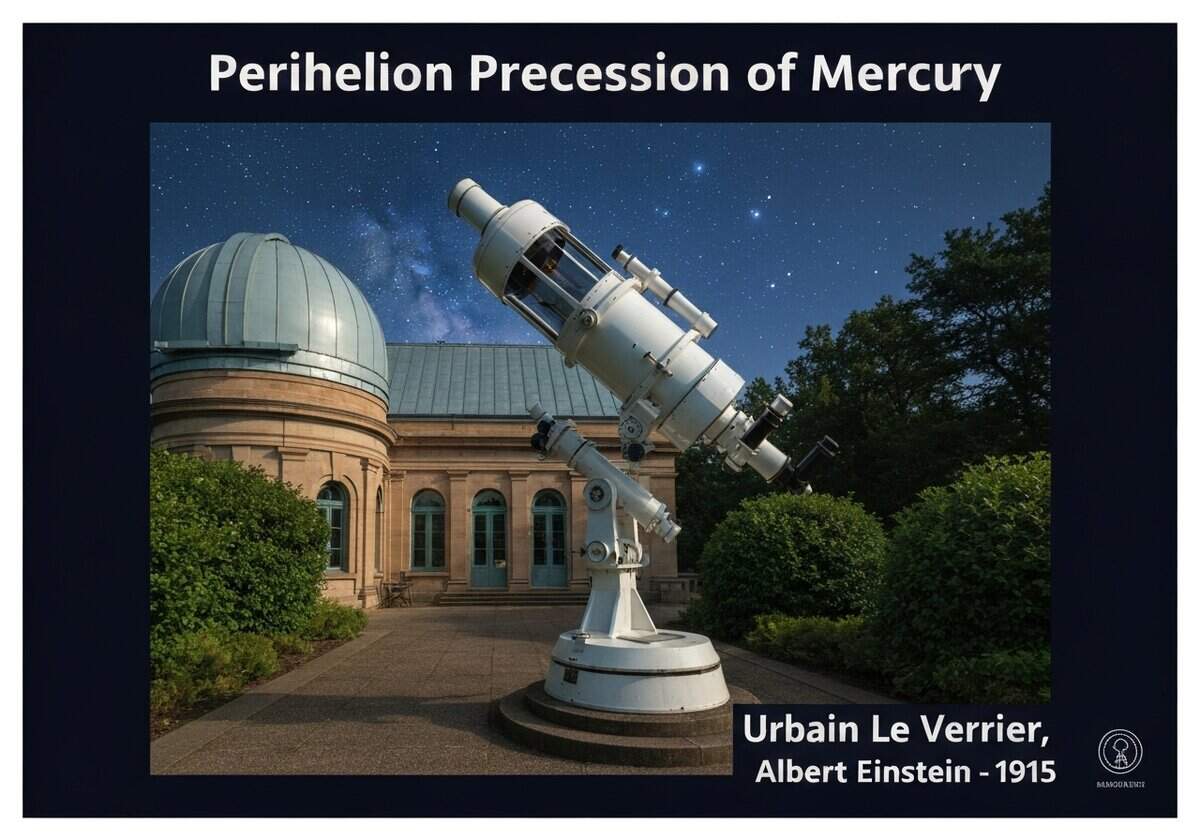
Astronomical observatory with telescope, illustrating perihelion precession in relativity.

(generated image for illustration only)

General relativity provided the first accurate explanation for the anomalous precession of Mercury’s perihelion. Newtonian gravity could not fully account for the slow, gradual shift in the orientation of Mercury’s elliptical orbit. Einstein’s theory correctly predicted the missing 43 arcseconds per century, attributing it to the curvature of spacetime around the Sun, a major early triumph for the theory.

In the 19th century, astronomers observed that Mercury’s elliptical orbit was not stationary. Its point of closest approach to the Sun, the perihelion, was slowly advancing, or precessing. While most of this precession was explained by the gravitational tugs of other planets according to Newton’s laws, a small discrepancy of about 43 arcseconds per century remained unaccounted for. This anomaly puzzled scientists, with some proposing the existence of an undiscovered planet, Vulcan, between Mercury and the Sun.

In 1915, Albert Einstein applied his new theory of general relativity to the problem. His calculations showed that the curvature of spacetime caused by the Sun’s mass would introduce a correction to the Newtonian description of gravity. This correction perfectly accounted for the missing 43 arcseconds per century without any ad-hoc parameters. Unlike Newton’s theory, where orbits are closed ellipses (in a two-body system), general relativity predicts that orbits are not closed but trace a rosette pattern. This effect is most pronounced for objects in strong gravitational fields and with eccentric orbits, making Mercury the ideal candidate in our solar system. The successful explanation of Mercury’s perihelion precession was one of the first strong pieces of evidence that general relativity was a more accurate description of gravity than Newton’s theory.

UNESCO Nomenclature: 2211
– Relativity

Type

Abstract System

Disruption

Substantial

Usage

Widespread Use

Precursors

  • Kepler’s laws of planetary motion
  • Newton’s law of universal gravitation
  • Urbain Le Verrier’s detailed calculations of planetary orbits
  • Special relativity

Applications

  • first major observational evidence supporting general relativity
  • a precision test for general relativity and other theories of gravity
  • used to constrain alternative gravity theories
  • high-precision celestial mechanics calculations

Patents:

NA

Potential Innovations Ideas

Due to scrapping bot traffic, currently more than 40k per day, this content is reserved to community members.
> Login < or > Register < (100% free) to access this, so as all other restricted content and tools.

Related to: perihelion precession, mercury, general relativity, newtonian gravity, spacetime curvature, orbital mechanics, celestial mechanics, gravity.

Historical Context

Perihelion Precession of Mercury

1910
1911-04-08
1913
1915
1916
1917
1918
1909
1910
1912
1915
1915-11
1916
1918
1919-05-29

(if date is unknown or not relevant, e.g. "fluid mechanics", a rounded estimation of its notable emergence is provided)

Related Invention, Innovation & Technical Principles

Full size images and downloads are only available, 100% free, for registered members.

> Login <