Product Design, Manufacturing & Innovation Resources
Home » Passivation

Passivation

1850
  • Christian Friedrich Schönbein
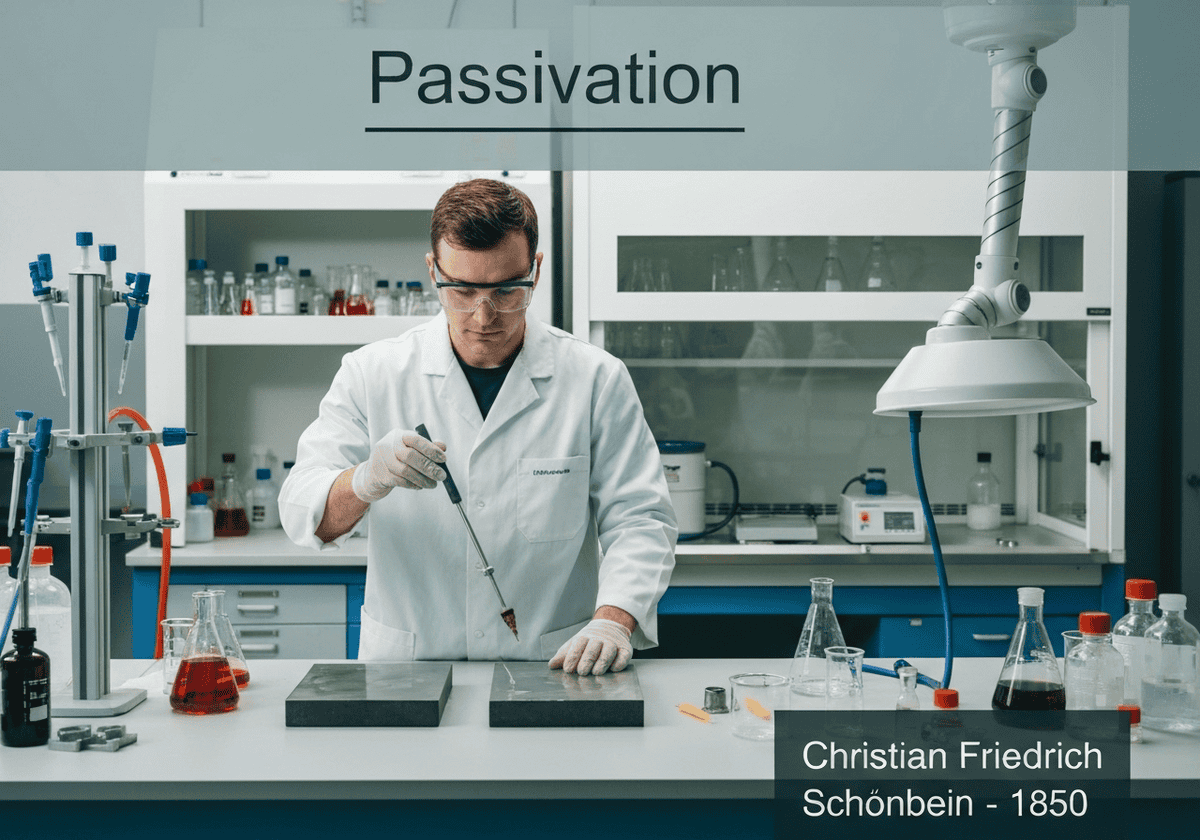
Materials scientist performing passivation on stainless steel samples in a lab.

(generated image for illustration only)

Passivation is the process by which a material becomes ‘passive,’ meaning it is less affected by environmental factors such as corrosion. It involves the spontaneous formation of a very thin, non-reactive surface film that acts as a barrier, shielding the bulk material from further attack. This film is typically an oxide or nitride layer, a few nanometers thick.

The mechanism of passivation is electrochemical. When a reactive metal like chromium, aluminum, or titanium is exposed to an oxidizing environment (like air or certain acids), its surface rapidly oxidizes. If the resulting metal oxide is stable, dense, non-porous, and well-adhered to the metal surface, it forms a protective passive layer. This layer is extremely thin, often only 1-3 nanometers, but it is sufficient to dramatically slow down the rate of corrosion by preventing direct contact between the metal and the corrosive environment.

The stability of this passive film is dependent on the environment, particularly pH and the presence of certain ions like chlorides. For example, the chromium oxide (\(Cr_2O_3\)) layer on stainless steel is highly effective in many environments but can be locally broken down by chloride ions, leading to pitting corrosion. The breakdown and reformation of this passive layer is a dynamic process. If the film is mechanically scratched or damaged, the exposed metal will often repassivate almost instantly, a property known as self-healing.

Passivation can be a natural process or can be enhanced artificially through chemical treatments, such as dipping stainless steel in nitric or citric acid to remove free iron from the surface and encourage the formation of a more robust chromium-rich oxide layer. This process is distinct from applying a coating, as the passive layer is formed from the base metal itself.

UNESCO Nomenclature: 3314
– Materials science

Type

Chemical Process

Disruption

Foundational

Usage

Widespread Use

Precursors

  • Discovery of reactive metals like chromium and aluminum
  • Early observations of metals resisting corrosion in specific acids
  • Development of electrochemical theories

Applications

  • stainless steel’s corrosion resistance (chromium oxide layer)
  • titanium’s biocompatibility in medical implants (titanium dioxide layer)
  • anodizing of aluminum for protection and color
  • protecting silicon wafers in microelectronics

Patents:

NA

Potential Innovations Ideas

Due to scrapping bot traffic, currently more than 40k per day, this content is reserved to community members.
> Login < or > Register < (100% free) to access this, so as all other restricted content and tools.

Related to: passivation, passive film, corrosion resistance, stainless steel, chromium oxide, titanium, anodizing, surface science.

Historical Context

Passivation

1700
1761
1807-01-01
1850
1850
1850
1850
-500
1750
1788
1834
1850
1850
1850
1850

(if date is unknown or not relevant, e.g. "fluid mechanics", a rounded estimation of its notable emergence is provided)

Full size images and downloads are only available, 100% free, for registered members.

> Login <