Linux for engineers is now a practical question, not a hobby. The solvers you rely on for finite element analysis, CFD, molecular dynamics or circuit verification increasingly run on Linux, and Linux for scientists is already the norm on research clusters. Every system on the TOP500 list of supercomputers has been Linux based since November 2017. Some commercial tools, such as the Cadence Xcelium and Synopsys VCS simulators, run only on Linux. Your own desk is a different matter. Interactive CAD, schematic tools and instrument software often still assume Windows.
This guide to Linux for engineers and scientists helps you decide which operating system fits your simulations, designs and measurements. It compares Linux with Windows and macOS. It sets the main distributions side by side. It lists the risks that can stop a move, names twenty applications used in engineering and science, and ends with current statistics. No system administration background is needed. Each figure names its origin.
Key Takeaways
- Linux dominates unattended work: cluster runs, batch solvers and automated test chains.
- Windows keeps interactive commercial CAD and ECAD such as SolidWorks and Altium Designer.
- Your solver vendors’ support lists decide the distribution. Personal taste does not.
- Hybrid setups are normal in Linux for engineers: a Windows or macOS desk with Linux compute, or Linux inside Windows on one laptop.
- Read the unsupported lines of each list. Add-ons and secondary modules are where gaps hide.
Pro Tips before changing OS
- Inventory before you move: list every tool you use each week, with vendor, release and the line of the vendor’s support list that covers it. A tool without such a line is your first risk. This inventory is the first step of any Linux for engineers migration.
- Pilot with a finished study: rerun one archived project end to end on Linux. Compare the results with the archived ones against your acceptance tolerance before you migrate anything else.
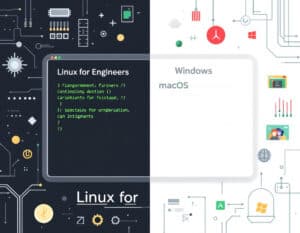
Linux for engineers compared with Windows and macOS
The real comparison is rarely Linux against one other system. Most teams run a mix.
Windows 11 hosts interactive CAD and ECAD tools that have no Linux build. macOS attracts people who want Unix tooling on Apple silicon. Linux hosts the solvers, the job schedulers and the automated pipelines. That mix is the normal case for Linux for engineers who also depend on commercial CAD.
Windows Subsystem for Linux (WSL) changes the arithmetic. In the 2025 Stack Overflow survey, 16.8% of professional respondents already ran Linux inside Windows. The table below shows what Linux for engineers gains and loses against Windows and macOS on the points that decide technical workloads.
| Linux | Windows 11 | macOS | |
|---|---|---|---|
| Interactive commercial CAD and ECAD | FreeCAD 1.1 and KiCad 10 run natively. SolidWorks and Altium Designer have no Linux build. Siemens ended interactive NX support on Linux with NX 1847. | Widest coverage. SolidWorks and Altium Designer are validated here. | SolidWorks and Altium Designer have no native build. AMD Vivado lists no macOS support. |
| Simulation solvers | Ansys, Abaqus, COMSOL, STAR-CCM+ and MATLAB support Linux. Batch runs on clusters are the normal mode. | The same vendors support Windows, which suits GUI-heavy pre- and post-processing. | Vendor dependent. Check each product matrix. |
| Digital design simulators | Cadence Xcelium and Synopsys VCS are marked Linux only in Intel’s EDA interface tables. | Not available for those two simulators. | Not available for those two simulators. |
| GPU compute | CUDA is supported on RHEL, Ubuntu, Debian, SLES, Fedora and RHEL rebuilds such as AlmaLinux. | NVIDIA supports CUDA on Windows. | NVIDIA offers no CUDA toolkit for macOS. |
| Parity with the cluster | The same OS family runs on laptop, workstation and cluster. JUPITER Booster, Europe’s first exascale system, runs RHEL. | Matching a cluster needs WSL, containers or remote login. | Apple silicon and a different userland call for containers or remote login. |
| Support per release | Ubuntu 26.04 LTS: 5 years, or 10 with Ubuntu Pro. RHEL 10: 10 years. Debian 13: 5 years including LTS. | Windows 11 25H2: 24 months for Home and Pro, to October 12, 2027. Enterprise and Education: 36 months, to October 10, 2028. | Apple publishes no fixed support period per release. |
| Licensing | No license fee for the OS. Paid support exists (RHEL, SLES, Ubuntu Pro), and some vendors expect a certified distribution. | Bundled with hardware or sold under volume agreements. | Bundled with Apple hardware. |
| Office suites | Microsoft 365 desktop applications have no Linux build. Browser versions and LibreOffice fill the gap. | Full desktop applications. | Full desktop applications. |
| Instrument and add-on coverage | MATLAB R2025b has no Data Acquisition Toolbox or Spreadsheet Link on Linux. | Both add-ons exist. | Vendor dependent. Check the platform matrix. |
Pro Tips
- Split the work by interaction: keep model preparation and post-processing on the platform where the vendor’s graphical tool is best supported. Send the solves to Linux with identical input files, and test that the files transfer without conversion. This split is the most common pattern in Linux for engineers teams.
- Re-baseline the numerics: when a validated model changes operating system, compiler or solver build, rerun a reference case and record the difference. Small floating-point deviations are normal. Fix your acceptance tolerance before the test, not after.
Linux for scientists: main distributions compared
Linux for scientists follows one rule: choose the distribution after you list the tools you cannot give up. Vendors certify named releases and, in several cases, named minor versions. Ansys 2026 R1 lists RHEL 8.8, 8.10, 9.4 and 9.6, SLES 15 SP5 to SP7, Ubuntu LTS 22.04 and 24.04, and Rocky Linux 8.10, 9.4 and 9.6. MATLAB R2025b validates Ubuntu 20.04, 22.04 and 24.04, Debian 12 and 13, and RHEL 9 from 9.2. Other distributions may run, but vendor support is limited.
Note: figures checked on November 1, 2026. Vendor support matrices change with each release, so confirm the exact version of your solver before choosing a distribution.
| Distribution | Current release | Support model | Typical use | Watch point |
|---|---|---|---|---|
| Ubuntu LTS | 26.04, April 23, 2026. Linux 7.0, GNOME 50. | 5 years standard, to 2031. 10 years with Ubuntu Pro, to 2036. Legacy add-on extends to 2041. | Engineering and R&D workstations with NVIDIA or AMD GPUs, since 26.04 ships CUDA and ROCm support. Robotics and simulation work, as ROS 2 Jazzy and Kilted use Ubuntu 24.04 at Tier 1. The usual choice for a design engineer who runs MATLAB, Ansys or Vivado locally before sending larger jobs to a cluster, because all three list Ubuntu LTS releases. | The 26.04 desktop is Wayland only. In the matrices checked here, only CUDA lists 26.04 so far. |
| Debian | 13 trixie, August 9, 2025. Point release 13.7 on September 12, 2026. | 3 years of full support to August 9, 2028, then LTS to June 30, 2030. | Long-lived laboratory servers, data acquisition hosts and build machines where package changes must stay rare. A conservative base for containerized analysis. MATLAB R2025b and CUDA list Debian 12 and 13, so it suits MATLAB stations and GPU compute nodes. | Not listed by Ansys 2026 R1. LTS covers fewer architectures. |
| Red Hat Enterprise Linux | 10, May 20, 2025. Kernel 6.12. | Full support to May 2030, maintenance to May 2035. Extended Life Cycle, Premium stretches a major release to 14 years. | Production simulation farms running commercial CAE such as Ansys and STAR-CCM+. Chip design flows whose vendors certify RHEL. Regulated programs that need a documented vendor lifecycle. National HPC centers: JUPITER Booster runs RHEL, and Eni’s HPC7 runs RHEL 9. | Subscription cost. RHEL 10 dropped x86-64-v2 processors. |
| Rocky Linux and AlmaLinux | 10 for both, built on RHEL 10. | Free rebuilds. Rocky 10 is supported to May 31, 2035. | University and institute clusters where a per-node subscription is hard to justify. Experiment software at CERN and Fermilab, which chose AlmaLinux after Scientific Linux and CentOS 7 ended in June 2024. Compute nodes behind Green500 systems such as Otus (Rocky 9.4) and Capella (AlmaLinux 9.4). Rocky is the listed choice for Ansys 2026 R1. Both are listed for Vivado and for CUDA. | Rocky is a 1:1 rebuild. AlmaLinux is ABI compatible and still supports x86-64-v2 CPUs. Vendors may decline cases they cannot reproduce on RHEL. |
| SUSE Linux Enterprise Server | 16.0, November 4, 2025. | 16 years in total. A minor release every November, each with 2 years of general support plus 3 years of optional LTS. | Large simulation clusters in European centers: the Leibniz Supercomputing Centre runs Abaqus 2026 on SLES 15 SP4 or newer. Industrial sites that want a long guaranteed lifecycle. Ansys lists SLES 15 SP5 to SP7, and CUDA lists SLES 15 and 16. Rarely a desktop choice. | 16.0 upgrades only from SLES 15 SP7. SUSE does not plan a Desktop edition for 16.0. |
| Fedora | 44, April 2026. Kernel 6.19, GNOME 50, KDE Plasma 6.6, DNF5. | About 13 months per release. Fedora 44 runs to June 2, 2027. Fedora 43 ends December 9, 2026. | Researchers who write code against the newest compilers and libraries, with GCC 16 on Fedora 44, which CUDA validates. A test bed for toolchains and containers before they move to RHEL 10, since RHEL is built from Fedora work. Not for validated production solvers. | The short cycle forces yearly upgrades. Absent from the Ansys 2026 R1 and MATLAB R2025b matrices. |
| Arch Linux | Rolling release. | No fixed support window. | Personal workstations of people who maintain their own toolchain. Newest kernels and graphics drivers for recent hardware. Open-source CAD, EDA and code development with tools such as FreeCAD and KiCad. Avoid it for vendor-supported solvers. | Not listed in the vendor matrices checked here. Continuous library changes complicate validated toolchains. |
| NixOS | Declarative configuration. | Community channels, no vendor lifecycle. | Reproducible research. Every compiler, library and solver version is pinned in one configuration file, so the same environment can be rebuilt years later for a publication or an audit. Also suited to shared lab machines where several students need identical stacks. | The non-standard file layout means vendor binary installers often need wrappers or a container. Not listed in the matrices checked here. |
The practical rule is short. List the vendors you cannot replace. Find the largest set of releases that all of them support. In the matrices above, that set for Linux for engineers usually lands on RHEL or a rebuild for clusters and on Ubuntu LTS for workstations.
FYI, vendor matrices consulted
-
-
- Ansys 2026 R1: RHEL, SLES 15, Ubuntu 22.04 and 24.04, Rocky Linux.
- MATLAB R2025b: Ubuntu 20.04, 22.04 and 24.04, Debian 12 and 13, RHEL 9.
- AMD Vivado 2026.1: AlmaLinux 8.10 to 10.1, Rocky Linux 8.10 to 10.1, Ubuntu 22.04.3 to 24.04.3.
- NVIDIA CUDA 13.x: RHEL 8 to 10, Ubuntu 22.04, 24.04 and 26.04, Debian 12 and 13, SLES 15 and 16, Fedora 44.
- ROS 2 Kilted Kaiju: Ubuntu 24.04 at Tier 1, RHEL 9 at Tier 2.
-
Pro Tips
- Freeze the minor version on solver nodes: if the vendor certifies RHEL 9.4 and 9.6, do not let the machine drift to another minor release. Disable automatic minor upgrades and update on your own schedule, after the vendor adds the new release to its list. This habit is standard on Linux for scientists clusters.
- Keep one reference machine: vendors may decline cases they cannot reproduce on RHEL. If your cluster runs a rebuild, keep one subscribed RHEL install where you can reproduce a fault before you open a support ticket.
Risks and showstoppers
Most migrations fail on a single missing tool, not on the operating system itself. Linux for engineers works best when you check these risks first. The items below are the ones that appeared repeatedly in vendor documentation and in lifecycle data.
- Windows-only tools. Altium Designer is validated only on Windows 10 and 11. Linux users fall back on virtual machines, which the vendor does not validate. SolidWorks is Windows only. Siemens retired interactive NX on Linux from release 1847, although NX batch mode and the Simcenter 3D solvers still run there.
- Gaps inside supported products. MATLAB R2025b lacks Data Acquisition Toolbox and Spreadsheet Link on Linux. Ansys 2026 R1 does not support BladeGen or the Vista CCD, CPD, RTD and AFD tools on Linux. Read the exclusions, not only the headline.
- Narrow certification windows. Ansys names RHEL 9.4 and 9.6 and Rocky 9.4 and 9.6, not a generic family. MATLAB says distributions with kernel 4.18 and glibc 2.28 or later will likely work, with limited technical support. Rolling releases sit outside these windows by design.
- Lifecycle churn. CentOS 7 and Scientific Linux 7 both reached end of life on June 30, 2024. That date forced CERN, Fermilab and many other labs to rebase on AlmaLinux 9. Fedora 43 ends on December 9, 2026. Budget a migration cycle for every long-term release.
- Licensing shifts. In May 2026, reports said the free Basic tier of AMD Vivado 2026.1 would drop Linux. The installation guide dated June 23, 2026 lists Linux support for all tiers, Basic included. A tier change can still alter your operating system options with little notice.
- Display stack changes. Ubuntu 26.04 LTS ships a Wayland-only GNOME 50 session and drops X11. Test remote visualization, screen capture and any legacy GUI that assumes an X11 session before you roll out.
- CPU baseline. RHEL 10 and Rocky Linux 10 no longer support x86-64-v2 processors. AlmaLinux 10 keeps that support, which matters for older cluster nodes.
- Support accountability. Rocky and AlmaLinux are community distributions. A vendor may decline a ticket that it cannot reproduce on RHEL. Weigh the subscription cost against that exposure.
- Workaround costs. Wine and virtual machines can host Windows-only CAD. Feature coverage and performance vary. A virtual machine also needs its own Windows and application licenses. Community guides describe SolidWorks under Wine as limited.
- Office exchange. Microsoft 365 desktop applications do not exist for Linux. Browser versions and LibreOffice cover most documents. Plan for colleagues who depend on desktop-only features.
In a Linux for engineers plan, a true showstopper exists when a mandatory interactive tool has no Linux build and no headless Linux solver. Keep a Windows or macOS seat for that tool and run the compute on Linux. If the vendor ships batch solvers for Linux, as Siemens does for Simcenter 3D, the migration usually survives.
Pro Tips
- Test your exact modules on a trial license: headline Linux support says little about the add-on you use. Run the specific toolbox, solver option or CAD interface you need before you sign off the migration. Linux for scientists labs often skip this step and find the gap months later.
- Put end-of-life dates in the project calendar: enter each operating system’s end date, such as December 9, 2026 for Fedora 43, twelve months ahead. A forced migration in the middle of a validation campaign costs far more than a planned one.
Twenty professional applications that run on Linux

These tools make Linux for engineers and Linux for scientists productive. The list mixes paid and free software across simulation, design, verification, computing and cluster operations. Support statements come from the vendor documents cited in the sources. Confirm the matrix for your release.
- MATLAB and Simulink (paid). Numerical computing and model-based design, with R2025b validated on Ubuntu 20.04, 22.04 and 24.04, Debian 12 and 13, and RHEL 9 from 9.2.
- Ansys Mechanical APDL, Fluent and CFX (paid). Structural, thermal and fluid solvers, with release 2026 R1 supported on RHEL, SLES, Ubuntu LTS and Rocky Linux.
- COMSOL Multiphysics (paid). Coupled-physics finite element modeling, supported on maintained LTS releases of Ubuntu, Debian and RHEL.
- Abaqus (paid). Nonlinear finite element analysis from Dassault Systèmes, run as release 2026 on the Linux clusters of the Leibniz Supercomputing Centre under Slurm.
- Simcenter STAR-CCM+ (paid). Siemens multiphysics CFD, with a Linux-based client that links to NX and Simcenter 3D running in batch mode since release 2021.1.
- OpenFOAM (free). An open-source CFD toolkit driven from the command line, suited to scripted parametric studies on clusters.
- Code_Aster (free). A structural and thermal mechanics solver published as open source by EDF, usually paired with the Salome-Meca platform.
- ParaView (free). Visualization for large simulation results, able to run in parallel on cluster nodes behind a remote client.
- FreeCAD (free). Parametric 3D CAD with a finite element workbench. Version 1.1 appeared on March 25, 2026, followed by 1.1.1.
- KiCad (free). Schematic capture and PCB layout. Version 10 added design variants, a graphical DRC rule editor and importers for Allegro, PADS and gEDA designs.
- Cadence Xcelium (paid). A logic simulator for digital verification, marked Linux only in Intel’s EDA interface tables.
- Synopsys VCS (paid). A Verilog and SystemVerilog simulator, also marked Linux only in the same tables.
- AMD Vivado (paid tiers and a free Basic tier). FPGA and SoC design suite, with release 2026.1 listing AlmaLinux, Rocky Linux and Ubuntu LTS.
- NVIDIA CUDA Toolkit (free). GPU compilers and libraries, officially supported on RHEL 8 to 10, Ubuntu LTS, Debian and SLES, and on RHEL rebuilds such as AlmaLinux since CUDA 13.2.
- ROS 2 (free). Robotics middleware and tooling, with Ubuntu 24.04 as the Tier 1 Linux platform for the Jazzy and Kilted releases.
- GROMACS (free). A molecular dynamics engine for biomolecular systems, run on GPU workstations and on clusters.
- LAMMPS (free). A classical molecular dynamics code from Sandia National Laboratories, widely used for materials simulation.
- Python with NumPy, SciPy and Jupyter (free). The general analysis stack, kept reproducible across laptop and cluster with conda or virtual environments.
- Julia (free). A compiled language for numerical work, common in differential equation and optimization studies, with official Linux binaries.
- Slurm (free). The job scheduler for compute clusters, used for the batch queues of SuperMUC-NG at the Leibniz Supercomputing Centre.
Pro Tips
- Keep several solver versions side by side: use environment modules or containers so that an older release stays available for a running project. Linux for scientists groups rely on this to keep long studies on a fixed release. The Leibniz Supercomputing Centre loads Abaqus through a module command with the release in its name, which lets 2026 and older versions coexist.
- Run studies as scripted batch jobs: submit through the scheduler with the solver’s command line, and archive the input files, the solver release and the license log with the results. Any run can then be repeated and audited, which is how Linux for scientists keeps results traceable.
Sources
- MathWorks, MATLAB and Simulink R2025b Linux system requirements
- Ansys 2026 R1, supported Linux platforms
- COMSOL, supported Linux operating systems
- Leibniz Supercomputing Centre, Dassault Systèmes software (Abaqus) on HPC systems
- Siemens, Simcenter STAR-CCM+ client for NX and Simcenter 3D on Linux
- FreeCAD blog, versions 1.1 and 1.1.1
- CNX Software, KiCad 10 release
- Intel, EDA interface information (Cadence Xcelium)
- Intel, EDA interface information (Synopsys VCS)
- AMD, Vivado supported operating systems (UG973)
- NVIDIA, CUDA Installation Guide for Linux
- Phoronix, CUDA 13.2 and RHEL-compatible distributions
- ROS 2 Kilted Kaiju, supported platforms

Linux for scientists and engineers: trends and statistics
Linux for scientists is the stronger story in cluster data, while Linux for engineers on the desktop is still growing. Server and cluster figures are firm.
Desktop figures are noisy, because web-traffic counters and gaming surveys measure different populations.
Treat single-month jumps with caution.
| Metric | Value | Source and date |
|---|---|---|
| Linux share of TOP500 systems | 100% since November 2017 | TOP500 statistics, reported through the November 2025 list |
| TOP500 systems with accelerators | 276 of 500, up from 255 six months earlier | TOP500, June 2026 (67th edition) |
| Exascale systems on the list | 5: LineShine, El Capitan, Frontier, Aurora, JUPITER Booster | TOP500, June 2026 |
| Combined TOP500 performance | 18.73 exaflop/s, up from 14.99 six months earlier | TOP500, June 2026 |
| Websites running Linux | 62.2% of sites with a known OS. Windows: 8.3%. | W3Techs, September 1 and August 5, 2026 |
| Kubernetes in production | 82% of container users, up from 66% in 2023 | CNCF Annual Cloud Native Survey, published January 20, 2026 |
| OS used by professional developers | Windows 49.5%, macOS 32.9%, Ubuntu 27.7%, WSL 16.8%, Linux outside WSL 16.7% | Stack Overflow Developer Survey 2025, multiple answers allowed |
| Linux on worldwide desktops | 4.39%, against 56.55% for Windows | StatCounter, June 2026 |
| Linux on North American desktops | 10.65%, up from 5.52% in June | StatCounter, July 2026. An Unknown category distorted these months. |
| Linux on Steam | 3.05% in October 2025, 5.33% peak in March 2026, 4.01% in July 2026 | Valve hardware survey, as reported by the press |
| Longest vendor lifecycles | Ubuntu LTS up to 15 years with the Legacy add-on. RHEL up to 14 years with Extended Life Cycle, Premium. SLES 16: 16 years. | Canonical, Red Hat, SUSE, 2025 and 2026 |
Trends worth tracking
- Linux inside Windows. Canonical’s VP of engineering said Ubuntu usage in WSL is growing faster than native desktop installs. He expects it to pass them within months (reported September 2026).
- Longer lifecycles. Red Hat introduced Extended Life Cycle, Premium on April 2, 2026. SUSE gave SLES 16 a 16-year plan with a new minor release each November.
- GPU vendors follow the enterprise rebuilds. NVIDIA added official CUDA support for RHEL-compatible distributions in CUDA 13.2, released in March 2026. Ubuntu 26.04 LTS launched with native CUDA and ROCm support.
- Desktop stack changes. Ubuntu 26.04 LTS is Wayland only. Fedora 44 ships KDE Plasma 6.6 and DNF5. SLES 16 brings atomic updates and the Agama installer.
- Kernel direction. Linux 7.0 arrived on April 12, 2026 and retired the experimental label on Rust support. Linus Torvalds expects AI-assisted bug reports to keep arriving for some time.
- More variety at the top of HPC. For Linux for scientists at the top end, the June 2026 number one, LineShine, runs Kylin OS. Other top systems run RHEL, Rocky Linux 9.4 and AlmaLinux 9.4.
- Windows 10 end of support. Support ended on October 14, 2025. Linux crossed 3% on Steam the same month. The effect on professional workstations has not been measured.
Pro tips
- Quote the source and the date: use TOP500 and W3Techs for cluster and server claims. Treat monthly desktop share swings as noise until two or three consecutive months agree. That caution applies to any claim about Linux for engineers on the desktop.
- Re-read your vendor lists twice a year: subscribe to the release notes of the three to five tools you cannot replace. Recheck their operating system lines each January and July, and before every upgrade.
Conclusion: Linux for engineers and scientists
Linux for engineers and Linux for scientists share one reality: Linux is where large simulations run and where results can be reproduced. It is also a workable desk system for most solvers. It is not universal. Some interactive CAD and ECAD tools still require Windows.
Three questions settle the decision. Which tools can you not replace? Which releases do their vendors certify? Which of them need an interactive seat? With Linux for engineers, pick the distribution from those answers, keep one Windows or macOS seat if a tool demands it, and plan a migration step for every long-term release.
FAQ
Which Linux distribution should I choose for commercial solvers?
Choose from your vendors’ support lists, not from preference. Ansys 2026 R1 lists RHEL 8.8, 8.10, 9.4 and 9.6, SLES 15 SP5 to SP7, Ubuntu LTS 22.04 and 24.04, and Rocky Linux 8.10, 9.4 and 9.6. MATLAB R2025b validates Ubuntu 20.04, 22.04 and 24.04, Debian 12 and 13, and RHEL 9 from 9.2. Take the largest set of releases that all your vendors cover.
Can I run Ansys, MATLAB or COMSOL on a distribution that is not listed?
It may run, but support will be limited. MathWorks states that distributions with kernel 4.18 and glibc 2.28 or later will likely work, with reduced technical support. COMSOL supports maintained LTS releases of Ubuntu, Debian and RHEL. For validated work, stay inside the listed releases.
Is Rocky Linux or AlmaLinux acceptable in place of RHEL?
Technically yes, since both rebuild RHEL sources. Rocky aims at a 1:1 rebuild, while AlmaLinux is ABI compatible. Ansys 2026 R1 lists Rocky but not AlmaLinux, and Vivado 2026.1 lists both. A vendor may decline a case it cannot reproduce on RHEL, so keep one subscribed RHEL machine for fault reproduction.
Should I move to Ubuntu 26.04 LTS now?
Not before your vendors list it. The release ships Linux 7.0 and a Wayland-only GNOME 50 session. In the vendor matrices checked for this guide, only NVIDIA CUDA lists 26.04 so far. Ubuntu 24.04 remains the safer target for Ansys, MATLAB, Vivado and ROS 2.
Which professional engineering tools have no Linux version?
Altium Designer is validated only on Windows 10 and 11, and SolidWorks is Windows only. Siemens retired interactive NX on Linux from release 1847, although NX batch mode and the Simcenter 3D solvers still run there. Some add-ons are also missing, such as the MATLAB Data Acquisition Toolbox and Spreadsheet Link, and the Ansys BladeGen and Vista tools in release 2026 R1.
Can I run Windows-only CAD in a virtual machine or under Wine?
It is possible, with limits. Vendors such as Altium validate their software on Windows only, so a virtual machine is unvalidated. A virtual machine also needs its own Windows and application licenses. Community guides describe SolidWorks under Wine as limited, so treat both routes as a stopgap.
How long is each Linux release supported?
Ubuntu 26.04 LTS receives 5 years of standard maintenance, 10 with Ubuntu Pro and up to 15 with the Legacy add-on. RHEL 10 has full support to May 2030 and maintenance to May 2035, and Extended Life Cycle, Premium stretches it to 14 years. Debian 13 reaches June 30, 2030 with LTS, SLES 16 has a 16-year plan, and Fedora lasts about 13 months.
What changes for older cluster nodes with RHEL 10?
RHEL 10 and Rocky Linux 10 no longer support x86-64-v2 processors. AlmaLinux 10 keeps that support. Check the CPU generation of every node before you plan a rebuild of the cluster image.
Do I need Linux for GPU computing?
Not strictly, but it gives the widest official coverage. CUDA 13.x lists RHEL 8 to 10, Ubuntu 22.04, 24.04 and 26.04, Debian 12 and 13, SLES 15 and 16, and Fedora 44. NVIDIA supports CUDA on Windows too, and offers no CUDA toolkit for macOS. Since CUDA 13.2, RHEL rebuilds such as AlmaLinux are officially supported.
Is WSL a substitute for a native Linux install?
It suits scripting, open-source toolchains and tooling parity on a Windows laptop. In the 2025 Stack Overflow survey, 16.8% of professional respondents used it. Vendor support lists name distributions, so confirm that your vendor accepts WSL before relying on it. Large production runs still belong on native Linux nodes.
How do I keep results reproducible when the operating system changes?
Rerun a reference case after any change of operating system, compiler or solver build, and record the difference. Small floating-point deviations are normal, so fix the acceptance tolerance beforehand. Pin solver versions with environment modules or containers, and archive input files, release numbers and license logs with each result.
Which setup gives the most reproducible research environment?
NixOS pins every compiler, library and solver version in one configuration file, so the environment can be rebuilt years later for a publication or an audit. It has no vendor lifecycle and its file layout often needs wrappers for vendor installers. Containers on a stable base such as Debian or a RHEL rebuild are the more common compromise.
What do the world’s fastest supercomputers run?
Every TOP500 system has been Linux based since November 2017. In the June 2026 list, the number one system LineShine runs Kylin OS, JUPITER Booster runs RHEL, and Green500 entries such as Otus and Capella run Rocky Linux 9.4 and AlmaLinux 9.4. Research centers such as CERN and Fermilab standardized on AlmaLinux after CentOS 7 and Scientific Linux 7 ended in June 2024.
How should I plan the migration of a validated workflow?
Start with an inventory of each tool, its vendor, its release and the matching line in the support list. Pilot one archived project end to end and compare results within tolerance. Keep a Windows or macOS seat for any tool without a Linux build, and put each operating system’s end date in the project calendar twelve months ahead. Fedora 43, for example, ends on December 9, 2026.