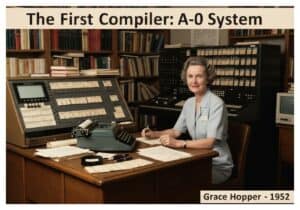
The best Linux software for engineers and scientists covers far more than compilers and text editors. Our guide lists 100 professional tools in 16 domains, from finite element solvers and chip design suites to molecular dynamics codes and cluster schedulers. Every entry runs on Linux, and each states whether it is free, paid, or both. Price was not a criteria here. Capability in a technical domain and a working Linux version were.
Whether you search for scientific software for Linux or for Linux simulation software, use the chapters as a map. Each entry explains what the tool does, who uses it, what it is known for, where it comes from and what to check on Linux. Where a vendor publishes a support list, the entry names the distributions.
How we selected the best Linux software for engineers
Five rules we used to shap our list:
- Technical domain only. Tools for engineering, science, electronics, computing and research. No accounting, HR or office suites.
- Works on Linux. Either a native build, a documented vendor support list for Linux, or a browser-based service that needs no local install.
- Professional use. Software used in industry, national laboratories, universities and research groups, not hobby utilities.
- Price is not a filter. Free and paid tools compete on merit. Each entry states its license model in the text.
- Coverage over duplication. Each domain gets a balanced set, so the list does not become ten solvers of the same type.
FYI, across the 100 entries, 71 are free, 26 are paid and 3 offer both free and paid editions or plans. Licenses of NAMD and ORCA allow free use for academic or non-commercial work only. The table shows the split by chapter.
The reading of this more general Linux for Engineering post is recommended before diving in applications:


1. Numerical computing and mathematics
Before anyone meshes a part or routes a board, someone writes a few lines to test an idea. Numerical computing environments serve that moment. They bundle a language, a plotting system and a library of algorithms, so matrices, equations and measurements can be handled interactively and then turned into scripts.
Two families compete: commercial packages sell curated toolboxes and support, open-source ones sell transparency and zero license cost. On Linux the situation is favorable, since the shell, schedulers and cluster queues convert a script into an unattended job.
The usual trap is version drift between a workstation and a cluster node.
Our own view: in this domain, the Linux alternatives generally equal other solutions on Windows.
|
MATLAB MATLAB is a numerical computing environment built around matrices and its own high-level language. Its main functions cover linear algebra, optimization, signal and image processing, statistics and plotting, and, through Simulink, block-diagram modeling and code generation for control systems. Typical users are control engineers, signal processing specialists, instrumentation labs and researchers who prototype algorithms before moving them to production code. MATLAB is famous for its toolboxes, which add domain functions for fields from machine learning to aerospace. Cleve Moler wrote the first version in the late 1970s at the University of New Mexico to give students easy access to the LINPACK and EISPACK libraries, and Jack Little, Moler and Steve Bangert founded MathWorks in 1984. It is paid commercial software. Release R2025b is validated on Ubuntu 20.04, 22.04 and 24.04, Debian 12 and 13, and RHEL 9 from 9.2. Data Acquisition Toolbox and Spreadsheet Link are not available on Linux. Feature particularities
Linux requirements: Validated on Ubuntu 20.04, 22.04 and 24.04, Debian 12 and 13, and RHEL 9 from 9.2. Other distributions with kernel 4.18 or later and glibc 2.28 or later will likely run it, with limited support. Minimum 8 GB of RAM, 16 GB recommended, and an SSD is strongly recommended. A future release will require a processor with AVX2. Linux alternative to Mathcad, OriginPro, or even Microsoft Excel for numerical modeling. |
Wolfram Mathematica Wolfram Mathematica is a technical computing system built on the Wolfram Language, a symbolic language in which algebra, calculus, graphics, data import and machine learning functions share one syntax. Users work in notebooks that combine code, formulas, plots and text. Physicists, mathematicians, engineers and quantitative analysts use it to derive exact results, test models and publish interactive documents. It is known for its symbolic engine and for the breadth of its built-in knowledge, including curated data on chemistry, geography and physics. Stephen Wolfram released the first version in June 1988, and Wolfram Research has developed it ever since. Mathematica is paid commercial software, with academic and site licenses available. A native Linux edition exists, so notebooks move between Linux and other systems without conversion. Feature particularities
Linux requirements: Wolfram 15.0 is fully tested on Ubuntu 22.04, 24.04 and 26.04, RHEL 8 to 10, AlmaLinux 8 to 10, Debian 11 to 13, Fedora 43 and 44, openSUSE Leap 16, and SUSE Linux Enterprise Server 15 and 16 (x86-64). Other distributions with kernel 4.18 or later and glibc 2.28 or later will likely work, and newer distributions may need extra compatibility libraries. About 23 GB of disk space with local documentation (10 GB without) and 4 GB of RAM or more are recommended. Linux alternative to Mathcad, or Maple on Windows. |
|
Maple Maple is a computer algebra system and numerical environment for symbolic mathematics, exact arithmetic, differential equations, optimization and technical documents. Its worksheet interface mixes text, equations, code and plots, and an add-on named MapleSim builds physical models. Engineering students and teachers use it widely, and engineers rely on it to derive formulas, such as control laws or kinematic chains, before turning them into code. Maple is known for its strong symbolic solvers and its educational tools. Research on it began in 1980 at the University of Waterloo in Canada, and Maplesoft now develops and sells it. It is paid commercial software, and a Linux edition is available for workstations and servers. Feature particularities
Linux requirements: Maple 2026 for Linux x64 lists Red Hat Enterprise Linux 8 and 9 and SUSE Linux Enterprise Desktop 15, with 8 GB of RAM and 10 GB of disk space recommended. The Maplesoft license manager has needed LSB compatibility on Linux, so install the lsb package if activation reports a host ID error. Linux alternative to Mathcad or SMath Studio. |
GNU Octave GNU Octave is a free, open-source language and environment for numerical computation, released under the GNU General Public License. Its syntax closely follows MATLAB, so many scripts run with small changes. It covers linear algebra, differential equations, optimization, signal processing and plotting, and it can call C, C++ and Fortran code. Students, researchers and engineers use it where a MATLAB license is missing, for example on shared cluster nodes or in teaching labs. Octave is known for being the most MATLAB-compatible free option. John W. Eaton began it around 1988 as companion software for a chemical reactor design course, and the first public release followed in 1993. It is a GNU project, and Linux is one of its home platforms. Feature particularities
Linux requirements: No requirement. Octave is packaged in the main distributions. Linux alternative to MATLAB on Windows, or Mathcad. |
|
Scilab Scilab is a free, open-source platform for numerical computation with its own scripting language, matrix operations, optimization, signal processing and 2D and 3D graphics. Its Xcos editor builds block diagrams of dynamic systems, the role Simulink plays in the MATLAB family. Control engineers, teachers and industrial users choose it when license cost matters or when an open codebase is required. Scilab is known for Xcos and for its French research origin: researchers at INRIA, the French national institute for computer science, created it in the 1990s. It runs on Linux, Windows and macOS. Check that the toolboxes you need exist before porting a large MATLAB project, because the library catalog is smaller. Feature particularities
Linux requirements: No particular requirement. Packages exist for the main distributions. Linux alternative to MATLAB and Simulink on Windows, or Mathcad. |
SageMath SageMath is a free, open-source mathematics system that wraps many existing libraries, such as those for algebra, number theory, graph theory and numerical analysis, behind a common Python-based interface. Users write commands in notebooks or scripts and can call specialized engines without learning each one. Mathematicians, cryptography researchers and teachers use it, and engineers use it when they need symbolic work next to Python. It is known for its stated aim of being a viable open-source alternative to Magma, Maple, Mathematica and MATLAB. William Stein started the project in 2005. Sage runs natively on Linux, and distribution packages or a container simplify the installation. Feature particularities
Linux requirements: No particular distribution requirement. Installation through distribution packages, conda or a container is typical, and the dependency set is large. Linux alternative to Maple and Mathematica on Windows. |
|
Julia Julia is a free, open-source programming language for numerical and scientific computing. It is compiled just in time through LLVM, so loops and array code reach speeds near C while the syntax stays close to MATLAB and Python. Its main functions include multiple dispatch, a package manager, built-in parallelism and calls into C, Fortran and Python libraries. Researchers use it for differential equations, optimization, climate and quantitative modeling, and engineers use it for fast prototypes that need no rewrite. Julia is known for solving the two-language problem. Jeff Bezanson, Stefan Karpinski, Viral Shah and Alan Edelman began it at MIT and announced it in 2012, and version 1.0 appeared in August 2018. Official Linux binaries are provided. Feature particularities
Linux requirements: No requirement. Official Linux binaries are available for download. Linux alternative to MATLAB on Windows, or Mathcad. |
R R is a free, open-source language and environment for statistical computing and graphics. It offers data frames, linear and nonlinear modeling, time series, hypothesis tests, clustering and a graphics system, and thousands of contributed packages on CRAN extend it into almost every field. Statisticians, biologists, social scientists and engineers use it to design experiments, analyze measurements and write reproducible reports. R is known for its package archive and for the ggplot2 graphics package. Ross Ihaka and Robert Gentleman created it at the University of Auckland in the early 1990s, modeled on the S language, and it became a GNU project with version 1.0 in 2000. On Linux it installs from distribution packages, and Rscript runs analyses unattended, which suits cluster jobs. Feature particularities
Linux requirements: No requirement for the base system. Packages that compile from source need a C, C++ or Fortran compiler and development libraries. Linux alternative to Minitab (partially), JMP, or IBM SPSS Statistics. |
2. Mechanical CAD and CAM
CAD turns an idea into geometry that a workshop or a solver can use, and CAM turns that geometry into tool paths. Parametric modeling, where dimensions drive the shape, and exchange formats such as STEP are the central concepts. Interactive commercial CAD has been a weak spot on Linux: SolidWorks has no Linux build, and Siemens retired interactive NX there. The platform answers in three ways. Open-source modelers cover traditional design, code-driven tools treat a part as a program, and a browser-based service needs no local install. Machine control is the area where Linux leads, because real-time kernels can run a mill directly.
Our own view: while promising (OnShape) in this domain, the Linux alternatives are not yet at the level of Windows solutions.
|
FreeCAD FreeCAD is a free, open-source parametric 3D modeler. Its workbenches cover part design, sketching, assemblies, 2D drafting, architecture, finite element analysis, CAM paths and more, and nearly every function is reachable through Python scripting. Mechanical designers, makers, architects and researchers use it to build editable models and to exchange STEP or STL files. It is known for its modular architecture and for being the most complete free parametric modeler. Jürgen Riegel, Werner Mayer and Yorik van Havre started it around 2002, and version 1.0 arrived in November 2024. Version 1.1 followed on March 25, 2026, then 1.1.1. FreeCAD runs natively on Linux. Feature particularities
Linux requirements: No distribution requirement. A graphics driver with working OpenGL is needed. Installs from distribution packages or Flatpak. Linux alternative to SolidWorks, Autodesk Inventor or Autodesk Fusion. |
 |
|
OpenSCAD OpenSCAD is a free, open-source solid modeler in which you write code that describes a part, instead of drawing it. Primitives, boolean operations, loops and variables generate the geometry, and the program exports STL and other formats. Designers of fixtures, enclosures, mechanical kits and parametric part families use it, particularly when dimensions must change by editing a number and the design must live in version control. It is known for its text-first approach and for the large community of shared designs. Clifford Wolf started it around 2009, and Marius Kintel has maintained it for many years. It lacks freeform surfacing, so organic shapes are better made elsewhere. It runs natively on Linux. Feature particularities
Linux requirements: No requirement. Available in the main distributions. Linux alternative to SolidWorks, Autodesk Fusion for simple parametric parts. |
CadQuery CadQuery is a free, open-source Python library for parametric CAD, built on the OpenCascade geometry kernel. A model is a script that chains sketches, extrusions, fillets and boolean operations, and the result exports to STEP, STL and other formats. Engineers who want CAD inside an automated workflow use it, for instance to generate part families, run optimization loops or test designs in continuous integration. It is known for its fluent, readable interface and for treating a design as code. The project began in the 2010s and an active community maintains it. A Linux installation needs only Python and the package. Feature particularities
Linux requirements: No requirement beyond a supported Python installation. Linux alternative to SolidWorks and Autodesk Inventor with their macro or rules interfaces. |
|
SolveSpace SolveSpace is a free, open-source parametric CAD program with a constraint solver for 2D sketches and 3D assemblies. It supports extrusions, revolves, boolean operations, linked parts and the export of 2D drawings and 3D formats. Mechanism designers, makers and engineers use it for kinematic layouts and small parts, where a quick and light tool beats a large suite. It is known for its small size, fast start and dependable constraint solving. Jonathan Westhues created it and released it around 2008, and a community has maintained it since. It runs natively on Linux. Feature particularities
Linux requirements: No requirement. Packages exist for the main distributions. Linux alternative to: Autodesk Fusion, SolidWorks for small mechanisms. |
BRL-CAD BRL-CAD is a free, open-source solid modeling system based on constructive solid geometry, with a command-oriented interface, geometry converters, a ray tracer and analysis tools. It models solids by combining primitives with boolean operations, and it can compute how rays or projectiles pass through a model. Defense researchers, vulnerability analysts and engineers who need exact solid geometry use it. It is known for its age and for its ray-tracing engine. Development began in 1979 at the US Army Ballistic Research Laboratory, led by Mike Muuss, and the code was released as open source in 2004. It runs natively on Linux. Feature particularities
Linux requirements: No requirement. Builds from source, and packages exist for several distributions. Linux alternative to: Rhinoceros, SolidWorks for solid modeling tasks. |
|
Onshape Onshape is a professional parametric CAD and data management system that runs entirely in a web browser, so nothing is installed on a Linux machine beyond the browser. It covers parts, assemblies, drawings, sheet metal, surfacing and configurations, with version control and live multi-user editing built in. Product design teams, startups, schools and distributed engineering groups use it. It is known for being the first full-cloud 3D CAD system. Former SolidWorks leaders, among them Jon Hirschtick, started the company in 2012, launched the product in 2015, and PTC bought the company in 2019. Onshape is sold by subscription, with a free plan for non-commercial use in which all documents are public. An internet connection is required. Feature particularities
Linux requirements: Only a current web browser and an internet connection. Nothing is installed locally. Linux alternative to SolidWorks, Autodesk Inventor, or PTC Creo. |
LinuxCNC LinuxCNC is a free, open-source machine controller that drives milling machines, lathes, routers, plasma cutters, robots and other motion systems from a PC. It interprets G-code, plans coordinated motion, runs a real-time layer for precise timing and offers configurable operator interfaces and a hardware abstraction layer. Workshops, universities and builders of custom machines use it to avoid a proprietary controller. It is known for running on ordinary PC hardware with a real-time kernel. The project descends from the Enhanced Machine Controller developed at the US National Institute of Standards and Technology in the 1990s, and it took the name LinuxCNC in 2011. As the name says, it runs on Linux. Feature particularities
Linux requirements: A real-time kernel is required to run machines: PREEMPT-RT, RTAI or Xenomai. The project provides installable ISO images based on Debian 13 Trixie and Debian 12 Bookworm with a PREEMPT-RT kernel, and LinuxCNC 2.9 is not supported on Debian 9 or older. On a standard kernel it runs in simulation only. Linux alternative to Mach3 and Mach4. |
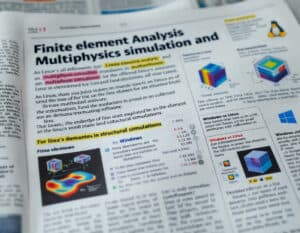
3. Finite element and multiphysics: Linux simulation software for structures
Finite element analysis cuts a structure into small elements and solves the equations of equilibrium on the resulting mesh, which predicts stress, deformation, vibration, heat flow and failure before anything is built. Solvers differ in what they do best: implicit codes for slow, smooth loading, explicit codes for crash and impact, and multiphysics tools for coupled effects.
Linux simulation software dominates the heavy end of the field, because large models need many cores, a scheduler and a batch workflow. Commercial vendors certify named distributions and minor releases, while open-source solvers build almost anywhere. A Windows workstation for preparation and Linux nodes for the solve is a common split.
Our own view: in this domain, the Linux alternatives equals or even supersede other solutions on Windows!
|
Ansys Mechanical Ansys Mechanical is the structural analysis family of the Ansys simulation suite, offered through the Mechanical APDL command-driven solver and the Workbench graphical interface. It covers static, modal, harmonic, transient, thermal, contact and nonlinear analysis, with links to optimization and other physics. Design engineers and analysts in aerospace, automotive, energy and electronics use it, and large models run on clusters. It is known for its long history and for the breadth of its element library. John Swanson founded Swanson Analysis Systems in 1970, and the company later became Ansys. It is paid commercial software. Release 2026 R1 is supported on RHEL 8.8, 8.10, 9.4 and 9.6, SLES 15 SP5 to SP7, Ubuntu 22.04 and 24.04, and Rocky Linux 8.10, 9.4 and 9.6. Feature particularities
Linux requirements: Release 2026 R1 lists RHEL 8.8, 8.10, 9.4 and 9.6, SLES 15 SP5 to SP7, Ubuntu 22.04 and 24.04, and Rocky Linux 8.10, 9.4 and 9.6. Not all products are available on all Linux platforms. Linux alternative to SolidWorks Simulation, or Autodesk Inventor Nastran. |
Abaqus Abaqus is a finite element suite from Dassault Systèmes SIMULIA, with Abaqus/Standard for implicit analysis and Abaqus/Explicit for fast, highly nonlinear events. It handles contact, large deformation, plasticity, rubber and composites, and it couples structural, thermal and other effects. Automotive, aerospace, biomedical and materials engineers use it for crash, forming, seal and fracture problems. It is known for reliable nonlinear convergence and for user subroutines that extend material behavior. David Hibbitt, Bengt Karlsson and Paul Sorensen founded the company in 1978, and Dassault Systèmes acquired it in 2005. Abaqus is paid commercial software. The Leibniz Supercomputing Centre runs Abaqus 2026 on its Linux clusters under Slurm. Feature particularities
Linux requirements: The vendor publishes a platform matrix per release. At the Leibniz Supercomputing Centre the 2026 release runs on SLES 15 SP4 or newer. Linux alternative to SolidWorks Simulation, or Autodesk Inventor Nastran. |
|
COMSOL Multiphysics COMSOL Multiphysics is a finite element environment designed to couple physical effects within one model, for example heat, structures, fluids, electromagnetics, acoustics and chemical transport. A model builder, an application builder and add-on modules for specific fields guide the work, and models can be turned into apps. Researchers, product developers and teachers use it, especially where several physics interact. It is known for its equation-based flexibility and its ease of coupling. COMSOL was founded in Stockholm in 1986, started as Femlab and took its present name in 2005. It is paid commercial software. COMSOL supports maintained LTS releases of Ubuntu, Debian and RHEL, and does not extend support to distributions past their initial LTS period. Feature particularities
Linux requirements: Maintained LTS releases of Ubuntu, Debian and RHEL. No support extension for distributions past their initial LTS period. Linux alternative to SolidWorks Simulation, Autodesk CFD. |
Simcenter Nastran Simcenter Nastran is the Siemens solver in the Nastran family. It handles linear and nonlinear statics, dynamics, acoustics, rotordynamics, aeroelasticity, thermal analysis and optimization, and it runs standalone or inside Simcenter 3D. Aerospace, automotive, electronics and heavy machinery engineers use it for large structural models. Nastran is known for its origin in NASA-sponsored work in the 1960s on the structural analysis of aerospace vehicles, after which several companies developed commercial versions. The Siemens version descends from NX Nastran. It is paid commercial software. The Nastran lineage runs on Windows and Linux, which suits batch runs on compute servers while models are prepared on workstations. Feature particularities
Linux requirements: No public Siemens platform list for the standalone solver could be found. The Nastran lineage runs on Windows and Linux, and Siemens gives the exact distribution list to customers per release, so request the matrix for your version before installing. Linux alternative to Autodesk Inventor Nastran, and SolidWorks Simulation. |
|
LS-DYNA LS-DYNA is a general purpose transient finite element code with a strong explicit solver and an implicit solver. It simulates crashworthiness, metal forming, impact, blast, drop tests and earthquake response, with many material and contact models. Automotive crash teams, aerospace engineers, defense analysts and researchers use it, and it scales across cluster nodes. It is known for the crash simulation of whole vehicles. John Hallquist began the work at Lawrence Livermore National Laboratory in 1976 with DYNA3D, founded Livermore Software Technology Corporation in 1987, and Ansys acquired the company in 2019. LS-DYNA is paid commercial software. On Linux the solver runs in shared and distributed modes. Ansys staff said the Workbench interface on Linux was not fully supported in release 2022 R2, so teams often run input files from the command line. Feature particularities
Linux requirements: Ansys states that the solvers are supported on RHEL 9.4. An Ansys employee said in 2023 that Rocky Linux was not supported. Check the current Ansys platform matrix. Linux alternative to Abaqus Explicit and Altair Radioss on Windows. |
Code_Aster Code_Aster is a free, open-source finite element solver for structural and thermomechanical analysis, published by the French utility EDF under the GPL. It covers nonlinear mechanics, fatigue, fracture, contact, dynamics and coupled thermal-mechanical problems, with a command language that scripts every study. Nuclear, civil and mechanical engineers use it, often through the Salome-Meca platform. It is known for its very wide physics coverage and its long record in nuclear plant studies. EDF started development in 1989 and released it as open source in 2001. The learning curve is steep, and part of the documentation is in French. It runs on Linux, where distributions and containers are the usual route to an installation. Feature particularities
Linux requirements: No particular requirement. Salome-Meca distributions and containers are the usual route. Linux alternative to Abaqus, or Ansys Mechanical on Windows. |
|
CalculiX CalculiX is a free, open-source finite element program with a solver, called CCX, and a graphical pre- and post-processor, called CGX. The solver reads an input format close to Abaqus and handles linear and nonlinear statics, dynamics, heat transfer, contact and some coupled analyses. Students, small engineering firms and researchers use it for small and medium models without license cost. It is known for its Abaqus-like syntax, which lowers the barrier for users of that package. Guido Dhondt wrote the solver and Klaus Wittig the pre-processor, starting in the late 1990s. Many users pair it with Gmsh or SALOME for meshing. It is available on Linux through distribution packages and source builds. Feature particularities
Linux requirements: No requirement. Packages exist in the main distributions. Linux alternative to SolidWorks Simulation, Autodesk Inventor Nastran, or Abaqus on Windows. |
Elmer FEM Elmer is a free, open-source multiphysics finite element package from CSC, the Finnish IT Center for Science. Its solvers cover heat transfer, fluid flow, structural mechanics, electromagnetics, acoustics and more, and it couples them in one run, in parallel through MPI. Researchers and engineers who need unusual physics couplings, or who want to modify a solver through user code, use it. Elmer is known for its flexibility in coupling and for its use in research on glaciers and microsystems. Development started in 1995 in collaboration with Finnish universities, research institutes and industry, and CSC released the code as open source in 2005. It runs on Linux, and ElmerGUI offers a graphical front end. Feature particularities
Linux requirements: No distribution requirement. Parallel use needs an MPI library. Linux alternative to COMSOL Multiphysics, and Ansys Workbench on Windows. |
|
FEniCSx FEniCSx is a free, open-source platform for solving partial differential equations with the finite element method. Users write the variational form of a problem in Python, and the system generates efficient low-level code, assembles it and solves it in parallel, with DOLFINx as the core library. Researchers in applied mathematics, mechanics and geophysics use it for new models and discretizations. It is known for letting equations be written close to their mathematical form. The FEniCS Project began in 2003 through work at the University of Chicago and Chalmers University of Technology, and FEniCSx is its newer generation. It is developed mainly on Linux, and installation works through conda, Docker or distribution packages. Feature particularities
Linux requirements: No distribution requirement. Install through conda, Docker or distribution packages, with MPI for parallel runs. Linux alternative to COMSOL Multiphysics, MATLAB PDE Toolbox. |
4. Meshing, visualization and post-processing
A solver only sees numbers. Meshing tools describe geometry as cells it can compute on, and visualization tools turn the resulting files back into pictures an engineer can judge. This pair rarely gets attention in tool lists, yet bad meshes and misread plots cause more wrong conclusions than bad solvers do. Data volume is the main particularity, since a transient CFD run can write terabytes. Linux adds remote work as a strength. Viewers can run in client-server mode with rendering on cluster nodes, and batch scripts can produce figures overnight with no display attached.
Our own view: in this domain, the Linux alternatives equal or supersede other solutions on Windows technically, as long as you get used to the GUI (or no GUI) or re-inject/process results in other solutions.
|
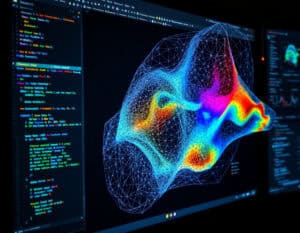
Gmsh Gmsh is a free, open-source mesh generator with a built-in CAD engine, a scriptable geometry language, a Python and C++ interface and a post-processor. It creates one-, two- and three-dimensional finite element meshes, with size fields to control element density, and writes formats for many solvers. Engineers and researchers use it behind solvers such as CalculiX, Elmer and FEniCSx, and as a command-line mesher in automated pipelines. It is known for the quality of its meshing algorithms and for being small and scriptable. Christophe Geuzaine and Jean-François Remacle developed it and released the first version in 1996. It is released under the GPL and runs natively on Linux. Feature particularities
Linux requirements: No requirement. The graphical mode needs OpenGL. Linux alternative to Altair HyperMesh, Ansys Meshing, or Pointwise. |
 |
|
SALOME SALOME is a free, open-source platform for the pre- and post-processing of numerical simulations. Its modules cover geometry creation and repair, meshing, visualization and coupling to solvers, and a Python console scripts the whole chain. Engineers who use Code_Aster, Code_Saturne or other open solvers work in it, and the Salome-Meca distribution packages it with Code_Aster. It is known for combining the OPEN CASCADE geometry kernel with an integrated study workflow. CEA, EDF and OPEN CASCADE developed it, starting around 2000. It is released under the LGPL, and Linux is its main platform. Feature particularities
Linux requirements: The project publishes binaries for named distributions, for example Debian, CentOS, Fedora and Ubuntu LTS builds in the 9.x downloads, plus a universal Linux binary with a minimum glibc requirement. Binaries may work on other distributions such as RHEL, but that is not guaranteed. Check the download page for the current list. Linux alternative to Ansys SpaceClaim, Altair HyperMesh, and Siemens Femap. |
ParaView ParaView is a free, open-source application for visualizing large scientific datasets. It builds on the VTK library and offers slices, contours, streamlines, volume rendering, animation and a Python scripting interface. Its client-server mode keeps the heavy processing on cluster nodes while the user works on a laptop. Simulation engineers, physicists and climate scientists use it to inspect results, and it is the usual viewer for OpenFOAM cases. It is known for handling datasets that are too large for a single machine. Kitware developed it with Los Alamos National Laboratory and funding from the US Department of Energy, and the first release appeared in 2002. It runs natively on Linux. Feature particularities
Linux requirements: No requirement. Headless servers use off-screen rendering builds. Linux alternative to Tecplot 360, Ansys CFD-Post, or Altair HyperView. |
|
VisIt VisIt is a free, open-source parallel visualization and analysis tool. It offers plots, slices, queries, expressions and scripting, and it is built to process very large mesh-based data on distributed systems. Physicists, engineers and computational scientists at national laboratories and universities use it to analyze results that cannot be moved to a laptop. It is known for its origin in the Advanced Simulation and Computing program of the US Department of Energy. Lawrence Livermore National Laboratory began the project around 2000. Linux is the platform on which it is usually run on clusters. Feature particularities
Linux requirements: No requirement. Usually installed from the project binaries on clusters. Linux alternative to Tecplot 360 or EnSight. |
Tecplot 360 Tecplot 360 is a commercial plotting and visualization package for CFD and test data. It offers XY, 2D and 3D plots, contours, streamlines, animation and a macro language, and its Python interface, PyTecplot, automates reports. Aerospace, turbomachinery and automotive engineers use it for report-quality figures and for comparing simulations with measurements. It is known for its dedicated CFD workflow and for the SZL file format. Tecplot, Inc. has developed it since the 1980s. Tecplot 360 is paid software. The vendor lists RHEL 8 and 9, Rocky Linux 8 and 9, Ubuntu 22.04 and 24.04 LTS, and SUSE Linux Enterprise Desktop 15 on Linux. Feature particularities
Linux requirements: RHEL 8 and 9, Rocky Linux 8 and 9, Ubuntu 22.04 and 24.04 LTS, SUSE Linux Enterprise Desktop 15. Linux alternative to Ansys CFD-Post and OriginPro. |
5. Computational fluid dynamics
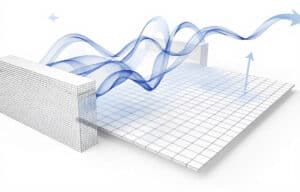
Computational fluid dynamics solves the equations of fluid motion, usually the Navier-Stokes equations, on a mesh to predict flow, pressure, heat transfer and chemical reactions. Aircraft, engines, buildings, ships and pumps all rely on it. Turbulence modeling, mesh quality and boundary conditions decide whether a result is believable. CFD is among the heaviest consumers of cluster time, so the field leans on Linux more than most. Commercial solvers publish certified distribution lists and ship cluster launchers, and open-source codes such as OpenFOAM are developed on Linux first. Expect to match the MPI library and the compiler to what the solver demands.
Our own view: in this domain, the Linux alternatives frequently supersede other solutions on Windows!
 |
Ansys Fluent Ansys Fluent is a general purpose commercial CFD solver. It handles incompressible and compressible flow, turbulence, heat transfer, combustion, multiphase flow and many other models, and it includes meshing tools such as Fluent Meshing. Engineers in aerospace, automotive, energy, process and electronics industries use it for design studies and troubleshooting. It is known for the breadth of its physical models and its large user base. Fluent Inc. was founded in 1983 in the United States, and Ansys acquired the company in 2006. Fluent is paid commercial software. On Linux, large jobs commonly run on clusters, and the Ansys 2026 R1 Linux guide lists Fluent Meshing among the Workbench components. Feature particularities
Linux requirements: Same platform list as Ansys 2026 R1: the RHEL, SLES 15, Ubuntu LTS and Rocky Linux releases named by Ansys. Linux alternative to SOLIDWORKS Flow Simulation, Autodesk CFD. |
|
Simcenter STAR-CCM+ Simcenter STAR-CCM+ is a Siemens multiphysics CFD code that unites geometry, meshing, solving and post-processing in one client. It covers flow, heat transfer, multiphase flow, combustion and fluid-structure interaction, and it offers design exploration tools that script many variants of a model. Automotive, aerospace, marine and energy engineers use it. It is known for its automated polyhedral meshing and its single-environment workflow. CD-adapco introduced STAR-CCM+ in 2004, and Siemens acquired CD-adapco in 2016. It is paid commercial software. Since release 2021.1, a Linux-based CAD client links it to NX and Simcenter 3D, with NX running in batch mode on Linux. Feature particularities
Linux requirements: Siemens publishes supported distributions per release. The release 2021.1 fact sheet listed RHEL, CentOS, SLES and openSUSE Leap, and the list moves with each release. A CFD-Online user reports Rocky Linux as officially supported. The Viewer needs glibc 2.17 or newer plus the xkbcommon libraries. Linux alternative to SOLIDWORKS Flow Simulation, and Autodesk CFD. |
OpenFOAM OpenFOAM is a free, open-source toolbox of C++ solvers and utilities for continuum mechanics, mainly CFD. A case is a folder of text files, so studies are scripted, versioned and run unattended on clusters. Solvers cover incompressible and compressible flow, turbulence, multiphase flow, combustion and heat transfer, and users can write new ones in C++. Researchers, consultants and engineers use it where a license server or a fixed interface would get in the way. It is known for its flexibility and for having no license cost per core. It grew from work at Imperial College London in the 1990s and became open source in 2004. Two main distributions exist, one from the OpenFOAM Foundation and one from ESI. It has no integrated GUI and runs natively on Linux. Feature particularities
Linux requirements: No distribution requirement. Needs a C++ compiler for source builds and an MPI library for parallel runs. Package repositories exist for Ubuntu, Debian and RPM-based systems. Linux alternative to SOLIDWORKS Flow Simulation, Autodesk CFD, or Ansys Fluent on Windows. |
|
SU2 SU2 is a free, open-source suite for multiphysics simulation and design optimization on unstructured meshes. It solves compressible and incompressible flow, and it is known for adjoint-based shape optimization, which delivers gradients with respect to many design variables from one extra solve. Aerodynamic designers, researchers and students use it. Stanford University’s Aerospace Design Laboratory, led by Juan Alonso, released it in 2012, and a community now develops it. It is written in C++ with Python drivers, and it runs on Linux workstations and clusters. Feature particularities
Linux requirements: No distribution requirement. Needs a C++ compiler, Python and an MPI library to build. Linux alternative to Ansys Fluent on Windows, or Autodesk CFD. |
Code_Saturne Code_Saturne is a free, open-source CFD solver from EDF for incompressible and weakly compressible flows. Its functions include turbulence models, heat transfer, combustion, atmospheric flows and particle tracking, and it scales to large numbers of cores. Nuclear and energy engineers use it for plant and component studies, and research groups use it to test turbulence modeling. It is known for being a long-maintained industrial code released as open source. EDF started the development in 1997 and published the source under the GPL in 2007. It pairs with SALOME for geometry and meshing, and it runs on Linux. Feature particularities
Linux requirements: No distribution requirement. Needs a compiler and an MPI library to build. Linux alternative to Ansys Fluent on Windows, and SOLIDWORKS Flow Simulation. |
|
CONVERGE CONVERGE is a commercial CFD solver known for autonomous meshing, which builds and refines the computational grid during the run, so the user does not draw a mesh. Its strongest field is the internal combustion engine, with detailed chemistry and moving boundaries, and it also handles reacting flows, turbomachinery and aftertreatment. Engine developers, fuel researchers and automotive suppliers use it. Convergent Science, based in Madison, Wisconsin, develops it. CONVERGE is paid commercial software. The vendor documents Linux installation with HPC-X, Intel MPI, MPICH or Open MPI, and lists Linux distributions such as RHEL and Ubuntu. CONVERGE 5 needs glibc 2.28 or later on Linux. Feature particularities
Linux requirements: CONVERGE 5 needs glibc 2.28 or later. Earlier guides list RHEL, CentOS, SLED and Ubuntu. MPI choices are HPC-X, Intel MPI, MPICH or Open MPI. Linux alternative to Ansys Forte or GT-SUITE on Windows. |
FLOW-3D FLOW-3D is a commercial CFD package specialized in free-surface flows, with models for casting, hydraulics, coating and additive manufacturing. It tracks the moving liquid surface with a volume-of-fluid method and offers solidification, surface tension and fluid-structure models. Foundry engineers, hydraulic engineers and process developers use it. It is known for its accuracy on filling and splashing problems. The method goes back to work by C. W. Hirt, and Flow Science of Santa Fe, New Mexico, released the first version of FLOW-3D in 1985. It is paid commercial software. The vendor ships Windows and Linux versions, and its documented Linux support has covered RHEL and SUSE. Feature particularities
Linux requirements: Older vendor documents list RHEL 6 or later and SUSE Linux Enterprise 12 or later, and call other distributions unsupported. Mesa-based OpenGL renderers are not recommended. Check the current platform page. Linux alternative to SOLIDWORKS Flow Simulation or Autodesk CFD. |
6. Electromagnetics, RF and photonics
Electromagnetic simulation computes how fields travel through antennas, cables, circuit boards, waveguides and optical components. Methods fall into three groups: frequency-domain finite elements, time-domain finite differences and integral equations. Each suits a different problem, such as resonant structures, wideband pulses or very large radiating objects. Photonics adds nanoscale features and visible wavelengths. Linux plays two roles here, a full workstation for some tools and a pure solver platform for others. Several commercial suites keep exceptions on Linux, and a Windows front end that dispatches jobs to Linux servers is a legitimate setup. Read each vendor note before planning.
Our own view: in this domain, the Linux alternatives can equal other solutions on Windows.
|
Ansys HFSS Ansys HFSS, the High Frequency Structure Simulator, is a 3D full-wave electromagnetic solver based on the finite element method. It computes S-parameters, fields and radiation for antennas, filters, connectors, packages, printed circuit boards and high-speed interconnects. RF, microwave and signal-integrity engineers use it, from mobile phone antennas to radar. It is known for accuracy on complex 3D structures. Ansoft first released HFSS around 1990, and Ansys acquired Ansoft in 2008. HFSS is paid commercial software. Most of the Ansys Electromagnetics Suite runs on supported Linux platforms. A few parts, such as Twin Builder, the Simplorer design type and the HFSS Antenna Toolkit extension, are not available on Linux. Feature particularities
Linux requirements: Supported Linux platforms are listed by Ansys, with some applications missing on Linux, such as Twin Builder, Simplorer and the HFSS Antenna Toolkit extension. Intel MPI is the supported MPI at the Leibniz Supercomputing Centre. Linux alternative to CST Studio Suite, Altair Feko, or Keysight EMPro. |
CST Studio Suite CST Studio Suite is a collection of electromagnetic solvers for antennas, microwave components, EMC and EMI, low-frequency devices and charged-particle systems. Time-domain, frequency-domain, integral-equation and asymptotic solvers share one modeling environment, and high-performance computing options spread simulations across machines. Antenna designers, automotive and aerospace EMC engineers and accelerator physicists use it. It is known for its finite integration technique and its time-domain solver. Computer Simulation Technology was founded in Germany in 1992, and Dassault Systèmes acquired it in 2016. CST is paid commercial software. Linux support covers enterprise distributions such as SUSE Linux Enterprise 15, though not every CAD import works on Linux. A Windows front end can control Linux solver servers. Feature particularities
Linux requirements: The vendor table lists SUSE Linux Enterprise 15.x, 64-bit only. Not all CAD imports work on Linux. A Windows front end can control Linux solver servers. Linux alternative to Keysight EMPro, Sonnet Suites, and AWR Microwave Office. |
|
Ansys Lumerical Ansys Lumerical is a family of photonic simulation tools. FDTD and RCWA solve Maxwell’s equations for nanophotonic structures, MODE handles waveguides and mode solving, CHARGE and HEAT treat carriers and heat, and INTERCONNECT simulates photonic circuits. Photonics engineers, sensor designers and metasurface researchers use it for integrated optics, image sensors and lasers. It is known for FDTD Solutions, its original product, and for scripting in its own language and in Python. Lumerical Solutions was founded in Vancouver, Canada, in 2003, and Ansys acquired it in 2020. It is paid commercial software. On Linux it runs both the graphical tools and batch engines under Open MPI or Intel MPI, and release 2025 R1 lists Rocky Linux 8 and above and RHEL 9 and above. Feature particularities
Linux requirements: Release 2025 R1 supports Rocky Linux 8 and above and RHEL 9 and above. The default installation needs root access. On systems without a graphical session, simulation files run but script files do not. Linux alternative to Synopsys RSoft, and Optiwave OptiFDTD. |
openEMS openEMS is a free, open-source electromagnetic field solver using the finite-difference time-domain method with an equivalent-circuit formulation. Models are defined through Octave, MATLAB or Python scripts, which makes parameter sweeps and optimization easy to automate. RF and microwave engineers use it for antennas, microstrip lines, filters and EMC studies, and researchers use it to test methods. It is known for being a scriptable alternative to commercial field solvers. Thorsten Liebig started it at the University of Duisburg-Essen around 2010. It has no polished GUI, and it runs on Linux. Feature particularities
Linux requirements: No distribution requirement. Source builds need a compiler and libraries such as HDF5 and VTK. Linux alternative to CST Studio Suite, Sonnet Suites, or Keysight EMPro. |
|
Meep Meep is a free, open-source FDTD package for electromagnetic simulation, especially photonics. Its name stands for MIT Electromagnetic Equation Propagation. It models dispersive and nonlinear materials, computes transmission, resonant modes and band structures, and runs in parallel with MPI. Researchers in photonic crystals, waveguides, resonators and metamaterials use it, driven from Python or Scheme scripts. It is known for being scriptable and for its support of adjoint optimization. Steven G. Johnson’s group at MIT developed it, with the first releases in the 2000s. It runs natively on Linux. Feature particularities
Linux requirements: No distribution requirement. Install from distribution packages, conda or source. Linux alternative to Lumerical FDTD, Optiwave OptiFDTD, or Synopsys RSoft. |
GNU Radio GNU Radio is a free, open-source toolkit for building software-defined radio systems from signal-processing blocks written in C++ or Python. Blocks cover filters, modulation, synchronization and coding, and a graphical editor, GNU Radio Companion, wires them into flowgraphs. Radio engineers, students and researchers use it with hardware such as USRP devices, or with recorded signals, for communication links, spectrum monitoring and radar prototypes. It is known for its role in teaching and prototyping wireless systems. Eric Blossom started it in the late 1990s, and it became a GNU project in 2001. It is developed mainly for Linux. Feature particularities
Linux requirements: No distribution requirement. Radio hardware needs its driver packages. Linux alternative to SDR# and HDSDR for reception, or even LabVIEW for prototyping. |
7. PCB and circuit design: Linux CAD and EDA software for electronics
Board-level electronic design automation covers schematic capture, component libraries, layout, design rule checks and the files a manufacturer needs. Circuit simulation sits beside it and predicts voltages and currents before a prototype exists. This chapter is the friendliest entry point to Linux CAD and EDA software, because the leading tools are open source and need no license server. Libraries rather than features usually decide the choice, since trustworthy footprints and symbols save weeks. Linux users also gain scriptable text formats that fit version control, and simulators that run in batch mode for corner and Monte Carlo studies.
Our own view: in this domain, the Linux alternatives are not there yet… (and some of these solutions exists as-is on Windows).
|
KiCad KiCad is a free, open-source suite for electronic design automation. It combines schematic capture, PCB layout, a 3D viewer, a design rule checker and libraries of symbols, footprints and 3D models, and it integrates the ngspice simulator. Hardware engineers, startups, researchers and educators use it for boards from simple prototypes to dense multilayer designs. It is known for being the leading open-source PCB tool and for its support from CERN. Jean-Pierre Charras started it in 1992, and CERN joined the development in 2013. Version 10, released in March 2026, added design variants, a graphical design rule editor and importers for Allegro, PADS and gEDA designs. It runs natively on Linux. Feature particularities
Linux requirements: No distribution requirement. Distribution packages may lag, so many users add the project repository or use Flatpak. Linux alternative to Altium Designer, OrCAD, or even PADS. |
 |
|
LibrePCB LibrePCB is a free, open-source PCB design tool built around a managed library of components and a consistent project structure. It offers schematic capture, board layout, design rule checks and output generation, and it keeps schematic, board and library data tied together. Makers, small teams and students who want a clean workflow use it, and it offers a smaller feature set than KiCad. It is known for its strict library approach and cross-platform design. Urban Bruhin started the project around 2013. It runs natively on Linux, and packages are available for the main distributions. Feature particularities
Linux requirements: No requirement. Available as an AppImage and in distribution packages. Linux alternative to Altium CircuitMaker or DipTrace. |
Lepton EDA Lepton EDA is a free, open-source suite of tools for schematic capture, netlisting, symbol management and circuit simulation interfaces. It is a fork of the gEDA project, which Ales Hvezda started in the late 1990s, and it keeps gEDA’s Unix approach of small programs working on plain text files. Engineers who value scripted flows, Scheme extensibility and long-lived file formats use it. It is known for its modular design. A group around Vladimir Zhbanov started the fork in 2017. It runs on Linux and other Unix-like systems. Feature particularities
Linux requirements: Needs GTK libraries. Packaged for Debian-family distributions and builds on other Unix-like systems. Linux alternative to OrCAD Capture, the schematic editor of Altium Designer. |
 |
ngspice ngspice is a free, open-source mixed-level circuit simulator. It performs DC, AC, transient, noise and other analyses, accepts standard device models and netlists, and can be embedded in other programs or run in batch mode for Monte Carlo and corner studies. Analog and mixed-signal designers, students and EDA tool builders use it, and KiCad calls it for simulation. It is known for continuing the SPICE tradition. SPICE was created at the University of California, Berkeley, in the early 1970s, and ngspice builds on Berkeley’s SPICE3f5, with its own project starting around 2000. It runs on Linux and is packaged in all main distributions. Feature particularities
Linux requirements: No requirement. Packaged in all main distributions. Linux alternative to LTspice, PSpice, and NI Multisim. |
|
Qucs-S Qucs-S is a free, open-source graphical front end that drives circuit simulation engines such as ngspice and Xyce. Users draw a schematic, pick an analysis and view the plots in the same window, with the simulator running behind the scenes. Electronics engineers, students and radio amateurs use it for filters, amplifiers and RF circuits. It is known for giving open simulators a modern visual workflow. It grew out of Qucs, the Quite Universal Circuit Simulator, which Michael Margraf started in 2003, and Vadim Kuznetsov launched the Qucs-S fork around 2015. It runs on Linux. Feature particularities
Linux requirements: Needs ngspice or Xyce installed. Uses the Qt libraries. Linux alternative to LTspice, PSpice, or NI Multisim. |
Xyce Xyce is a free, open-source parallel circuit simulator from Sandia National Laboratories. It reads SPICE-style netlists and solves very large circuits across many processors, and it includes models for effects such as radiation and for specialized devices. Engineers who simulate large integrated circuits, and researchers in radiation-hardened electronics, use it. It is known for scaling beyond what serial SPICE programs can handle. Sandia developed it from the late 1990s for its own electronics work and released it as open source in 2013. Qucs-S can drive it. It runs on Linux workstations and clusters. Feature particularities
Linux requirements: Building from source needs a C++ compiler with C++11 support, a Trilinos build made with the options Xyce documents, and an MPI library such as Open MPI or MPICH for the parallel version. Distribution Trilinos packages are discouraged. Sandia provides binary installers for Red Hat Linux with each release. Linux alternative to PSpice, and LTspice. |
8. FPGA and digital design
Digital design starts from a hardware description language such as Verilog, SystemVerilog or VHDL and ends in a bitstream for an FPGA or a layout for a chip. Simulation, synthesis, place and route and timing analysis sit in between. Two worlds meet here. FPGA vendor suites are free or inexpensive, while chip-level simulators and synthesizers carry high prices and run on Linux servers, sometimes only there. An open-source flow assembled from Yosys, Verilator and OpenROAD has matured quickly. Linux requirements tend to be strict, with named enterprise distributions and specific libraries, so read the vendor guide before installing.
Our own view: in this domain, the Linux “alternatives” may sometimes even be the only choice!
|
AMD Vivado Vivado is the design suite for AMD FPGAs and adaptive SoCs. It covers high-level synthesis, RTL synthesis, implementation, timing closure, simulation, a logic analyzer for debugging and IP integration. Digital designers, embedded engineers and researchers building FPGA systems use it. It is known for its IP integrator and its place in the Xilinx tool tradition. Xilinx introduced Vivado in 2012 as the successor to ISE, and AMD acquired Xilinx in 2022. Vivado is offered in tiers, including a free Basic tier and paid tiers. In May 2026 reports said the free tier would drop Linux, but the AMD 2026.1 guide documents Linux support across all tiers. Release 2026.1 lists AlmaLinux, Rocky Linux and Ubuntu LTS. Feature particularities
Linux requirements: Release 2026.1 lists AlmaLinux 8.10, 9.4 to 9.7, 10.0 and 10.1; Rocky Linux 8.10, 9.6, 9.7, 10.0 and 10.1; and Ubuntu 22.04.3 to 22.04.5 and 24.04 to 24.04.3. Ubuntu needs the libtinfo.so.5 library. Linux alternative to Lattice Radiant, and Microchip Libero SoC. |
Intel Quartus Prime Quartus Prime is the design software for Intel FPGAs. It provides synthesis, place and route, timing analysis, power estimation and in-system debugging, and it connects to third-party simulators. FPGA and embedded designers use it, and compile servers run it on Linux. It is known for its Lite edition, which is free for smaller devices, next to paid Standard and Pro editions. Altera introduced the Quartus tools in the early 2000s, Intel acquired Altera in 2015, and the Quartus Prime name dates from that period. The Intel documentation lists Cadence Xcelium and Synopsys VCS as Linux only simulators in its interface tables. Feature particularities
Linux requirements: Quartus Prime Standard and Lite 25.1std added RHEL 8.10, 9.4 and 9.6, SLES 15 SP5 and Ubuntu 24.04, and removed RHEL 8.6, 8.7 and 9.1 to 9.3, Ubuntu 18.04 and SLES 12 SP5 and 15 SP3. Pro 25.1 added SLES 15 SP5 and Ubuntu 24.04. Questa Intel FPGA Edition 2025.2 runs on RHEL 8 and 9 only. Xcelium and VCS run only on Linux. Linux alternative to Lattice Radiant, or Microchip Libero SoC. |
 |
Cadence Xcelium Xcelium is a Cadence logic simulator for digital designs written in Verilog, SystemVerilog and VHDL. It uses parallel simulation to speed up large regressions, and it supports coverage, debug and mixed-signal flows. Verification engineers at chip and FPGA companies run suites of thousands of tests on server farms. It is known as the successor to the Cadence Incisive and NC-Verilog simulators, introduced in 2017. It is paid commercial software. Intel’s Quartus documentation marks it as Linux only. Feature particularities
Linux requirements: Linux only. Cadence roadmaps list RHEL 8.6 and later, RHEL 9 and RHEL 10 for 2026.x releases on x86_64, with Rocky Linux and AlmaLinux at limited support. Not every product supports every combination. Linux alternative to Aldec Riviera-PRO, or Aldec Active-HDL. |
|
Synopsys VCS VCS is a Synopsys simulator for Verilog and SystemVerilog, used to verify ASICs and FPGAs. As a compiled-code simulator, it translates the design into native code before running it. It supports assertions, coverage, constrained-random testing and debug through the Verdi tool. Verification teams run it in regression farms. The name stands for Verilog Compiled Simulator. It began in the early 1990s at Chronologic Simulation, and Synopsys later acquired the technology. It is paid commercial software. Intel’s FPGA documentation lists VCS as Linux only. Feature particularities
Linux requirements: Linux only. For releases 2026.03 to 2026.09 Synopsys lists RHEL 8.4 and later and 9.x, Rocky Linux 8.4 and later and 9.x, and AlmaLinux 8.4 and later and 9.1 and later, and it dropped CentOS Linux and RHEL 7. The processor must support AVX2, meaning Intel Haswell or newer or AMD Excavator or newer. The SolvNetPlus download center shows which product is offered on which platform. Linux alternative to Aldec Riviera-PRO, Aldec Active-HDL. |
Siemens Questa Questa is the verification platform of Siemens EDA, built around a simulator for SystemVerilog, VHDL and mixed-language designs. It adds formal verification, coverage and verification management, and it supports UVM test benches. Verification engineers on ASIC and FPGA projects use it. It is known for its heritage in ModelSim, the Mentor Graphics simulator that many FPGA vendors bundled. Mentor Graphics launched Questa in the 2000s, and Siemens acquired Mentor in 2017. It is paid commercial software, run on Linux servers and workstations. Feature particularities
Linux requirements: Questa One Sim lists RHEL 8 and 9, Rocky Linux 8 and 9 and SLES 15 SP4 on x86 Linux, and RHEL 8 and 9 and Rocky Linux 8 and 9 on AArch64 Linux, plus Windows 11. Questa Intel FPGA Edition 2025.2 is supported on RHEL 8 and 9 only. Linux alternative to Aldec Active-HDL, Aldec Riviera-PRO and ModelSim on Windows. |
|
Synopsys Design Compiler Design Compiler is a logic synthesis tool from Synopsys. It turns RTL descriptions into gate-level netlists mapped to a target technology library, optimizing for timing, area and power. ASIC design teams use it in the front end of chip flows, followed by place and route, timing and power analysis. It is known for having commercialized logic synthesis. Synopsys introduced it in 1987, and it remains a reference tool in the industry. It is paid commercial software. Synopsys documents RHEL as the baseline of its Linux support. Feature particularities
Linux requirements: Same Synopsys platform list as VCS for 2026.03 to 2026.09: RHEL 8.4 and later and 9.x, with Rocky Linux and AlmaLinux as binary-compatible systems, and SLES 15 in the roadmap. GCC 13.3 is the compiler named for those releases, and AVX2 processors are required. Linux alternative to: no direct Windows equivalent for ASIC synthesis. For FPGA targets, the Vivado and Quartus synthesis engines on Windows. |
Verilator Verilator is a free, open-source tool that translates Verilog and SystemVerilog into optimized C++ or SystemC models. The compiled model runs fast, so large designs such as CPUs and SoCs can be simulated inside software test benches. Hardware engineers in open-source and commercial projects use it for verification and for co-simulation with software. It is known for speed. It first appeared in the mid-1990s, and Wilson Snyder has maintained it for many years. Version 5 added timing support. It builds and runs on Linux. Feature particularities
Linux requirements: No distribution requirement. A C++ compiler and standard build tools are needed. Linux alternative to Aldec Riviera-PRO, Aldec Active-HDL or ModelSim on Windows. |
|
Yosys Yosys is a free, open-source framework for RTL synthesis. It reads Verilog, optimizes the design through a series of scripted passes, maps it to FPGA or ASIC cell libraries and writes netlists for place and route tools such as nextpnr. Researchers, open FPGA toolchain developers and students use it. It is known for its role as the core of open-source FPGA and chip flows. Claire Xenia Wolf, formerly Clifford Wolf, started it in 2012. It runs on Linux and is packaged in the main distributions. Feature particularities
Linux requirements: No distribution requirement. Source builds need a C++ compiler, Python, Bison and Flex. Linux alternative to The Vivado and Quartus synthesis engines on Windows. |
OpenROAD OpenROAD is a free, open-source system that carries a digital design from RTL to GDSII layout without human intervention. It bundles floorplanning, placement, clock tree synthesis, routing and timing analysis, and it works with Yosys and open process design kits. Researchers, students and small teams use it to explore chip design, and professionals use it to study physical design algorithms. It is known for its goal of no-human-in-the-loop design. The project began in 2018 with DARPA funding through the IDEA program, with a group at the University of California San Diego in a leading role. It builds and runs on Linux. Feature particularities
Linux requirements: Builds on Linux with CMake and several libraries. Container images simplify installation. Linux alternative to: no direct Windows equivalent. Commercial physical design tools run on Linux. |
9. Integrated circuit design
Integrated circuit design means drawing transistors and wires for a manufacturing process, then proving the result will work and can be built. Designers use schematic and layout editors, circuit simulators, extraction tools and sign-off checkers, all tied to a foundry kit that describes the process. The user base is small and the stakes are large, because a mask set is expensive.
Linux is the working platform for these flows. Compute farms run it, and kits are validated for specific tool and operating system releases. The open silicon movement adds free tools, though commercial sign-off still defines production practice.
|
Cadence Virtuoso Virtuoso is the Cadence environment for custom and analog integrated circuit design. It covers schematic capture, circuit simulation, layout editing, parasitic extraction and verification, linked to foundry process design kits. Analog, RF and mixed-signal designers at semiconductor companies use it, as do university chip groups. It is known for its layout editor and its position as an industry reference in analog design. Cadence introduced Virtuoso in the early 1990s. It is paid commercial software, and it runs on Linux workstations and servers. Feature particularities
Linux requirements: Cadence publishes a compute platform roadmap per release stream. For 2026.x releases on x86_64 it lists RHEL 8.6 and later, RHEL 9 and RHEL 10, with Rocky Linux and AlmaLinux at limited support, and earlier roadmaps list SLES 15 SP3 and later. Virtuoso IC 6.1.8 officially stopped at RHEL 7. The checkSysConf tool of Cadence warns when an operating system is unsupported, and not every product supports every combination. Linux alternative to: no direct Windows equivalent. Tanner L-Edit serves smaller flows on Windows. |
 |
|
Siemens Calibre Calibre is a physical verification suite from Siemens EDA. It runs design rule checks, layout versus schematic comparison, parasitic extraction and manufacturing-oriented checks on finished chip layouts, with the work split across many cores. Physical verification engineers use it as a sign-off tool at semiconductor companies, and foundries distribute Calibre rule decks for their processes. It is known for its position in sign-off verification. Mentor Graphics developed it in the 1990s, and Siemens acquired Mentor in 2017. It is paid commercial software, and it runs on Linux servers and farms. Feature particularities
Linux requirements: The Siemens platform support documents (2022 and 2024 editions) list Red Hat Enterprise Linux, CentOS and SUSE Linux Enterprise Server. Builds for RHEL 8 and SLES 15 need a processor with AVX2. Fedora and CentOS Stream are not supported, and Siemens does not provide operating system support itself. Linux alternative to: no direct Windows equivalent for full-chip sign-off. Tanner tools cover small designs on Windows. |
KLayout KLayout is a free, open-source viewer and editor for GDS and OASIS layout files. It offers layer management, a design rule checker, layout versus schematic checking, a scripting engine in Python and Ruby, and macros for automated layout generation. Chip designers, MEMS and photonic circuit engineers and students use it to inspect layouts, write custom checks and build parametric cells. It is known for its speed with large layouts and its use in open silicon flows. Matthias Köfferlein has written it since around 2006. It runs natively on Linux. Feature particularities
Linux requirements: No requirement. Distribution packages and project binaries exist. Linux alternative to Tanner L-Edit. |
10. Embedded systems and robotics
Embedded engineering builds software that runs inside devices, from a thermostat to a drone, usually under tight limits on memory, power and timing. Robotics adds sensors, actuators and perception. The toolchain consists of cross-compilers, real-time operating systems, emulators, simulators and build systems that produce firmware images. Linux is the natural host for all of it, since cross-compilation, serial consoles, containers and continuous integration feel at home there. Many products also run Linux on the target. Expect a reference distribution, often an Ubuntu LTS release, and toolchain versions that a project pins exactly.
Our own view: in this domain, some of the Linux versions lead the way, not alternatives.
|
ROS 2 ROS 2 is a free, open-source set of libraries and tools for building robot software from communicating nodes. It provides messaging, device drivers, navigation, manipulation, perception, simulation links and tools for logging, replaying and visualizing data. Robotics engineers, researchers and companies building mobile robots, drones and arms use it. It is known as the successor to the original Robot Operating System, which began at Willow Garage and Stanford in the late 2000s. ROS 2 reached its first release in 2017, and Open Robotics maintains it. Ubuntu 24.04 is the Tier 1 Linux platform for the Jazzy and Kilted releases, and RHEL 9 is Tier 2 for Kilted. Jazzy is supported to May 2029. Feature particularities
Linux requirements: Ubuntu 24.04, amd64 and arm64, is Tier 1 for Jazzy and Kilted. Kilted lists RHEL 9 amd64 at Tier 2 and Debian Bookworm at Tier 3. Linux alternative to MATLAB Robotics System Toolbox or LabVIEW Robotics. |
Gazebo Gazebo is a free, open-source robotics simulator with a physics engine, sensor models, 3D rendering and plugins. Users load robot models in standard formats, add virtual sensors and test navigation, control and perception code against simulated worlds. Roboticists and students use it for testing before hardware runs, often together with ROS 2. It is known for its long record in robotics competitions and research. Nate Koenig and Andrew Howard began it in 2002 at the University of Southern California, and Open Robotics now maintains it. ROS 2 Kilted recommends the Ionic release, which the Gazebo project lists as reaching end of life in September 2026. New projects can use Jetty or the Harmonic LTS release. It runs on Linux. Feature particularities
Linux requirements: Binary packages exist for Ubuntu 24.04 (Noble) on amd64, with other platforms at best effort. The Gazebo documentation gives Ionic an end of life in September 2026, recommends Jetty for Ubuntu 24.04, and marks Harmonic as the LTS release until September 2028. Linux alternative to Webots or CoppeliaSim on Windows. |
 |
PX4 PX4 is a free, open-source flight control software stack for drones and other uncrewed vehicles. It includes estimation, control, mission handling and drivers for sensors, and it supports software-in-the-loop and hardware-in-the-loop simulation. Drone makers, researchers and universities use it, with flight control boards in the aircraft and Linux computers for development. It is known for its permissive license and its governance under the Dronecode Foundation. It started at ETH Zurich around 2009, and the Linux Foundation hosted Dronecode from 2014. Development and simulation run on Linux. Feature particularities
Linux requirements: The development environment supports Ubuntu 24.04 and 22.04 LTS. CI and release builds target 24.04, with build tests on 22.04, and Ubuntu 26.04 is not yet supported. The setup script is meant for clean installations. Other Debian-based systems may work but are not the supported path. Linux alternative to MATLAB UAV Toolbox, Simulink. |
|
ArduPilot ArduPilot is a free, open-source autopilot for aircraft, multicopters, rovers, submarines and boats. It offers many flight modes, sensor drivers, mission planning through ground control software and a software simulator, SITL, that runs on Linux. Hobbyists, researchers and commercial drone operators use it for survey, inspection and mapping. It is known for the breadth of vehicle types it supports. It grew from the Arduino-based autopilot work of the DIY Drones community around 2009. Development tools run on Linux. Feature particularities
Linux requirements: No distribution requirement for the simulator. Ubuntu is the documented development platform. Linux alternative to: no direct Windows equivalent. The closest are closed autopilot suites from drone makers. |
Zephyr Zephyr is a free, open-source real-time operating system for microcontrollers, hosted by the Linux Foundation. It offers a scheduler, drivers, networking and Bluetooth stacks, a device tree and a build system based on CMake and the west tool. Firmware engineers building connected devices use it across many boards. It is known for broad hardware support and a security-minded process. It was announced in 2016 and builds on the Rocket RTOS from Wind River. Developers on Linux build, flash and debug with it, and QEMU can run tests without hardware. Feature particularities
Linux requirements: The getting started guide covers Ubuntu 24.04 LTS and later, and other distributions are handled in a separate host dependency page. Minimum tool versions in the current guide are CMake 3.20.5, Python 3.12 and device tree compiler 1.4.6. The Zephyr SDK provides the toolchains, and flashing may need udev rules. Linux alternative to Keil MDK or IAR Embedded Workbench. |
|
Yocto Project The Yocto Project is a free, open-source collaboration for building custom embedded Linux distributions. Recipes describe each package, and the BitBake build tool produces a complete image for a board, together with a toolchain and SDK. Embedded engineers at device makers use it to create reproducible firmware for products that run Linux. It is known for its layers, which let vendors add board support without forking the core. The Linux Foundation announced the project in 2010, building on OpenEmbedded. It runs as a build host on Linux. Feature particularities
Linux requirements: The project tests each release against stable distributions. Current documentation lists Debian 11 to 13, Fedora 42 to 44, openSUSE Leap 15.6 and 16.0, Rocky Linux 8 to 10, and Ubuntu 22.04 and 24.04, with others such as AlmaLinux in earlier lists. It does not support rolling or development distributions. Other hosts can use the buildtools tarballs, and WSL 2 works but is not validated. Linux alternative to: no direct Windows equivalent. Windows cannot serve as a Yocto build host. |
QEMU QEMU is a free, open-source machine emulator and virtualizer. It runs guest operating systems and firmware for many processor architectures, and with KVM on Linux it virtualizes at near native speed. Embedded teams use it to test firmware, kernels and boot flows before hardware exists, kernel developers use it for debugging, and continuous integration systems use it for cross-architecture tests. It is known for its wide architecture coverage. Fabrice Bellard created it in 2003. It is developed mainly on Linux. Feature particularities
Linux requirements: KVM acceleration needs a Linux kernel with KVM and hardware virtualization. Emulation of other architectures has no requirement. Linux alternative to VMware Workstation, VirtualBox and Hyper-V. |
11. Systems modeling and multi-domain simulation
Systems modeling connects parts from different physical domains, such as an engine, a gearbox, a hydraulic pump and a controller, in one model. Instead of deriving each part’s equations by hand, engineers assemble reusable components and let the tool derive and solve the system. Two approaches meet: equation-based modeling with the Modelica language, and block-diagram or bond graph tools.
Results feed control design and hardware-in-the-loop tests. On Linux these tools mostly run as batch solvers or compile models into code for a target, so a compiler such as GCC is often a hidden requirement.
Tip: in this domain, choice will heavily depend on the other packages and solutions
|
OpenModelica OpenModelica is a free, open-source environment for the Modelica modeling language. It provides a graphical editor for physical models, a compiler, simulation, plotting, scripting interfaces and support for FMI model exchange. Engineers and students model mechanical, electrical, thermal, hydraulic and control systems with it. It is known as the main open implementation of Modelica. Peter Fritzson’s group at Linköping University started it, and the Open Source Modelica Consortium, founded in 2007, now guides it. It runs on Linux. Feature particularities
Linux requirements: Official packages exist for Debian and Ubuntu: the LTS versions of both and the latest non-LTS Ubuntu, for x86, amd64 and armv7. Other distributions use source packages or a source build, and Linux Mint follows its Ubuntu base. Linux alternative to Dymola, Wolfram SystemModeler or MapleSim on Windows. |
Dymola Dymola is a commercial modeling and simulation environment for Modelica. It offers a graphical editor, a symbolic equation processor, model libraries for mechanics, thermal systems, power systems and more, and export to FMI. Engineers in automotive, aerospace, energy and robotics build detailed multi-domain system models with it. It is known as the tool from which Modelica grew, built on the work of Hilding Elmqvist. Dynasim AB was founded in Sweden in 1992, and Dassault Systèmes acquired it in 2006. Dymola is paid software. Dassault documents Linux as a supported platform with a 64-bit application, and GCC translates models into code. Check the short list of supported distributions first. Feature particularities
Linux requirements: 64-bit only, shipped as an RPM, with conversion needed on Debian-family systems. GCC translates the models. Only a few distributions are supported. The UserInteraction library is not supported on Linux. Linux alternative to MapleSim, Simcenter Amesim or Simulink Simscape. |
|
Simcenter Amesim Simcenter Amesim is a system simulation platform for mechatronic systems, with libraries for fluid power, thermal, electrical, mechanical and control components. Engineers draw a schematic of the system, set parameters and run steady-state and transient studies, with links to MATLAB and Simulink. Automotive, aerospace and machinery engineers use it to size hydraulics, engines, battery systems and drivelines. It is known for its component libraries and its bond graph foundation. The French company Imagine released AMESim in 1995, LMS International acquired Imagine in 2007, and Siemens bought LMS in 2012. It is paid software and runs on Linux and Windows. Since version 2210, Siemens ships a cross-compiler that exports FMUs with Linux 64-bit binaries from Windows. Feature particularities
Linux requirements: Runs on Linux and Windows. Check the Siemens release notes for distributions and for the real-time Linux targets. Linux alternative to MapleSim and Simulink Simscape Fluids. |
Project Chrono Project Chrono is a free, open-source physics engine for multibody dynamics, contact, flexible bodies, granular materials and vehicle simulation. Users script models in C++ or Python, and modules add fluid-solid interaction, sensors and robotics support. Vehicle dynamics researchers, robotics groups and engineers who need multibody simulation use it. It is known for its terrain and vehicle models under a permissive BSD license. It was developed at the University of Wisconsin-Madison and the University of Parma in Italy. It runs on Linux workstations and GPU nodes. Feature particularities
Linux requirements: No requirement. Builds with CMake, and GPU modules need CUDA. Linux alternative to MSC Adams, SolidWorks Motion or Simcenter 3D Motion. |
12. Molecular, materials and quantum chemistry: scientific software for Linux
Computational chemistry and materials science predict how atoms and molecules behave, either by solving quantum mechanical equations or by integrating classical equations of motion. Methods range from density functional theory for electrons to molecular dynamics for millions of atoms. These programs are usually written in Fortran or C++, parallelized with MPI and tuned for GPUs. They are a clear case of scientific software for Linux, where clusters, schedulers and module systems are the normal environment. Licensing matters as much as installation. NAMD and ORCA are free for academic or non-commercial use only, while VASP and Gaussian need a purchased license.
Our view: in this domain, Linux versions frequently lead the way.
|
GROMACS GROMACS is a free, open-source molecular dynamics package, released under the LGPL. It simulates proteins, lipids, nucleic acids and other molecular systems, and it includes tools for system setup and analysis, free energy methods and strong CPU and GPU performance across many nodes. Biophysicists, biochemists and computational chemists use it for membranes, drug binding and force field studies. It is known for speed. The name comes from Groningen Machine for Chemical Simulations. It was developed at the University of Groningen in the 1990s, and teams at KTH Royal Institute of Technology in Stockholm and other centers lead it today. It runs on Linux, where most production work happens. Feature particularities
Linux requirements: Builds with CMake and a C++17 compiler. GPU use needs CUDA, OpenCL or SYCL drivers. No distribution requirement. Linux alternative to BIOVIA Materials Studio or BIOVIA Discovery Studio. |
LAMMPS LAMMPS, the Large-scale Atomic/Molecular Massively Parallel Simulator, is a free, open-source molecular dynamics code released under the GPL. It models metals, polymers, semiconductors, soft matter and granular systems with a large set of interatomic potentials, and it runs in parallel with MPI and on GPUs. Materials scientists and physicists use it for mechanical properties, diffusion and fracture. It is known for its extensible package system and for text input scripts that automate large studies. Sandia National Laboratories developed it from the mid-1990s, with Steve Plimpton as a principal author. It runs on Linux clusters. Feature particularities
Linux requirements: No requirement. Builds with CMake and an MPI library. Linux alternative to BIOVIA Materials Studio and Synopsys QuantumATK. |
 |
NAMD NAMD is a molecular dynamics program built for large biomolecular systems on parallel machines. It simulates proteins, membranes and viral capsids with CHARMM-compatible force fields, and it works closely with the visualization program VMD. Structural biologists and biophysicists use it for systems with millions of atoms. It is known for its Charm++ parallel runtime and for its use in simulations of large molecular assemblies. The Theoretical and Computational Biophysics Group at the University of Illinois at Urbana-Champaign, led by Klaus Schulten, developed it from the 1990s. It is free for academic and non-commercial use under its license, which does not allow commercial use. It runs on Linux clusters and GPU nodes. Feature particularities
Linux requirements: No distribution requirement. Use is limited by its non-commercial license. Linux alternative to BIOVIA Discovery Studio or Schrodinger Maestro. |
|
OpenMM OpenMM is a free, open-source library for molecular simulation with a Python interface and high GPU performance. Researchers write simulations and custom forces in Python, run them on CUDA, OpenCL or CPU platforms, and use them for free energy methods, enhanced sampling and machine learning potentials. Computational chemists and method developers use it. It is known for its flexibility in defining new forces. It was developed at Stanford University, in the group of Vijay Pande, and it connects to the Folding@home project. It runs on Linux, including GPU servers. Feature particularities
Linux requirements: No distribution requirement. GPU use needs matching NVIDIA or OpenCL drivers. Linux alternative to BIOVIA Discovery Studio or Schrodinger Maestro. |
CP2K CP2K is a free, open-source program for the atomistic simulation of solids, liquids, molecules and interfaces, released under the GPL. It combines density functional theory with molecular dynamics, and its Quickstep module uses a mixed Gaussian and plane-wave method that scales to large systems on parallel computers. Materials scientists, surface chemists and electrochemists use it for ab initio dynamics. It is known for its efficiency on big periodic systems. The project began around 2000, and an international community, with strong groups in Switzerland, develops it. It runs on Linux clusters. Feature particularities
Linux requirements: No distribution requirement. The build needs Fortran, MPI and numerical libraries, and toolchain scripts help. Linux alternative to BIOVIA Materials Studio or Synopsys QuantumATK. |
|
Quantum ESPRESSO Quantum ESPRESSO is a free, open-source suite for electronic-structure calculations using density functional theory, plane waves and pseudopotentials, under the GPL. It computes ground states, structure relaxation, phonons, spectroscopy and transport properties of crystals and surfaces. Condensed-matter physicists and materials scientists use it. The name stands for opEn-Source Package for Research in Electronic Structure, Simulation, and Optimization. It grew in the 2000s from codes developed at the DEMOCRITOS center in Trieste, Italy, and Paolo Giannozzi is among its leading authors. It runs on clusters through MPI and has GPU-enabled versions. Feature particularities
Linux requirements: No distribution requirement. Needs Fortran, MPI and FFT libraries. Linux alternative to BIOVIA Materials Studio or Synopsys QuantumATK. |
VASP VASP, the Vienna Ab initio Simulation Package, is a plane-wave electronic-structure code for periodic systems. It performs density functional theory, hybrid functionals, molecular dynamics and many-body calculations, with projector augmented-wave pseudopotentials. Solid-state physicists and materials designers use it for crystals, surfaces and defects, and for screening new materials. It is known for being widely cited in materials research. Georg Kresse and colleagues developed it in Vienna from the early 1990s. VASP is paid software, licensed per research group, and users must be registered with the developers to get access. Production runs normally use Linux clusters under a scheduler. Feature particularities
Linux requirements: Licensed per research group, and access requires registration with the developers. The license holder builds it with a Fortran compiler and MPI. Linux alternative to BIOVIA Materials Studio or Synopsys QuantumATK. |
|
ORCA ORCA is a quantum chemistry program for molecules. It covers density functional theory, coupled-cluster and other correlated wave function methods, and spectroscopy calculations, with an efficient input format and parallel runs through MPI. Chemists use it for reaction mechanisms, spectra and transition metal compounds. It is known for fast local correlation methods and for free access in academia. Frank Neese’s group, at the Max Planck Institute for Chemical Energy Conversion in Mülheim, developed it, and the company FACCTs now supports it. ORCA is free for academic users who register, and commercial use needs a license. It runs on Linux. Feature particularities
Linux requirements: Parallel runs use MPI. Registration is required for the academic download. Linux alternative to Spartan or Gaussian for Windows. |
Gaussian Gaussian is a commercial package for electronic-structure calculations. It offers density functional theory, Hartree-Fock, coupled-cluster and other methods, with geometry optimization, frequency and spectra calculations, and the GaussView graphical front end. Chemists and chemical engineers use it for organic and inorganic reaction studies and property prediction. It is known for its role in shaping computational chemistry. John Pople and his group released the first version, Gaussian 70, in 1970, Gaussian, Inc. was founded in 1987, and Pople shared the 1998 Nobel Prize in Chemistry. It is paid software with strict license conditions. Gaussian 16 is offered for Linux among other platforms, and clusters often add TCP Linda for multi-node runs. Feature particularities
Linux requirements: Gaussian 16 ships separate Linux binaries for legacy, SSE4.2, AVX and AVX2 x86-64 processors under one license. The vendor platform document, last updated April 2023, lists the Red Hat and SUSE versions for revisions C.01 and C.02, and C.02 adds NVIDIA A100 GPU support. Multi-node runs add TCP Linda. Linux alternative to Spartan or Gaussian for Windows. |
13. Geoscience, climate and GIS: Linux software for scientists
Geoscience software handles data that has a place on Earth: maps, satellite images, elevation models, weather fields and climate records. Two groups of tools coexist, geographic information systems for spatial analysis and numerical models with processing utilities for atmosphere and ocean data. File formats such as GeoTIFF, NetCDF and GRIB shape the daily work. These tools make a strong case for Linux software for scientists. Most are developed on Linux, large data sets are processed in batch, and a GIS server or a weather model runs happily headless on a cluster.
Our view: here also Linux version frequently lead the way and may supersed Windows apps.
|
QGIS QGIS is a free, open-source geographic information system. It displays, edits and analyzes vector and raster data, offers a processing toolbox with hundreds of algorithms, supports plugins and Python scripting, and builds maps for print and web. Surveyors, environmental scientists, utility engineers and urban planners use it. It is known for being the main free alternative to commercial GIS. Gary Sherman started it in 2002 under the name Quantum GIS, and it is an Open Source Geospatial Foundation project. It runs natively on Linux. Feature particularities
Linux requirements: No requirement. Distribution packages, Flatpak and the project repositories are available. Linux alternative to ArcGIS Pro, MapInfo Pro or Global Mapper. |
 |
|
GRASS GIS GRASS GIS is a free, open-source geographic information system for raster, vector, imagery and time series analysis. Its modules model terrain, hydrology, landscape processes and remote sensing data, and they run in batch mode on servers. Researchers in hydrology, ecology and geomorphology use it, often with QGIS as the display. It is known for its age and analytical depth. The US Army Construction Engineering Research Laboratories began it in 1982, and it is now an OSGeo project. It runs on Linux. Feature particularities
Linux requirements: No requirement. Linux alternative to ArcGIS Pro, ERDAS IMAGINE or Global Mapper. |
GDAL GDAL is a free, open-source library and set of command-line tools for reading, writing and converting geospatial raster and vector data. It supports a very large number of formats, reprojection, mosaicking and warping, and bindings exist for Python and other languages. Nearly every GIS application depends on it, and scientists use it in batch scripts for large data sets. It is known as the hidden foundation of open GIS. Frank Warmerdam started it in 1998, and it is an OSGeo project. Scripts built on tools such as gdalwarp or ogr2ogr run on Linux. Feature particularities
Linux requirements: No requirement. Linux alternative to FME, Global Mapper or the data tools of ArcGIS Pro. |
|
WRF The Weather Research and Forecasting model is a free, open-source atmospheric simulation system. It supports real-data forecasts and idealized studies, with nested domains, a choice of physics schemes and data assimilation options, and it runs in parallel with MPI. Atmospheric scientists, regional forecasters and climate researchers use it for downscaling and case studies. It is known as one of the most widely used community weather models. The National Center for Atmospheric Research led its development with NOAA and other partners, starting in the late 1990s. Setting up domains and physics takes experience. It runs on Linux clusters. Feature particularities
Linux requirements: Needs a Fortran compiler, MPI and NetCDF libraries. No distribution requirement. Linux alternative to: no direct Windows equivalent. |
CDO CDO, Climate Data Operators, is a free, open-source collection of command-line operators for processing climate and numerical-model data, mainly in NetCDF, GRIB and related formats. Its operators perform statistics, interpolation, regridding, file arithmetic and time-series operations on long records. Climate scientists and data engineers chain them in pipelines. It is known for being fast and scriptable. The Max Planck Institute for Meteorology in Hamburg developed it, with Uwe Schulzweida as lead author. It runs on Linux and macOS. Feature particularities
Linux requirements: No requirement. Linux alternative to: no direct Windows equivalent. The closest are MATLAB or Python scripts. |
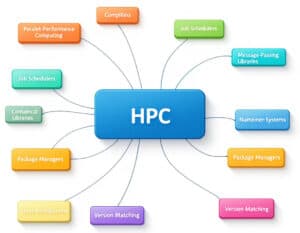
14. HPC, parallel programming and compilers
High-performance computing software lets a simulation use hundreds or thousands of cores. It includes job schedulers, message-passing libraries, compilers, numerical libraries, container systems and package managers. Users rarely see these tools, yet every performance problem and every reproducibility failure traces back to them. Linux is not merely permitted here, it is the assumption. Supercomputer centers run Linux distributions, and vendors build their solvers against particular compiler and library versions.
The practical skill is matching versions, which is why module systems and Spack exist.
Our view (more as a tip): in this domain, if you are not also on Linux … you are not likely on this domain.
|
Slurm Slurm is a free, open-source workload manager for compute clusters. It allocates nodes, queues jobs, enforces priorities and limits, runs job arrays and records accounting data, with users submitting batch scripts that request cores, memory and time. Cluster administrators and researchers who run simulations use it. It is known for running the batch systems of many large supercomputing centers. The name once stood for Simple Linux Utility for Resource Management. Lawrence Livermore National Laboratory started it in 2002, and SchedMD later took over development. The Leibniz Supercomputing Centre uses Slurm for its Linux clusters and for SuperMUC-NG. Feature particularities
Linux requirements: No distribution requirement. Needs matching versions on all nodes and shared configuration. Linux alternative to Microsoft HPC Pack, or IBM Spectrum LSF. |
Open MPI Open MPI is a free, open-source implementation of the Message Passing Interface standard for programs that run across many processes and nodes. It supports many network fabrics, process launchers and schedulers, and several commercial solvers support it as an option. Lumerical, for example, documents running simulations with Open MPI or Intel MPI. HPC developers and cluster operators use it. It is known for merging four earlier projects, FT-MPI, LA-MPI, LAM/MPI and PACX-MPI, in 2004. It runs on Linux. Feature particularities
Linux requirements: No requirement. Match versions with solvers that bundle their own. Linux alternative to Microsoft MPI or Intel MPI on Windows. |
|
Spack Spack is a free, open-source package manager for HPC. It builds scientific software from source with many versions and variants side by side, and recipes describe compilers, MPI libraries and dependencies. Cluster administrators and research software engineers use it to keep reproducible environments across machines. It is known for the concept of specs, which describe a build in one line. Todd Gamblin started it at Lawrence Livermore National Laboratory in 2013. It runs on Linux and macOS. Feature particularities
Linux requirements: Needs Python and a compiler. No distribution requirement. Linux alternative to vcpkg or Conda on Windows. |
Apptainer Apptainer is a free, open-source container system designed for shared HPC systems. It runs images without giving users root access on the host, packages an application and its libraries into a single file that moves between machines, and integrates with MPI and GPUs. Researchers and cluster operators use it to run the same software on laptops and supercomputers. It is known for its Singularity heritage. Gregory Kurtzer created Singularity at Lawrence Berkeley National Laboratory in 2015, and the project joined the Linux Foundation as Apptainer in 2021. It runs on Linux. Feature particularities
Linux requirements: Rootless use needs unprivileged user namespaces, with kernel 3.8 as the minimum and 4.18 or later recommended. Full functionality also needs FUSE and OverlayFS support. Setuid mode is the alternative, and it needs fuse3 libraries 3.3.0 or newer on Enterprise Linux. Distributions package it as apptainer and apptainer-suid. Linux alternative to Docker Desktop, or Podman Desktop. |
|
GCC The GNU Compiler Collection is a free, open-source compiler suite for C, C++, Fortran and other languages. It performs optimization, supports OpenMP and many processor architectures, and provides the default toolchain of most Linux distributions. Scientific programmers rely on it for Fortran, C++ and C codes, from legacy simulation programs to new libraries. It is known for being the foundation of the free software toolchain. Richard Stallman released the first version in 1987. Default versions differ across releases, for instance GCC 16 on Fedora 44, and vendors list compiler requirements, so check them. It runs on Linux. Feature particularities
Linux requirements: No requirement. Vendors specify supported versions. Linux alternative to Microsoft Visual C++, or the antique Intel Fortran on Windows. |
LLVM and Clang LLVM is a free, open-source compiler infrastructure, and Clang is its front end for C, C++ and related languages. They offer fast compilation, clear diagnostics, static analysis, sanitizers that detect memory errors and undefined behavior, and a framework used by many language and GPU toolchains. Scientific software developers and tool builders use them. It is known for its modular design. Chris Lattner started LLVM at the University of Illinois at Urbana-Champaign around 2000, and Clang followed later. NVIDIA lists Clang among the supported host compilers for CUDA. It runs on Linux. Feature particularities
Linux requirements: No requirement. Linux alternative to Microsoft Visual C++, or some of the Intel oneAPI compilers on Windows. |
|
PETSc PETSc, the Portable, Extensible Toolkit for Scientific Computation, is a free, open-source library from Argonne National Laboratory. It provides parallel solvers for linear and nonlinear systems, time integrators, optimization and mesh data structures, working on MPI and on GPUs. Developers of finite element, CFD and geophysics codes build on it, and researchers use it to test solver strategies. It is known for solver options that can be chosen at run time. Work began in the early 1990s at Argonne. It runs on Linux clusters. Feature particularities
Linux requirements: Needs MPI, BLAS, LAPACK and compilers. No distribution requirement. Linux alternative to Intel oneMKL solvers, or MATLAB sparse solvers. |
NVIDIA CUDA Toolkit The CUDA Toolkit is the NVIDIA development environment for GPU computing. It contains the nvcc compiler, a runtime, math libraries such as cuBLAS and cuFFT, profilers and debuggers. Developers of simulation codes, machine learning frameworks and signal processing software use it, and many commercial solvers use it for GPU acceleration. It is known for making general-purpose GPU computing mainstream. NVIDIA introduced CUDA in 2006 and 2007. The toolkit is free of charge but proprietary. Official Linux support covers RHEL 8 to 10, Ubuntu LTS, Debian, SLES and Fedora, and since CUDA 13.2 in March 2026 it covers RHEL rebuilds such as AlmaLinux. Feature particularities
Linux requirements: RHEL 8 to 10, Ubuntu 22.04, 24.04 and 26.04, Debian 12 and 13, SLES 15 and 16, Fedora 44, and RHEL rebuilds since CUDA 13.2. NVIDIA names kernel and GCC versions per distribution. Linux alternative to DirectCompute, OpenCL or various toolkits on Windows. |
15. Data science and machine learning
Data science and machine learning tools turn measurements into models. They clean data, fit statistical or neural models and test them. In engineering, typical uses are surrogate models of costly simulations, anomaly detection on sensor streams and image analysis in test labs. The field settled on Python and a handful of libraries, so environments look alike on a laptop and a server. Linux brings two strengths: GPU drivers and CUDA are documented for many distributions, and package managers such as conda can rebuild an environment exactly. The main hazard is dependency drift between a notebook and a production run.
Our view: as in the previous section, Linux is a must in this domain.
|
Python with NumPy and SciPy Python is a general-purpose language, and NumPy and SciPy turn it into a scientific computing platform. NumPy provides fast multidimensional arrays and linear algebra, and SciPy adds optimization, integration, interpolation, signal processing, sparse matrices and statistics. Engineers and scientists in almost every field use them as the base for data analysis, simulation scripts and plotting with Matplotlib. They are known for the large collection of libraries built around them. Guido van Rossum released Python in 1991, SciPy started around 2001, and Travis Oliphant created NumPy in 2006. Conda or virtual environments keep package versions reproducible between workstation and cluster. All of it runs natively on Linux, and all of it is free. Feature particularities
Linux requirements: No requirement. Linux alternative to MATLAB, OriginPro, or even Microsoft Excel. |
JupyterLab JupyterLab is a free, open-source, browser-based environment for notebooks, text editors and terminals. A notebook mixes code, results, plots and explanatory text, and it supports Python, Julia, R and other languages through kernels. Scientists and engineers use it for exploration, teaching and sharing analysis. It grew from IPython, started by Fernando Pérez in 2001, through Project Jupyter in 2014, and the JupyterLab interface reached a stable release in 2018. On Linux it often runs on a server or cluster node and is reached through a tunnel, which keeps the analysis next to the data. Long production runs belong in scripts, not notebooks. Feature particularities
Linux requirements: No requirement. Remote use needs SSH tunneling or a hub. Linux alternative to MATLAB Live Editor or Mathematica notebooks. |
|
PyTorch PyTorch is a free, open-source machine learning framework with tensors, automatic differentiation, neural network modules and GPU acceleration. Scientists use it for surrogate models, physics-informed networks and image analysis, and engineers use it for learning-based control and signal processing. It is known for its define-by-run style, which makes models easy to debug. Meta’s AI research group released it in 2016 and 2017, based on the earlier Torch library, and it moved to the PyTorch Foundation under the Linux Foundation in 2022. GPU training relies on the NVIDIA CUDA stack, which NVIDIA documents for many Linux distributions. Feature particularities
Linux requirements: GPU use depends on NVIDIA drivers and CUDA versions. No distribution requirement for CPU use. Linux alternative to MATLAB Deep Learning Toolbox, or Windows ML. |
scikit-learn scikit-learn is a free, open-source Python library for classical machine learning. It offers regression, classification, clustering, dimensionality reduction, model selection and preprocessing, in a consistent interface with pipelines. Engineers and scientists use it on sensor data, test results and process monitoring, where small and explainable models are often better than deep networks. It is known for its documentation and its uniform design. David Cournapeau began it in 2007 as a Google Summer of Code project, and a team at INRIA published the first public release in 2010. It runs natively on Linux. Feature particularities
Linux requirements: No requirement. Linux alternative to Minitab, JMP, or IBM SPSS Modeler. |
16. Research workflow and reproducibility
Research workflow tools compute nothing themselves. They record what was done, with which files, versions and parameters, so that a colleague, or the same person a year later, can repeat it. Version control, document preparation and workflow engines form the core of the chapter. Reproducibility is the unifying idea, and it matters in regulated engineering as much as in academic science. Linux is the home of these tools. Git was written for the kernel project, TeX Live installs through any package manager, and workflow engines hand steps to schedulers such as Slurm. Their requirements are small, and the discipline they demand is not.
Our view: the ones above are a must, but offer in this domain is limited anyway or not very specialized.
 |
Git Git is a free, open-source distributed version control system. It records every change to code, input decks, scripts and documents, supports branches and tags, and lets many people work on the same files. Engineers and scientists use it to track solver inputs and analysis scripts, which gives each result a traceable origin. It is known for its speed and for hosting the Linux kernel. Linus Torvalds wrote it in April 2005, after the kernel project lost access to the BitKeeper tool. Git comes from the Linux world, and every main distribution packages it. Feature particularities
Linux requirements: No requirement. Linux alternative to TortoiseSVN, and Team Foundation Version Control. |
|
TeX Live TeX Live is a free, open-source distribution of the TeX typesetting system, with LaTeX, BibTeX and Biber, fonts and thousands of packages. It produces high-quality documents with equations, cross-references, bibliographies and figures. Scientists and engineers use it for papers, theses, reports and specifications. It is known for the quality of its mathematical typesetting. Donald Knuth created TeX in 1978, Leslie Lamport built LaTeX in the early 1980s, and TeX user groups have maintained TeX Live since the late 1990s. Every main Linux distribution offers it through its package manager. Feature particularities
Linux requirements: No requirement. A full installation is large. Linux alternative to Microsoft Word with its equation editor, MiKTeX, or Scientific WorkPlace. |
Snakemake Snakemake is a free, open-source workflow management system. You write rules that describe how output files come from input files, and Snakemake works out which steps to run, runs independent ones in parallel and can submit them to a scheduler such as Slurm or to the cloud. Bioinformaticians, climate scientists and engineers use it to make multi-step analyses repeatable. It is known for its Python-based syntax and its support for conda and containers. Johannes Köster began it around 2012. It runs on Linux. Feature particularities
Linux requirements: Needs Python. No distribution requirement. Linux alternative to Alteryx Designer or KNIME. |
Bonus: our tips for choosing
- Start from the vendor support list. For commercial tools, find the exact distribution and minor release the vendor names, then pick the operating system that fits the whole set.
- Favor tools that run in batch mode. A solver that starts from a command line and a text input file can be queued, repeated and audited.
- Validate on a known case. Rerun one archived study and compare results against your tolerance before you trust a new combination of tools.
- Mix open and commercial tools. Gmsh with CalculiX, or SALOME with Code_Aster, shows that a free chain can cover a full study and that a commercial solver can sit in the middle of an open one.
- Plan the license side. Commercial packages need a license server and, for some, specific components that may be missing on Linux. Check exclusions such as those listed for HFSS and CST before you commit.

Conclusion on the best Linux software for engineers and scientists
The best Linux software for engineers and scientists is not one product. It is a toolchain. A numerical environment, a CAD or EDA tool, a solver, a visualizer, a scheduler and a way to record the work together cover most projects, and Linux hosts every one of them.
Use the 16 chapters to build your own chain. Start with the vendor support lists, test on a known case and keep every run scripted. Linux software for scientists and Linux CAD and EDA software are mature enough to support production work in 2026, with a few clear exceptions that each entry flags.
FAQ
How do I choose a distribution and a minor release for commercial solvers on Linux?
Start from the vendor matrix, not from preference, and pick the largest set of releases that all your vendors list. Ansys 2026 R1 names RHEL 8.8, 8.10, 9.4 and 9.6 and Rocky Linux 8.10, 9.4 and 9.6, so freeze the minor version on solver nodes and update only after the vendor adds the next one. Rebuilds such as Rocky or AlmaLinux work in practice, but a vendor may decline a case it cannot reproduce on RHEL, so keep one subscribed RHEL machine for fault reproduction.
How should I handle licensing and installation on Linux?
Treat the license server as a separate system and plan its installation before the solver. Ansys requires several releases to be installed in chronological order, or licensing can fail for all of them. Some installers need root access, as Lumerical does by default, and Maple activation may need the lsb package. Academic codes add legal conditions: VASP is licensed per research group, NAMD and ORCA are free for academic or non-commercial use only, and Gaussian bars use by anyone competing with the vendor.
What matters for GPU computing on Linux?
The driver, the kernel, the compiler and the toolkit must match as a set. NVIDIA names a validated kernel and GCC version per distribution, and the CUDA compiler rejects host compilers whose major version is outside its range, which matters on fast-moving systems such as Fedora 44 with GCC 16. Since CUDA 13.2, RHEL rebuilds such as AlmaLinux are officially supported. Check compute capability too, because MATLAB GPU functions and Gaussian GPU builds only accept specific cards.
How do I run these tools headless on servers and remote workstations?
Prefer batch modes and test the graphical side separately. Lumerical on a Linux system without a graphical session runs simulation files but not its script files, LS-DYNA is commonly driven from the command line, and ParaView and VisIt can render on cluster nodes through client-server modes. For remote OpenGL, CST advises VirtualGL or a similar solution, FLOW-3D does not recommend Mesa renderers, and Ubuntu 26.04 is Wayland only, so test remote display and screen capture before rollout.
How do I integrate commercial and open-source solvers with Slurm, MPI and containers?
Keep every node identical in operating system, MPI and library versions. CST requires homogeneous compute nodes, Calibre requires the same platform identifier on master and remote hosts, one documented center supports only Intel MPI for HFSS, and CONVERGE lists HPC-X, Intel MPI, MPICH or Open MPI. Environment modules or Spack keep several solver releases side by side. Apptainer needs unprivileged user namespaces, with kernel 4.18 or later recommended, or a setuid installation.
How do I make results reproducible across workstation, cluster and years?
Record the solver release, compiler, MPI, input files and license log with every run, and rebuild environments from definitions instead of by hand. Conda or virtual environments pin Python stacks, Spack describes compiler and library variants, and containers freeze the rest. Compiler versions differ by distribution, and some tools depend on them, since Dymola translates models with GCC and Synopsys names GCC 13.3 for its 2026 releases. Git and a workflow engine such as Snakemake tie each result to its inputs.
What do I do about tools that have no Linux build or a reduced one?
Map the exclusions before migrating and keep a defined fallback. Altium Designer and SolidWorks are Windows only, Siemens ended interactive NX on Linux, MATLAB lacks Data Acquisition Toolbox and Spreadsheet Link on Linux, and Ansys lists BladeGen and the Vista tools as unsupported. A common answer is a Windows seat for preparation and Linux for solving, as with a CST front end driving Linux solver servers. Virtual machines are not validated by Altium, and WSL does not replace a certified native install.
How do I plan for operating system lifecycles, security updates and hardware baselines?
Put every end-of-support date in the project calendar a year ahead. Fedora 43 ends on December 9, 2026, Ubuntu 26.04 LTS has standard maintenance to 2031, RHEL 10 maintenance runs to May 2035, and Debian 13 LTS ends on June 30, 2030. CentOS 7 and Scientific Linux 7 ended in June 2024 and forced labs to migrate. Check processors as well, since RHEL 10 dropped x86-64-v2, Synopsys and Calibre builds need AVX2, and MATLAB announced a future AVX2 requirement.