Product Design, Manufacturing & Innovation Resources
Home » Euler-Bernoulli Beam Theory

Euler-Bernoulli Beam Theory

1750
  • Leonhard Euler
  • Jacob Bernoulli
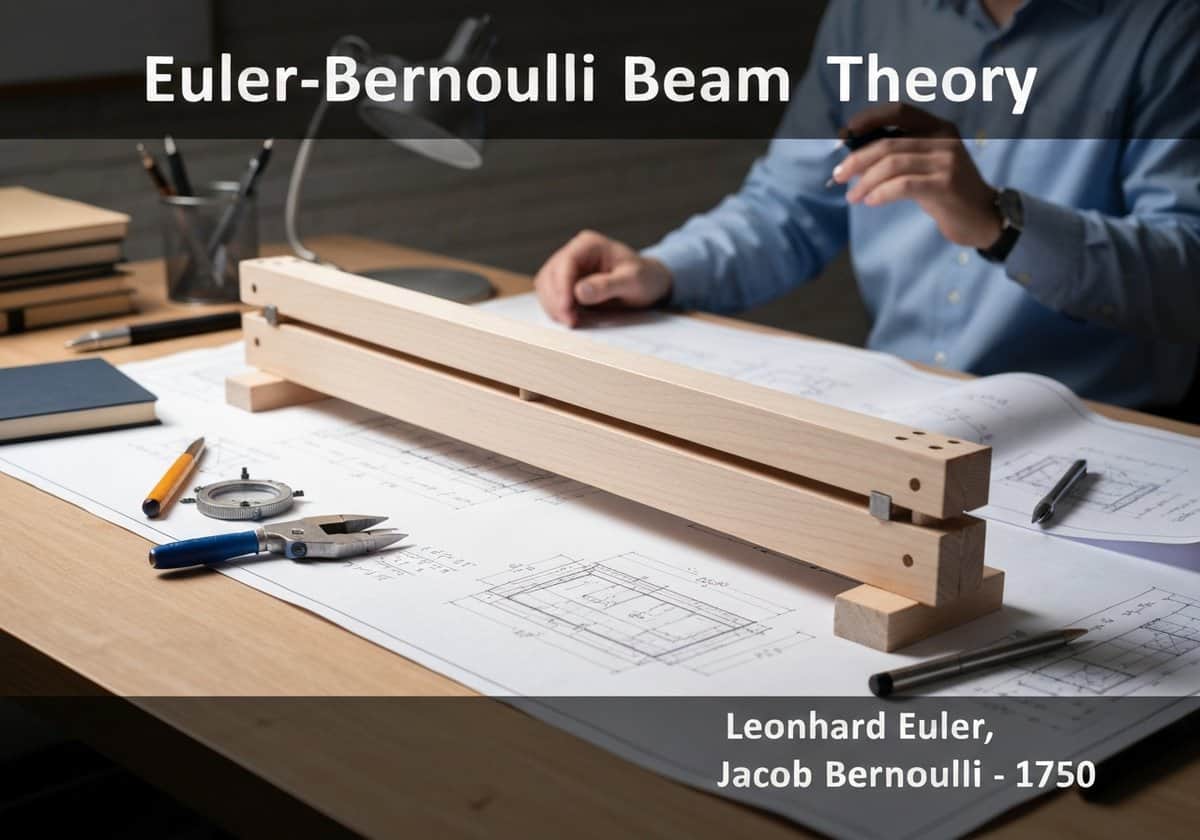
Wooden beam model and engineering tools illustrating Euler-Bernoulli Beam Theory in mechanical engineering.

(generated image for illustration only)

A fundamental theory in structural analysis for determining the stress and deflection of beams under load. It assumes that plane sections, initially perpendicular to the beam’s axis, remain plane and perpendicular to the neutral axis after bending. This simplification is highly accurate for slender beams where the effects of shear deformation and rotational inertia are negligible compared to bending effects.


The Euler-Bernoulli beam theory, also known as classical beam theory, is a cornerstone of mechanics of materials and structural engineering. Its primary assumption—that plane sections remain plane—leads to a linear strain distribution through the beam’s depth. Combined with Hooke’s Law for linear elastic materials, this results in a linear stress distribution, with zero stress at the neutral axis and maximum tensile and compressive stresses at the outer fibers.

This theory gives rise to the governing differential equation of the elastic curve: \(EI \frac{d^2w}{dx^2} = M(x)\), where \(E\) is the modulus of elasticity, \(I\) is the second moment of area of the cross-section, \(w\) is the vertical deflection, and \(M(x)\) is the internal bending moment as a function of position \(x\) along the beam. By integrating this equation with respect to the applied loads and boundary conditions, one can determine the beam’s slope and deflection at any point. While it has limitations for deep or short beams, its simplicity and accuracy for a vast range of common engineering problems make it an indispensable analytical tool.

UNESCO Nomenclature: 3313
– Mechanical engineering

Type

Abstract System

Disruption

Substantial

Usage

Widespread Use

Precursors

  • Galileo’s work on the strength of cantilever beams
  • Hooke’s law of elasticity
  • Newton’s laws of motion and calculus
  • Jacob Bernoulli’s work on the elastica curve

Applications

  • preliminary design of beams in buildings and bridges
  • analysis of aircraft wings (as a first approximation)
  • design of mechanical components like shafts and levers
  • basis for more advanced beam theories (e.g., timoshenko beam theory)
  • educational tool for teaching mechanics of materials

Patents:

NA

Potential Innovations Ideas

Due to scrapping bot traffic, currently more than 40k per day, this content is reserved to community members.
> Login < or > Register < (100% free) to access this, so as all other restricted content and tools.

Related to: Euler-Bernoulli beam theory, beam theory, mechanics of materials, structural mechanics, deflection, bending, stress, elasticity, civil engineering, mechanical engineering.

Historical Context

Euler-Bernoulli Beam Theory

-250
-500
1750
1788
1834
1850
1850
1850
-500
1700
1761
1807-01-01
1850
1850
1850

(if date is unknown or not relevant, e.g. "fluid mechanics", a rounded estimation of its notable emergence is provided)

Full size images and downloads are only available, 100% free, for registered members.

> Login <