Product Design, Manufacturing & Innovation Resources
Lar » Passivação

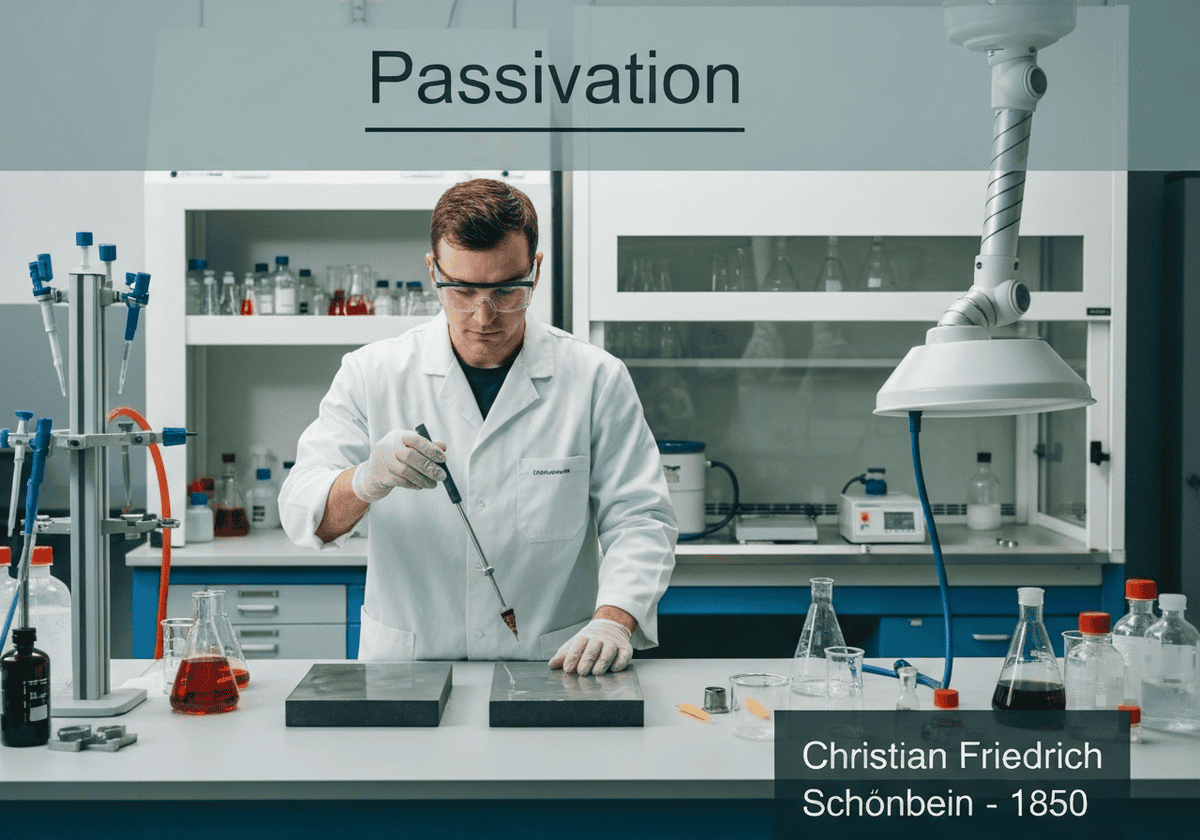
Passivação

1850
  • Christian Friedrich Schönbein
Cientista de materiais realizando passivação em amostras de aço inoxidável em um laboratório.

(Imagem gerada apenas para fins ilustrativos)

Passivation is the process by which a material becomes ‘passive,’ meaning it is less affected by environmental factors such as corrosion. It involves the spontaneous formation of a very thin, non-reactive surface film that acts as a barrier, shielding the bulk material from further attack. This film is typically an oxide or nitride layer, a few nanometers thick.

The mechanism of passivation is electrochemical. When a reactive metal like chromium, aluminum, or titanium is exposed to an oxidizing environment (like air or certain acids), its surface rapidly oxidizes. If the resulting metal oxide is stable, dense, non-porous, and well-adhered to the metal surface, it forms a protective passive layer. This layer is extremely thin, often only 1-3 nanometers, but it is sufficient to dramatically slow down the rate of corrosion by preventing direct contact between the metal and the corrosive environment.

The stability of this passive filme is dependent on the environment, particularly pH and the presence of certain ions like chlorides. For example, the chromium oxide ([latex]Cr_2O_3[/latex]) layer on stainless steel is highly effective in many environments but can be locally broken down by chloride ions, leading to corrosão por pite. The breakdown and reformation of this passive layer is a dynamic process. If the film is mechanically scratched or damaged, the exposed metal will often repassivate almost instantly, a property known as self-healing.

A passivação pode ser um processo natural ou pode ser aprimorada artificialmente por meio de tratamentos químicos, como a imersão do aço inoxidável em ácido nítrico ou cítrico para remover o ferro livre da superfície e estimular a formação de uma camada de óxido rica em cromo mais robusta. Esse processo é distinto da aplicação de um revestimento. revestimento, visto que a camada passiva é formada a partir do próprio metal base.

UNESCO Nomenclature: 3314
Ciência dos materiais

Tipo

Processo Químico

Interrupção

Fundamentais

Uso

Uso generalizado

Precursores

  • Descoberta de metais reativos como o cromo e o alumínio.
  • Early observations of metals resisting corrosão in specific acids
  • Desenvolvimento de teorias eletroquímicas

Aplicações

Patentes:

NA

Ideias de Inovação Potencial

  • self-healing passive layers incorporating microcapsules of oxidizing agents
  • nanostructured passive films with enhanced resistance to chloride pitting
  • bioactive passive layers on medical implants that promote bone integration
  • photo-catalytic passive films (e.g., tio2) for self-cleaning surfaces
  • smart coatings that can electrochemically induce passivation in response to damage
  • passivation techniques for high-entropy alloys in extreme environments
  • laser-based surface treatments to create highly stable and thick passive layers
  • passivation of metallic components in next-generation batteries to extend cycle life
Related to: passivation, passive film, corrosion resistance, stainless steel, chromium oxide, titânio, anodizing, surface science.

Contexto histórico

Passivação

1700
1761
1807-01-01
1850
1850
1850
1850
-500
1750
1788
1834
1850
1850
1850
1850

(Caso a data seja desconhecida ou irrelevante, por exemplo, "mecânica dos fluidos", é fornecida uma estimativa aproximada de seu surgimento notável)

10º ano aniversário

Imagens em tamanho real e downloads estão disponíveis apenas, 100% gratuitos, para membros registrados.