Product Design, Manufacturing & Innovation Resources
Home » Latent Heat Thermal Energy Storage (LHTES)

Latent Heat Thermal Energy Storage (LHTES)

1761
  • Joseph Black
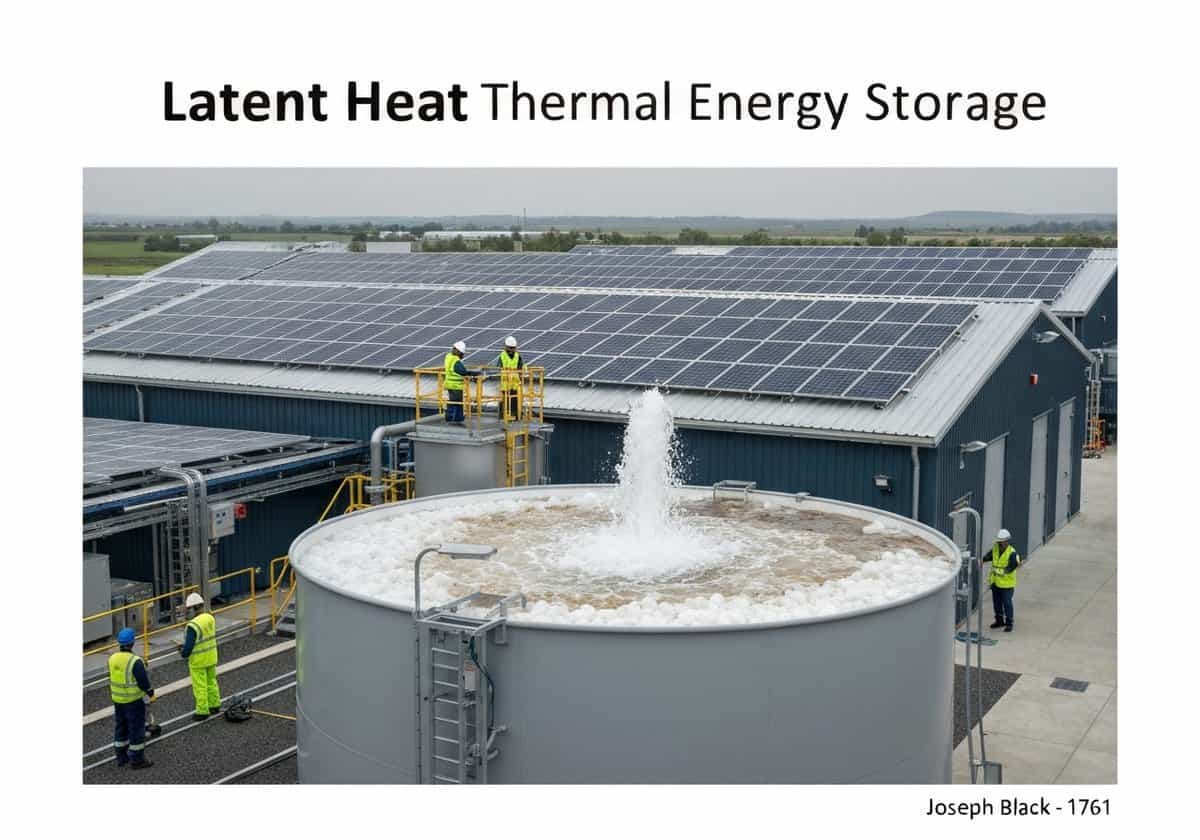
Thermal energy storage facility utilizing phase change materials for energy regulation.

(generated image for illustration only)

Latent heat thermal energy storage (LHTES) systems store thermal energy by utilizing the phase change of a material (PCM), such as melting from solid to liquid. Energy is stored at a nearly constant temperature during the phase transition. The amount of energy stored is the heat of fusion. This method offers a much higher energy storage density than sensible heat storage.

LHTES leverages the principle that a substance absorbs or releases a large amount of energy, known as latent heat (e.g., heat of fusion or vaporization), when it changes its physical state. This process occurs at a constant temperature. The total heat stored (\(Q\)) in a PCM includes both sensible heat and latent heat: \(Q = int_{T_i}^{T_m} m C_p dT + m Delta H_m + int_{T_m}^{T_f} m C_p dT\), where \(m\) is the mass, \(C_p\) is the specific heat capacity, \(Delta H_m\) is the latent heat of fusion, and \(T_m\) is the melting temperature. The key advantage is the high energy density within a small temperature range around the phase transition point. Materials used as PCMs include paraffin waxes, salt hydrates, and fatty acids. The choice of PCM depends on the target operating temperature. For example, molten salts are used in concentrated solar power (CSP) plants for high-temperature storage, while paraffin-based PCMs are used in building materials for passive heating and cooling. Challenges in LHTES include the low thermal conductivity of many PCMs, which can limit charging and discharging rates, and issues with volume change and long-term stability.

UNESCO Nomenclature: 3322
– Thermodynamics

Type

Chemical Process

Disruption

Substantial

Usage

Widespread Use

Precursors

  • Joseph Black’s discovery of latent heat and specific heat
  • the laws of thermodynamics
  • understanding of phase transitions in materials
  • development of materials science for creating and characterizing PCMs

Applications

  • solar thermal power plants
  • temperature regulation in buildings (e.g., phase change wallboards)
  • thermal management of electronics
  • cold storage for food transport and air conditioning
  • temperature-stabilized textiles

Patents:

NA

Potential Innovations Ideas

  • microencapsulation of pcms to contain them and increase heat transfer surface area
  • composite pcms with graphite or metal foams to enhance thermal conductivity
  • shape-stabilized pcms that retain their form even in the liquid phase
  • multi-phase-change materials for storage over a wider temperature range
  • integration of pcms into concrete for thermally massive buildings
  • pcm slurries for heat transfer fluids
  • pcm-based thermal batteries for electric vehicles to manage cabin and battery temperature
  • smart textiles with embedded pcm microcapsules for personal thermal comfort
  • cryogenic energy storage using liquid air/nitrogen as a pcm
  • thermochemical storage systems as a more advanced alternative
Related to: latent heat, thermal energy storage, phase change material, PCM, heat of fusion, thermodynamics, solar thermal, molten salt, energy density, constant temperature.

Historical Context

Latent Heat Thermal Energy Storage (LHTES)

-500
1700
1761
1807-01-01
1850
1850
1850
-250
-500
1750
1788
1834
1850
1850
1850

(if date is unknown or not relevant, e.g. "fluid mechanics", a rounded estimation of its notable emergence is provided)

10th year anniversary

Full size images and downloads are only available, 100% free, for registered members.

> Login <