Vapor-Compression Refrigeration Cycle
1834
- Oliver Evans
- Jacob Perkins
- Alexander Twining
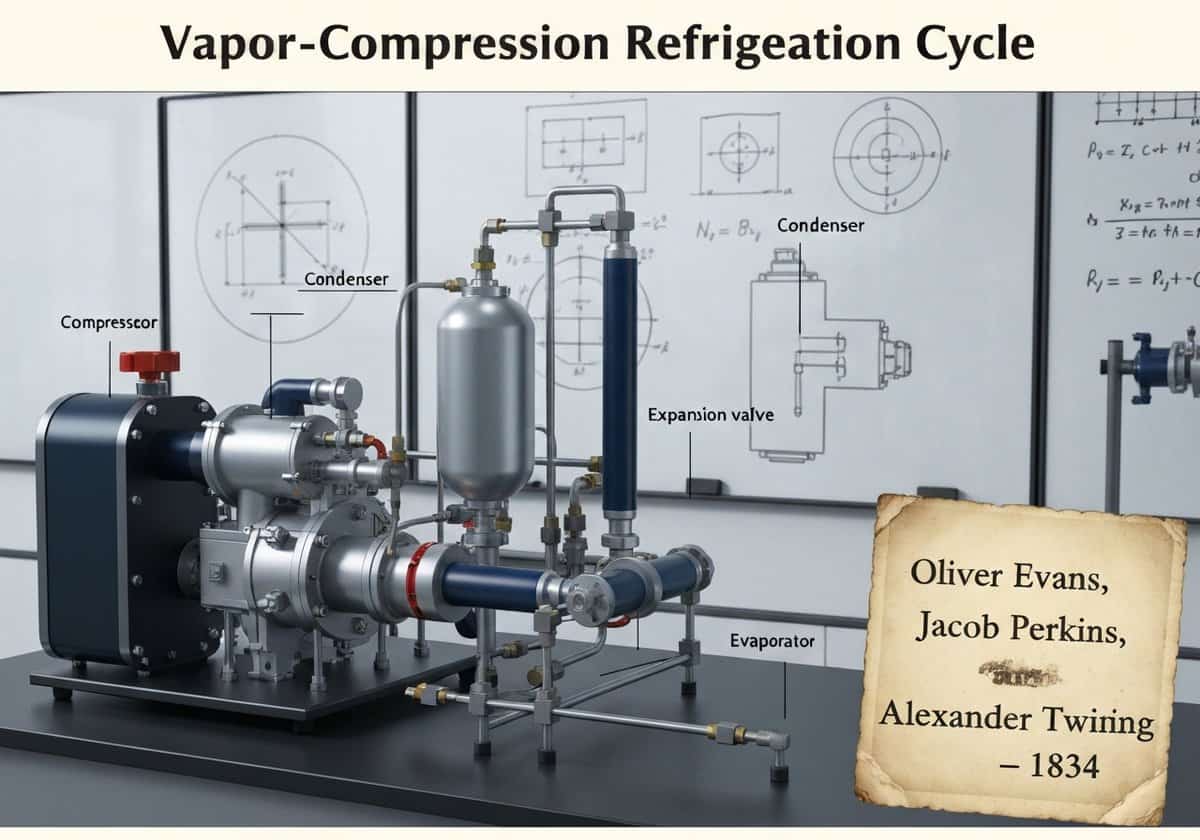
The vapor-compression cycle is the thermodynamic process used by most heat pumps. It involves four stages: compression of a refrigerant vapor, condensation to a high-pressure liquid while releasing heat, expansion through a valve to a low-pressure liquid/vapor mix, and evaporation to a low-pressure vapor while absorbing heat. This cycle effectively moves thermal energy against its natural direction of flow.
The vapor-compression cycle is the cornerstone of modern refrigeration and heat pump technology. It leverages the physical principle of latent heat of vaporization, where a substance absorbs or releases a large amount of energy as it changes phase between liquid and gas. The cycle uses a volatile fluid called a refrigerant.
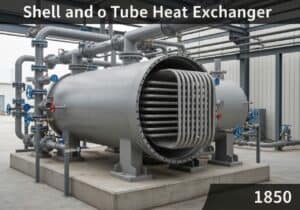
The process begins at the compressor, which takes in low-pressure, low-temperature refrigerant vapor and compresses it into a high-pressure, high-temperature superheated vapor. This requires a significant input of mechanical work. Next, the hot vapor flows into the condenser, a heat exchanger where it releases heat to the warmer environment (e.g., outside air in summer) and condenses into a high-pressure liquid. The third stage is the expansion valve (or a capillary tube), where the high-pressure liquid undergoes a rapid pressure drop, causing a process called flashing. This results in a low-pressure, low-temperature mixture of liquid and vapor. Finally, this cold mixture enters the evaporator, another heat exchanger, where it absorbs heat from the colder environment (e.g., indoor air in summer), causing the remaining liquid to boil into a vapor. This low-pressure vapor then returns to the compressor, and the cycle repeats. By reversing the roles of the condenser and evaporator, the system can provide heating instead of cooling.
UNESCO Nomenclature: 3322
– Mechanical engineering
Precursors
- understanding of latent heat by Joseph Black
- Boyle’s law and Charles’s law describing gas behavior
- development of early mechanical compressors for industrial processes
- discovery that volatile fluids like ether cause cooling upon rapid evaporation
Applications
- domestic refrigerators and freezers
- air conditioning systems for buildings and vehicles
- industrial-scale refrigeration for food processing and chemical plants
- cryogenics for liquefaction of gases like nitrogen and oxygen
- chillers for large commercial hvac systems
Patents:
- GB Patent 6662 (Jacob Perkins, 1834)
Potential Innovations Ideas
Due to scrapping bot traffic, currently more than 40k per day, this content is reserved to community members.
> Login < or > Register < (100% free) to access this, so as all other restricted content and tools.
Related to: vapor-compression, refrigeration cycle, refrigerant, compressor, condenser, expansion valve, evaporator, thermodynamics, phase change, heat transfer.