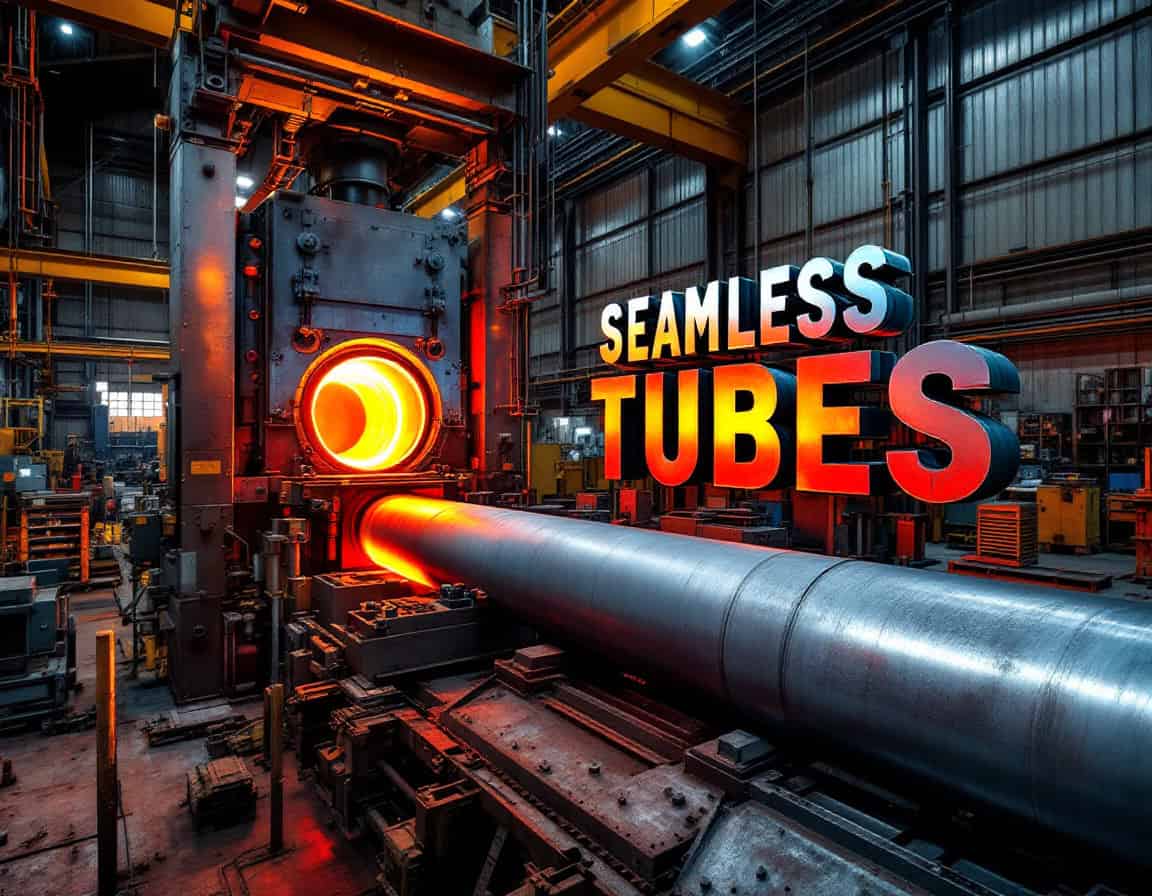
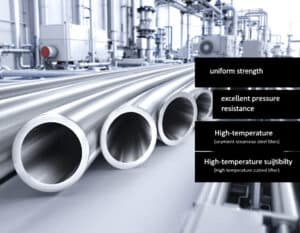
Seamless steel tubes are hollow sections formed from a solid billet that is pierced and rolled, so no weld seam exists along their length. The wall is uniform around the circumference. That gives predictable strength, high pressure resistance and stable behavior at elevated temperature. Oil and gas, power generation and heavy machinery rely on them for this reason.
Seamless Tubes Manufacturing Process
The process starts with solid round billets. They are heated in a furnace to about 1,200°C, where the steel is soft enough to deform but still solid. Piercing follows, most often by the Mannesmann process. The billet is driven between two angled, rotating rolls that advance it over a stationary piercing plug. The plug opens a central bore along the full length and leaves a thick-walled hollow shell. No sheet is bent and joined at any point, so the tube has no weld seam. This is why seamless product is specified for high-pressure pipelines, boilers and hydraulic systems.
The pierced shell is then elongated and thinned. In a mandrel mill or a pilger mill, rolls work the shell over an internal bar, which reduces the wall thickness and extends the length. A sizing or stretch-reducing mill brings the outside diameter to specification. Smaller, thinner or tighter-tolerance tubes are usually cold drawn. The hot-finished tube is pulled through a die at room temperature, with or without an internal mandrel. Cold drawing improves surface finish, dimensional tolerance and strength. Heat treatment follows to relieve stress and set the mechanical properties. After straightening and cutting to length, every tube is inspected. Ultrasonic and eddy-current testing detect internal and surface flaws before shipment.
Seamless Tubes Applications
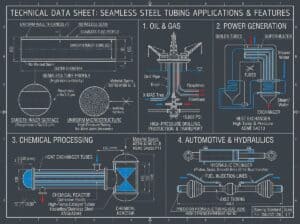
Seamless tube is specified where pressure, temperature or safety make a weld seam a risk.
- Oil and gas: casing, tubing and line pipe carry fluids at high pressure, often in corrosive downhole conditions.
- Power generation: boiler tubes, superheaters and heat exchangers handle high-temperature steam in thermal and nuclear plants.
- Chemical and petrochemical plants: process piping and reactors move aggressive media. Alloy and stainless grades are selected for corrosion resistance.
- Automotive and machinery: axles, drive shafts, bearing races and engine components need uniform wall thickness under cyclic loads.
- Hydraulics and pneumatics: cylinder barrels and high-pressure lines need a smooth, precise bore. Cold-drawn seamless tube provides it.
- Construction and structural use: bridges, offshore platforms and heavy scaffolding use tubes that carry high loads.
- Aerospace and defense: hydraulic lines, landing gear parts and gun barrels need high strength-to-weight ratios and consistent quality.
- Gas cylinders and pressure vessels: seamless construction removes the weld seam as a failure location in vessels holding compressed gas.
Reliability under pressure and consistent strength around the circumference usually decide the choice, while welded tube describes below costs less and suits lower-pressure and structural work.
Welded tube serves a different part of the market:
- electric resistance welded and high-frequency welded tube are used for structural hollow sections in buildings, scaffolding, fencing and handrails. Automotive exhaust systems, furniture frames and conveyor rollers also rely on it.
- large-diameter submerged-arc welded pipe is common in water and sewage mains and in long-distance oil and gas transmission lines. Fire sprinkler systems and HVAC piping use welded carbon steel tube, while sanitary stainless welded tube is standard in food, dairy and pharmaceutical plants.
In these applications the weld seam is acceptable, and lower cost per meter and a wider size range decide the choice.
External Links on Seamless Steel Tubes
International Standards
(hover the link to see our description of the content)