Product Design, Manufacturing & Innovation Resources
Home » Centrifugal Pump

Centrifugal Pump

1700
  • Denis Papin
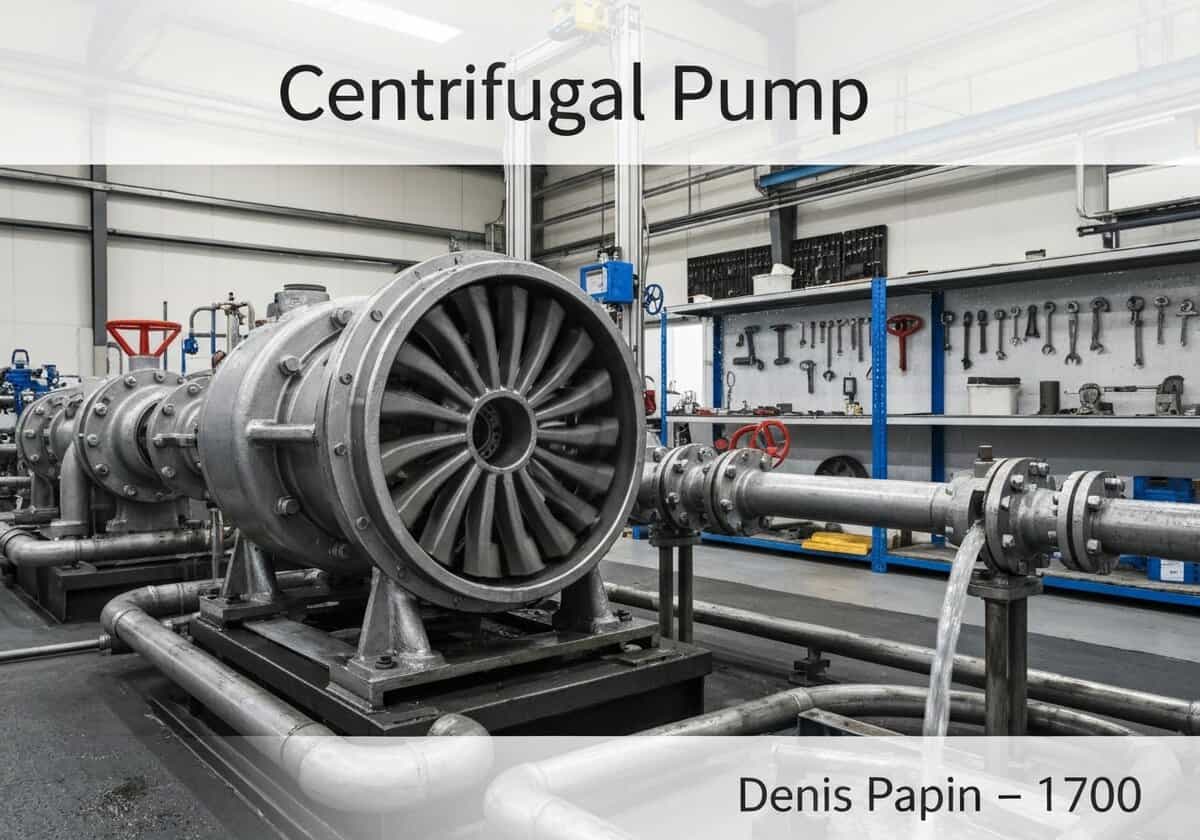
Centrifugal pump in industrial application for fluid dynamics and hydrodynamics.

(generated image for illustration only)

A centrifugal pump is a roto-dynamic pump that uses a rotating impeller to increase the pressure and flow rate of a fluid. Fluid enters the pump axially near the rotating axis, is accelerated by the impeller’s vanes, and flows radially outward into a diffuser or volute chamber. In this chamber, the fluid’s high kinetic energy is converted into high pressure energy.

The operation of a centrifugal pump is based on converting rotational energy from a motor into energy in a moving fluid. The two main components responsible for this are the impeller and the volute (or casing). The impeller is a rotor with a series of curved vanes. As it spins, it imparts a high velocity to the fluid, which is drawn in at the center (the ‘eye’ of the impeller) and thrown outward by centrifugal force. The fluid exiting the impeller has high kinetic energy.

The fluid then enters the volute, a specially designed spiral-shaped casing that surrounds the impeller. The volute’s cross-sectional area gradually increases along the fluid path. This increase in area causes the fluid to slow down. According to Bernoulli’s principle, as the fluid’s velocity decreases, its pressure must increase (assuming constant height). This conversion of kinetic energy to pressure energy is the primary function of the volute. The pressurized fluid is then discharged from the pump outlet.

Unlike positive displacement pumps, centrifugal pumps provide a smooth, non-pulsating flow. Their output flow rate varies significantly with the system’s back-pressure or head. They are highly efficient for pumping low-viscosity fluids like water and are capable of very high flow rates, making them the most common type of pump used globally for a vast range of applications.

UNESCO Nomenclature: 3308
– Fluid mechanics

Type

Physical Device

Disruption

Revolutionary

Usage

Widespread Use

Precursors

  • understanding of centrifugal force (Huygens’ work)
  • Bernoulli’s principle relating fluid velocity and pressure
  • advances in metallurgy for casting impellers and casings
  • development of rotating machinery and power sources like the steam engine

Applications

  • municipal water supply and distribution systems
  • industrial processing for chemicals, oil, and gas
  • building hvac systems for circulating hot and cold water
  • sewage and slurry pumping
  • fire-fighting equipment
  • automotive water pumps for engine cooling

Patents:

NA

Potential Innovations Ideas

  • self-priming centrifugal pumps with integrated air-water separation chambers
  • mag-drive sealless centrifugal pumps for leak-proof handling of corrosive chemicals
  • centrifugal pumps with smart monitoring systems predicting bearing failure
  • 3d-printed custom impellers optimized for specific fluid viscosities
  • multi-stage vertical centrifugal pumps for high-pressure, small-footprint applications like reverse osmosis
  • centrifugal pumps with variable frequency drives (vfds) for energy-efficient operation
  • slurry pumps with hardened, abrasion-resistant materials for mining
  • canned motor pumps for zero-emission applications in the nuclear industry
  • centrifugal pumps designed to mimic biological hearts for gentle blood circulation in medical devices
  • air-powered centrifugal pumps for use in explosive environments
Related to: centrifugal pump, roto-dynamic pump, impeller, volute, fluid dynamics, pressure head, kinetic energy, bernoulli’s principle, water supply, hydrodynamics.

Historical Context

Centrifugal Pump

-500
1700
1761
1807-01-01
1850
1850
1850
-250
-500
1750
1788
1834
1850
1850
1850

(if date is unknown or not relevant, e.g. "fluid mechanics", a rounded estimation of its notable emergence is provided)

10th year anniversary

Full size images and downloads are only available, 100% free, for registered members.

> Login <