Product Design, Manufacturing & Innovation Resources
Casa » Passivazione

Passivazione

1850
  • Christian Friedrich Schönbein
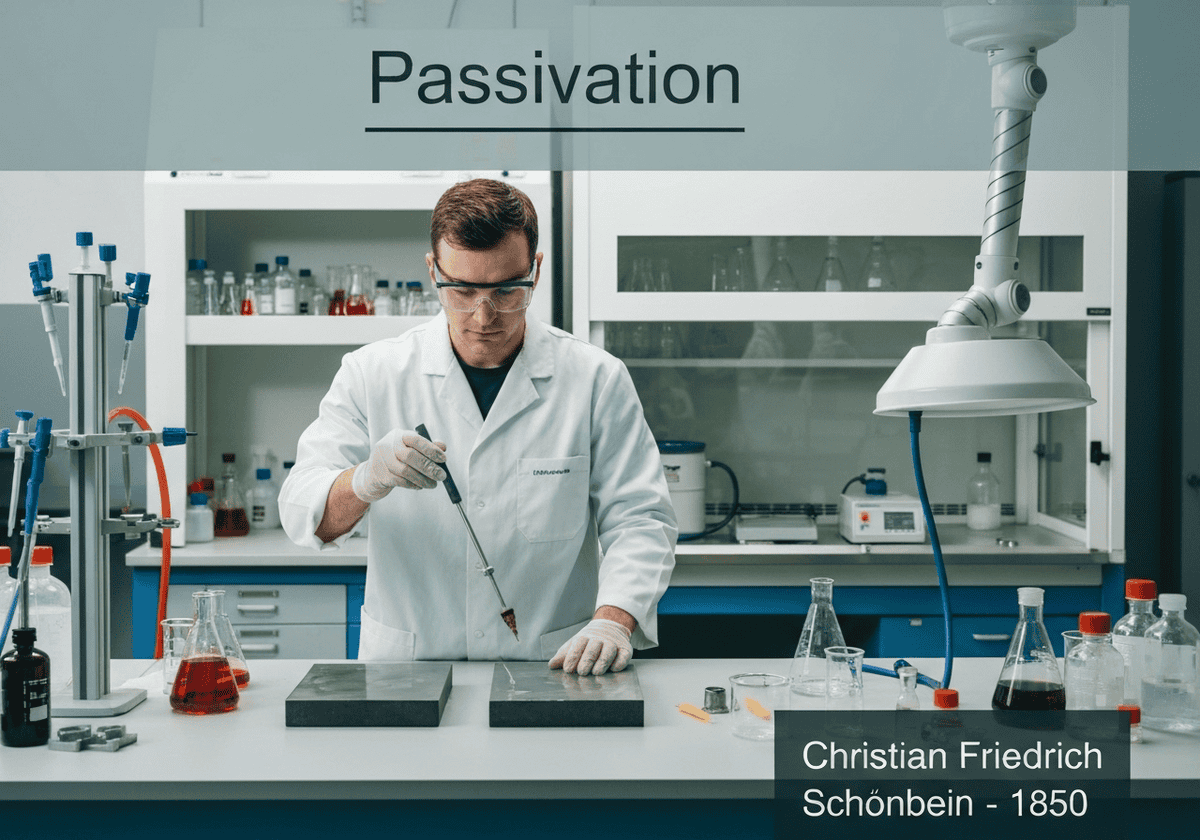
Scienziato dei materiali che esegue la passivazione su campioni di acciaio inossidabile in laboratorio.

(Immagine generata a solo scopo illustrativo)

Passivation is the process by which a material becomes ‘passive,’ meaning it is less affected by environmental factors such as corrosion. It involves the spontaneous formation of a very thin, non-reactive surface film that acts as a barrier, shielding the bulk material from further attack. This film is typically an oxide or nitride layer, a few nanometers thick.

The mechanism of passivation is electrochemical. When a reactive metal like chromium, aluminum, or titanium is exposed to an oxidizing environment (like air or certain acids), its surface rapidly oxidizes. If the resulting metal oxide is stable, dense, non-porous, and well-adhered to the metal surface, it forms a protective passive layer. This layer is extremely thin, often only 1-3 nanometers, but it is sufficient to dramatically slow down the rate of corrosion by preventing direct contact between the metal and the corrosive environment.

Mondo.innovazione

Passivation can be a natural process or can be enhanced artificially through chemical treatments, such as dipping stainless steel in nitric or citric acid to remove free iron from the surface and encourage the formation of a more robust chromium-rich oxide layer. This process is distinct from applying a coating, as the passive layer is formed from the base metal itself.

UNESCO Nomenclature: 3314
- Scienza dei materiali

Tipo

Processo chimico

Interruzione

Fondamento

Utilizzo

Uso diffuso

Precursori

  • Scoperta di metalli reattivi come il cromo e l'alluminio
  • Prime osservazioni di metalli resistenti alla corrosione in acidi specifici
  • Sviluppo delle teorie elettrochimiche

Applicazioni

  • stainless steel’s corrosion resistance (chromium oxide layer)
  • titanium’s biocompatibility in medical implants (titanium dioxide layer)
  • anodizzazione dell'alluminio per protezione e colore
  • protezione dei wafer di silicio nella microelettronica

Brevetti:

NA

Idee e potenziali innovazioni

A causa dell'eliminazione del traffico generato dai bot, che attualmente supera i 40.000 al giorno, questo contenuto è riservato ai membri della community.
> Accedi O > Registrati L'accesso a questo contenuto, così come a tutti gli altri contenuti e strumenti riservati, è (100% gratuito).

Related to: passivation, passive film, corrosion resistance, stainless steel, chromium oxide, titanium, anodizing, surface science.

Contesto storico

Passivazione

1700
1761
1807-01-01
1850
1850
1850
1850
-500
1750
1788
1834
1850
1850
1850
1850

(se la data è sconosciuta o non rilevante, ad esempio "meccanica dei fluidi", viene fornita una stima approssimativa della sua notevole comparsa)

Le immagini a grandezza naturale e i download sono disponibili, 100% gratuitamente, solo per i membri registrati.

> Login <