
In every Lean and Kaizen method, from the Toyota Production System to Lean Six Sigma, tools such as A3 and DMAIC are the easy part. The hard part is the set of human conditions that decides whether they produce results or only the look of improvement.
A must for any team manager and Black Belt practitioners, for efficient people (and companies and products just after, as a free consequence).
Scenario: picture two plants that run the same daily performance meeting at the same visual board. The layout matches. The metrics match. Even the marker colors match, because both plants copied the format from the same benchmark visit, ie a derivative of the famous Toyota system, or a cliché about it.
- At the first plant, a team leader points to a red cell and says, “This line stopped twice this shift and I do not know why yet.” Ten minutes later, a supervisor and a process engineer are standing at the machine.
- At the second plant, every cell is green. The red items appear on Friday, after someone has built an explanation that will not trouble anybody.
Same tool, opposite outcomes. The difference has little to do with the board and a great deal to do with what people do around it. This article follows that difference step by step. It starts with why tools travel and behaviors do not, then maps the behavior each common tool silently requires. It continues with the seven capabilities at the core of the system, the conditions that allow them to exist, the role of managers, and the time scale involved. It ends with a way to measure where your own organization stands, a realistic way to begin, and why the method itself is the easy part.
Why Tools Travel and Behaviors Do Not
A Kanban card fits in an email. An A3 template fits on a shared drive. A delegation on a benchmark visit can photograph every wall of a factory in one afternoon. Tools share three properties that make them easy to copy: they are visible, they are discrete, and they can be bought, scheduled or assigned to an owner.
Behaviors have none of these properties. Nobody can photograph the way a supervisor reacts when a technician reports a defect he caused. Nobody can purchase it. It cannot be rolled out in a quarter either, because it depends on what each person has learned to expect from the others.
Organizations therefore copy what can be copied, and they measure what they copied. Boards installed. A3 reports closed. Employees trained in 5S. These indicators can rise steadily while results stay flat, and the gap is often read as an execution problem. The response is more training, more audits, more boards.
Spear and Bowen studied this question in their 1999 Harvard Business Review article on the Toyota Production System. They argued that Toyota’s visible practices rest on four unwritten rules. The rules govern how work is specified, how people connect, how production flows along specified paths and how improvement is made. Employees discover the rules by solving real problems, with supervisors acting as teachers who ask questions. The authors noted that observers tend to mistake the tools and practices they see for the system itself, and that managers adopt those practices without the rules behind them.
Every Tool Carries a Behavioral Requirement
Each Lean tool rests on an assumption about human behavior. When the assumption holds, the tool amplifies it. When it does not, the tool keeps its appearance and loses its function.
The table lists common tools, the behavior each one depends on, and what the hollow version looks like on the shop floor:
| Tool | Behavior it depends on | Hollow version |
|---|---|---|
| Visual management | Honest reporting of the real state | Green by default, red items explained away or concealed |
| A3 problem solving | Curiosity about causes, willingness to be wrong | A report written to justify a decision already made |
| Kanban | Trust between teams, shared priorities | A board used to monitor individual speed |
| Standard work | Co-ownership by the people who perform it | Standard imposed, bypassed in practice, updated by nobody |
| Andon | Authority to stop, with no penalty for stopping | Cord disabled, or pulled only by supervisors |
| Obeya or war room | Decisions made together at the right level | Reporting theater for senior visitors |
| Daily meeting | Safe escalation of problems | A round of status updates with no escalation |
| Kaizen suggestions | Visible follow-up and ownership of ideas | A suggestion box that never answers |
| Gemba walk | Leaders who ask and listen | A scheduled tour with a checklist |
Three rows from above deserve a closer look:
- The andon is the cleanest test. Pulling the cord stops a line that costs money every minute. It works only if the operator is certain that stopping will be treated as good judgment. If the last person who pulled it was asked to justify the downtime, the cord will stay untouched and the defect will travel downstream to a customer. The tool is intact. The signal is dead.
- The A3 follows a similar logic: a sound A3 states a problem, shows data, tests a hypothesis and records what was learned. The format also makes it easy to fill in backwards: choose the countermeasure first, then write the analysis that supports it. From the outside, the two documents look identical. Only the conversation around them reveals which one was real.
- Standard work shows a third variant. A standard that operators had no part in writing is received as an instruction. A standard that operators wrote and can challenge is received as the best known method, and every deviation becomes information. The sheet on the wall is the same. Its status in people’s minds is not.
The Core System: The Seven Capabilities
Behind the tools sits a system that can be described through seven capabilities. They are not independent. Each feeds the others, and removing one degrades the rest. They fall into three groups: seeing, thinking and relating.
Seeing: making reality available

#1 – See the real situation. A problem must be observable before it can be worked on. That requires a precise definition of normal, so that abnormal is obvious, and direct observation of the process instead of a report about it. Data collected at the source within minutes is worth more than a monthly summary compiled by a third party.
#2 – Anchor in the field. Go where the work happens, listen, and support. The principle is genchi genbutsu: go and see for yourself. A decision made in a meeting room rests on an abstraction of the work. A decision made at the machine rests on observation of it.
Thinking: turning observation into improvement

#3 – Solve at the root. Treating a symptom is quick, and the problem returns. Root cause work, whether five whys, fault trees or designed experiments, needs time, tolerance for not knowing and the discipline to test a hypothesis before declaring it true. A countermeasure is itself a hypothesis, with a prediction that can be checked.
#4 – Decide together. Decisions belong at the level where the information is best, after the people affected have been consulted. Nemawashi is the practice of preparing a decision through individual conversations before the formal meeting. It tends to be slower at the start and faster in execution, because objections have already come out. This capability sits at the center of the system. The other six either feed it or depend on it.
#5 – Learn continuously. What works is captured, standardized and then challenged. The standard becomes the baseline for the next experiment. Without this step, an improvement stays with the person who found it and leaves when that person moves.
Relating: building people who can do all of this
#6 – Develop people. Seeing and thinking skills are taught through practice under a coach. A manager who develops others does it deliberately: assign a real problem slightly beyond current ability, ask questions instead of giving answers, review the reasoning afterward. This is the production process for the other capabilities. It is not a side program owned by HR.
#7 – Create trust and accountability. Autonomy is granted in stages as competence is demonstrated. Mistakes made within agreed limits are treated as the cost of learning. Commitments are kept in both directions. Delegation without follow-up destroys trust, and so does follow-up without delegation.
These seven capabilities describe what the system does. They do not explain why a few organizations manage to practice them and most do not. That depends on conditions.
Four Conditions That Make The Capabilities Possible
Capabilities cannot be mandated. They appear when certain conditions hold, and four matter most.
Respect for people as an operating premiseRespect here is operational. It means treating the person doing the work as the primary source of knowledge about it. An operator knows which fixture drifts after lunch, which supplier lot clamps badly, and which instruction nobody follows and why. Organizations that use this knowledge as design input can find defects earlier. Respect also covers dignity at the moment a problem comes up: the process is questioned, the person is not. | Psychological safetyAmy Edmondson’s 1996 study of hospital units produced a counterintuitive result. Units with stronger nurse manager coaching and direction, and better unit relationships, had higher detected rates of medication errors. She proposed that detected errors depend on two things: the errors actually made and the willingness to report them. One industrial reading is direct. A plant with very few reported near misses is not necessarily safe or capable. It may be a plant where reporting costs more than silence. Edmondson defined team psychological safety in 1999 as a shared belief that the team is safe for interpersonal risk taking. In practice, it means that raising a concern, asking a question or admitting a mistake will not bring a penalty. It is a precondition for seeing the real situation. Without it, visual management reproduces whatever people are comfortable showing. |
Collaboration across boundariesMany chronic problems sit between functions. A design tolerance that manufacturing cannot hold. A delivery promise that planning cannot meet. A test that quality runs differently from the way engineering specified it. Solving these takes a shared language, meaning one definition of a defect, of takt, of done, and the ability to disagree openly. Productive conflict targets the problem, ends in a decision and is followed by alignment. Teams that avoid conflict produce polite meetings and unresolved problems. | Engagement and ownershipImprovement works when it is a daily task for everyone and not a project for a specialist team. People engage when they understand why a task matters to the customer, when they can see the result of their contribution, and when they are building mastery. Pay and recognition play a part, and so do pride in craft and a sense of contribution. A practical test is simple: does an idea submitted on Monday receive an answer by Friday? |
Managers as carriers of the system
One factor multiplies all the others: the daily behavior of managers. Employees learn what the organization values by watching managers. They see what a manager does when something goes wrong, what gets asked during a visit to the floor, and what is rewarded at the end of the quarter. A poster on the wall competes poorly with those observations.
Five behaviors separate managers who carry the system from those who only sponsor it:
- Coaching instead of controlling. Ask “What did you try, what did you expect, what happened?” rather than “Why is this late?” The first question develops thinking. The second develops defensiveness.
- Regular presence at the work. Leader standard work places specific, repeated activities in the manager’s calendar: a fixed route through the process, a few set questions, and follow-up on earlier actions. Without a routine, presence is the first thing sacrificed under pressure.
- Humility. A manager who says “I do not know, show me” makes it legitimate for everyone else to say it. A manager who is never wrong makes error invisible.
- Consistency. A manager who praises problem reporting on Monday and reprimands the reporter on Wednesday has taught the Wednesday lesson.
- Patience. Capability grows over years. Decisions made on a quarterly horizon tend to cut the activities that build it first, namely training and coaching time.
Two structural elements keep these behaviors from depending on individual personality. Managerial discipline is the maintenance of routines, such as tier meetings, floor walks and action follow-up, when the schedule is tight and results are poor. Those are exactly the moments when routines are most likely to be dropped. Mutual commitment is the explicit exchange behind them. Management protects time for improvement, supplies resources and tolerates learning mistakes. Teams follow through on actions and report honestly.
Capability and time
Capability is built through practice, and practice takes calendar time. Teaching a team leader to run structured problem solving well requires repeated practice on real problems under coaching. A classroom course cannot substitute for that. The same applies to the chain of mentoring that lets each leader develop the next, and to the transfer of know-how that determines what survives when a key person leaves.
Toyota’s own history suggests that the system does not sustain itself. In February 2010, during the unintended acceleration recalls, its chief executive Akio Toyoda testified before the US House Oversight and Government Reform Committee. He said: “We pursued growth over the speed at which we were able to develop our people and our organization.” A mature system can degrade when the pace of expansion exceeds the pace at which people can be developed. The practical consequence for any rollout is to sequence it according to coaching capacity, not according to the project calendar.
Measuring Where You Stand
Do this quick test: answer each question below with a recent, specific example, not an impression. Score 0 if you cannot name one, 1 if it happened once, and 2 if it is routine:
Seeing and thinking
Safety and respect
| Leadership and engagement
Discipline and learning
|
Test result:
- a total of 0 to 8 could indicate an organization led by its tools.
- A total of 9 to 16 could indicate a mixed situation, where some areas run the system and others display it.
- A total of 17 to 24 could indicate a system-led organization.
A low score is not a verdict. It shows where the next effort belongs. Comparing scores between shifts or sites is also informative: large differences inside one company usually trace back to individual managers and/or communication.
Where to Start Without a Transformation Program
- Choose one tool already in use, for example the daily meeting.
- Identify the behavior it depends on, using the table above.
- Observe the meeting for a week without comment, and note what happens after each red item.
- Change one manager routine around the tool: what is asked, when, and how the manager reacts to bad news.
- After four weeks, check the corresponding diagnostic questions. Move to the next tool only when the behavior is visible.
Progress is slow by design. Launching seven workstreams for seven capabilities is a tempting shortcut, and it spreads attention thin. The capabilities develop together, through a small number of real problems solved well under coaching.
The Easy Part Is The Method
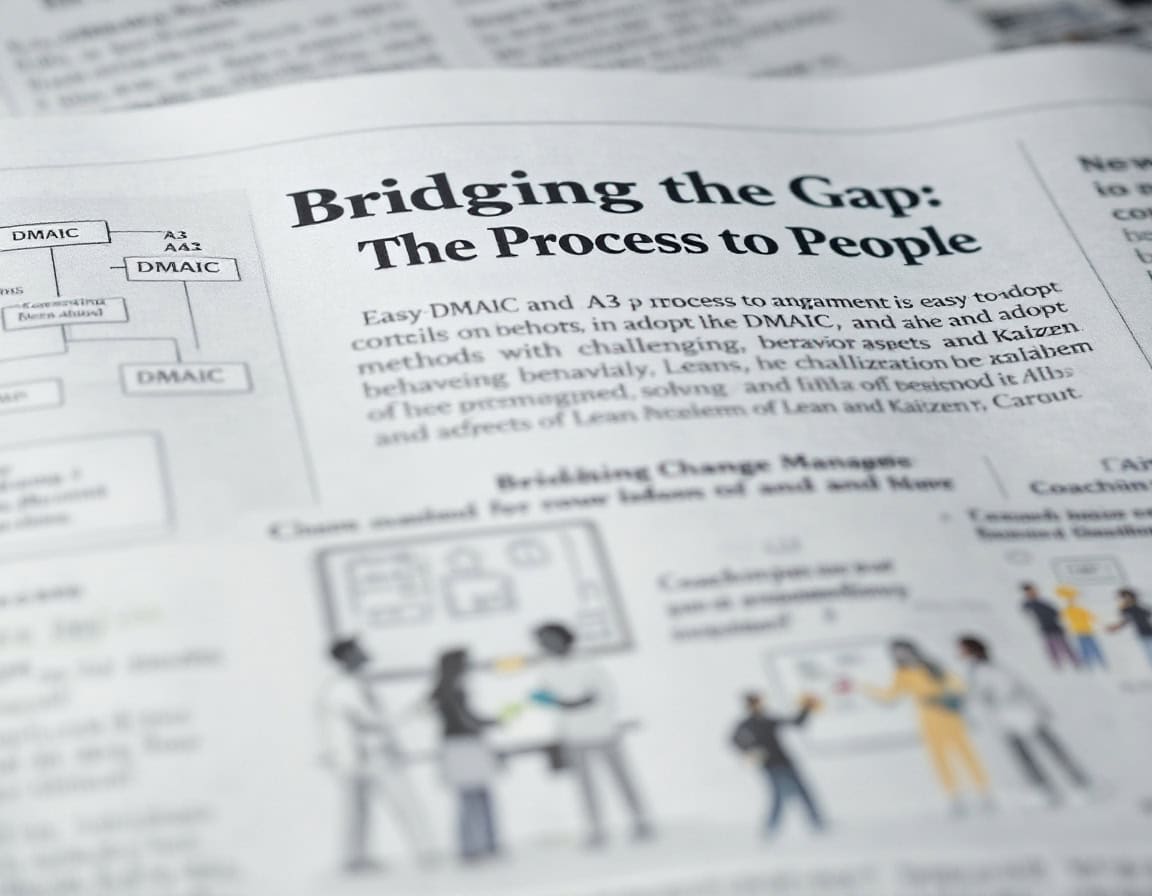
A3 reports, DMAIC projects, Kanban boards, 5S audits, hoshin kanri templates and kaizen event formats share one trait: they are the easy part. A motivated engineer can learn the mechanics of any of them quickly, a consultant can deploy them, and a competitor can copy them after a plant visit.
Precisely because they are easy, they are what organizations adopt, and their success is then judged by adoption: projects completed, belts certified, boards installed. The hard part receives no template. It consists of the seven capabilities and four conditions described above, and it is hard because it is slow, personal, and visible only in how people react under pressure.
The methods themselves are best used as exercises for the hard part. DMAIC and the A3 give a team a reason to practice root cause discipline on a real problem. Training Within Industry gives supervisors a routine for instruction and for handling people issues. Hoshin kanri, with its catchball exchanges between levels, forces decisions to be made together. The katas turn improvement into a routine taught through coaching. A kaizen event gives a team a few days of shared ownership of one problem, and making that ownership last is the harder lesson. Used this way, any Lean or Kaizen method works. Used without the behaviors, any of them degrades into paperwork.
Before adopting the next method, ask three questions. Which behavior is this method meant to build? Who will practice it daily, and who will coach them? What will a manager do when it is practiced badly? The answers matter more than the choice between DMAIC and A3, between Lean and Lean Six Sigma, or between a kaizen event and continuous daily kaizen.
As a follow-up of our introduction scenario, return to the second plant and its all-green board. The board was never the problem, and replacing it with a better one would change nothing. The first change is what the plant manager does the next time a red cell appears at 7:45 on a Monday: stay, look, and ask a question out of curiosity. After enough Mondays, the board starts to turn red. That looks like a decline. It is the first honest data the plant has had in years, and every improvement method starts from it.
The tool is learned quickly. The behavior is built one conversation at a time.
Further reading
- Spear, S. and Bowen, H.K. (1999). Decoding the DNA of the Toyota Production System. Harvard Business Review, September-October 1999.
- Edmondson, A. (1996). Learning from Mistakes Is Easier Said Than Done: Group and Organizational Influences on the Detection and Correction of Human Error. Journal of Applied Behavioral Science, 32(1), 5-28.
- Edmondson, A. (1999). Psychological Safety and Learning Behavior in Work Teams. Administrative Science Quarterly, 44(2), 350-383.
- Liker, J.K. (2004). The Toyota Way: 14 Management Principles from the World’s Greatest Manufacturer. McGraw-Hill.
- Rother, M. (2009). Toyota Kata: Managing People for Improvement, Adaptiveness and Superior Results. McGraw-Hill.
FAQ
Why can a DMAIC project pass its control phase and still lose the gain later?
The control plan is a document, and sustaining it is a behavior. Control charts, SOPs and audits hold only if process owners understand the reaction plan, have the authority to trigger it and expect support when they do. Otherwise out-of-control signals are rationalized and the process drifts back toward its previous state.
Can a Black Belt run Measure and Analyze reliably in an organization where reporting problems is penalized?
Not reliably, because measurement system analysis, such as gage R&R or attribute agreement analysis, addresses instrument and appraiser variation only. It does not detect data that people shape to avoid blame. If records are adjusted or samples selected for safety, the baseline and every downstream hypothesis test inherit that bias. Psychological safety is therefore a data quality requirement.
How can an A3 be audited to separate genuine problem solving from retrospective justification?
Check the sequence of evidence, not the format. A genuine A3 shows a dated hypothesis before the countermeasure, a prediction that could have failed, data on the result and a revision when the prediction missed. A root cause that matches a solution chosen earlier, with no rejected hypotheses, was probably written backwards. Ask the author what would have been done if the test had failed.
How do you design a kaizen event so that gains survive after the event team disbands?
Name the owner, the standard work change and the first three follow-up checks before the event starts. Place them in an existing management routine, such as the tier meeting. Events concentrate attention for a few days. Sustaining the result requires that the line supervisor, who may not have attended, can explain and defend the new standard.
What separates a standard that operators follow from one they merely comply with?
Compliance is measured by audit scores. Following shows up as deviations that are reported and analyzed. In a working system, an operator who cannot follow the standard raises it as a signal, and a defined change process revises the standard. In a hollow one, audit scores stay high while undocumented workarounds spread.
Do Lean Six Sigma and a coaching approach such as the Toyota Kata complement each other or conflict?
They complement each other when roles are explicit. DMAIC suits problems whose causes need statistical analysis, for example when variation has several candidate sources. The improvement kata suits daily progress toward a target condition under a coach. Conflict appears when belts run projects detached from line management, because the people who must sustain the change never practice the thinking behind it.
How do you measure psychological safety without reducing it to a survey score?
Combine a validated team survey with behavioral indicators from the process. Examples include near-miss and andon reporting rates, and the time from problem appearance to first response. Add the share of problems raised by operators rather than found by audits, and the proportion of actions closed. Track trends within a team over time. Do not compare teams directly, because reporting rates also vary with process and risk.
Is safety deteriorating when a plant’s near-miss reports double?
Not necessarily, because detected event rates depend on actual events and on willingness to report, as Edmondson’s 1996 hospital study illustrated. Check the severity distribution, the response time and whether the increase clusters where managers changed their behavior. A rise in reports followed by fewer severe events after countermeasures indicates that the system is learning.
Why do gemba walks often fail to produce improvement, and how can the routine be tested?
They fail when the walk is an inspection without follow-up. Test three elements you can observe. The manager asks about process and conditions rather than only results. Each visit produces an action with an owner and a date. The previous visit’s actions are reviewed at the start of the next. If any is missing, the walk is a tour.
How should a Kanban or pull system be governed so that the board does not become a tool to monitor individuals?
State the purpose in the working agreement: the board shows the flow of work and its constraints, not individual speed. Report upward only flow metrics such as lead time and work in progress, and review the board where the work is done. When managers compare people using card-level data, data quality tends to degrade, because people adjust what they record.
What should a manager do the first time a team stops the line for a problem that proves minor?
Thank the team for stopping, then review the decision criteria with them. Penalizing a false alarm teaches people to wait until a problem is certain, by which time the defect has traveled further. If stops are frequent and minor, clarify the stopping criteria and the training instead of discouraging stopping.