Is the Five Whys technique enough to find the true causes of complex problems?
The Five Whys is a simple and popular way to solve easy issues. It was created by Toyota. You keep asking “why” five times to get to the bottom of a problem. But, experts like John Allspaw and groups like ARMS Reliability doubt it works for complicated problems.
One big issue with the Five Whys is it looks for just one main cause. This approach might not get to the heart of complex problems. It’s a big deal when you’re trying to improve things constantly.
Another problem is it depends on who’s investigating. They need to ask the right questions, which can be hard. This means results can vary a lot, which is risky when you need reliable answers.
Key Takeaways
- The Five Whys is good for simple problems but struggles with complex ones.
- It often misses the deeper causes, focusing just on the surface.
- How well it works depends on the investigator’s skills and questions.
- Different people might get different results, impacting its reliability.
- Its straightforward approach might not fit problems that are more complex.
Introduction to the Five Whys Technique
The Five Whys Technique comes from Sakichi Toyoda, the creator of Toyota Industries. Created in the early 1900s, Toyota Motor Corporation embraced it. It’s known for being simple yet effective in finding hidden problems.
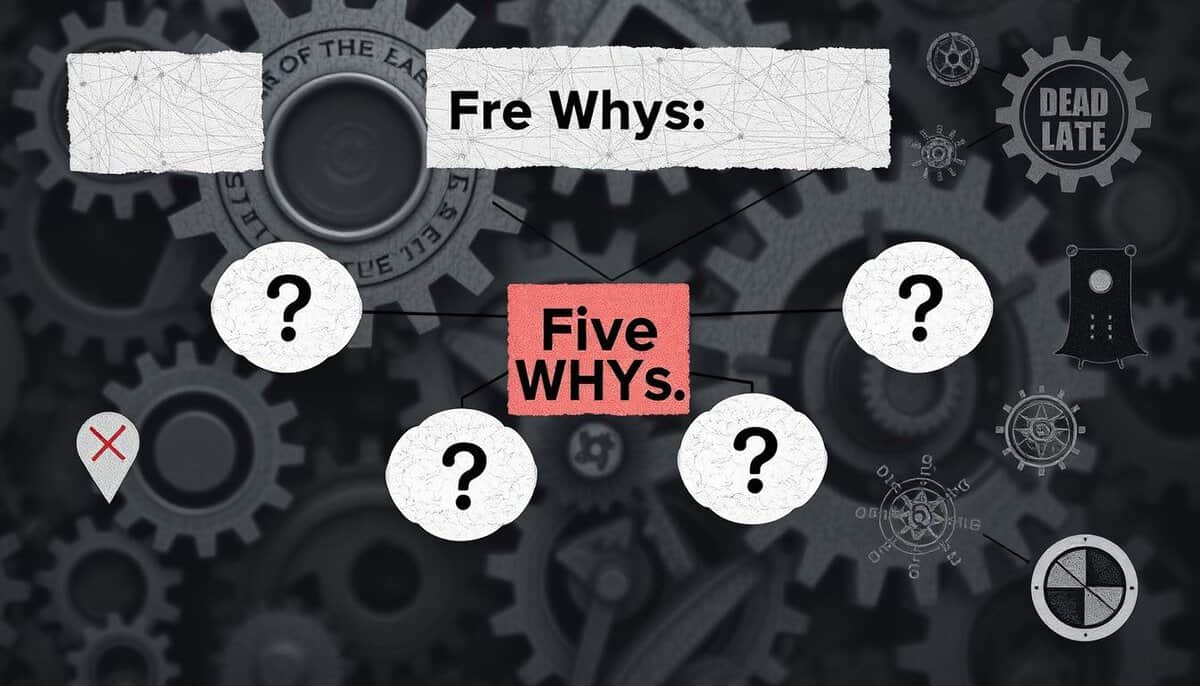
So, what is the Five Whys Root Cause Analysis Technique? It means asking “why?” five times to get to a problem’s core. The actual number of “why?” can change based on the problem’s size. This approach helps us see how different causes link together.
The key benefit of the Five Whys is finding the main reason for a problem. This helps teams fix the real issue, not just the signs. Here’s how to do it:
- Identify the problem.
- Ask “Why?” and supply an answer.
- Ask “Why?” again, referring to the previous answer.
- Repeat until you’ve asked “Why?” five times.
For example, a business might discover that weird water pressure levels come from ignored control valves. Asking why they were overlooked can reveal bigger issues. This way, teams can solve deep-rooted problems.
Also, the Five Whys can team up with tools like the Ishikawa diagram for a thorough analysis. This mix helps map out cause and effect clearly, boosting analysis quality.
Simplicity and Ease of Use
The Five Whys technique is known for being simple and easy to use. It comes from Toyota and is a big part of lean manufacturing. All you have to do is ask “Why?” five times or more to find the main issue. This method lets teams tackle problems quickly without complex tools.
Its main strength lies in quickly figuring out the root cause of a problem. But, the person leading the investigation needs to be skilled. Training is vital to dig deeper into problems and get better at solving them.

This technique works well in many different industries. It’s also flexible in dealing with various issues. Adding on-site observation helps understand the problem better. Tools like EasyRCA can make the process even more precise by mixing tech with traditional methods.
The simplicity of the Five Whys is a big plus in finding solutions. Yet, the outcome can vary based on who is using it. This shows the need for proper training and experience. Adding risk assessment makes the method even more effective, as it helps deal with potential risks fully.
The rest of this article is reserved for members
To limit scraping bots (currently 40,000 hits per day!),
we had to restrict access to full articles and tools to registered members only.
to access all the rest.
FAQ
What is the Five Whys Root Cause Analysis Technique?
The Five Whys technique is simple but widely used, especially in lean manufacturing like Toyota. It asks “why” several times to find the root cause of a problem quickly.
What are the advantages of the Five Whys method?
The Five Whys method is easy to use and quick at finding problem causes. It’s great for ongoing improvement and doesn’t need advanced skills to apply.
What are the limitations of the Five Whys technique?
This technique might not work well in complicated systems. It can lead to simple answers that don’t solve deeper issues. So, it may need more thorough tools.
How can the Five Whys technique lead to oversimplification?
Using the Five Whys alone can oversimplify problems. This can cause temporary fixes that don’t address the main issue, leading to repeated problems.
Why is it important to use broader analytical techniques along with the Five Whys?
Combining the Five Whys with other methods is key in complex situations. This ensures problems are fully resolved. It helps tackle complex issues more effectively.
Can the Five Whys method be useful for both simple and complex problem-solving?
The Five Whys works well for simple issues and fast fixes. But, it’s not enough for complex problems. These situations require deeper analysis to find the real causes.
External Links on Root Cause Analysis
International Standards
(hover the link to see our description of the content)
Glossary of Terms Used
Define Measure Analyze Improve Control (DMAIC): a data-driven quality strategy used in Six Sigma for process improvement, consisting of five phases: identifying the problem, measuring current performance, analyzing data to identify causes, improving processes based on findings, and controlling future performance to sustain improvements.
Eight Disciplines Problem Solving (8D): a structured problem-solving methodology used to identify, correct, and eliminate recurring issues, consisting of eight steps: team formation, problem description, containment actions, root cause analysis, corrective actions, implementation, prevention, and recognition of team efforts.
Failure Mode and Effects Analysis (FMEA): a systematic method for evaluating potential failure modes within a system, process, or product, assessing their effects on performance, and prioritizing risks to improve reliability and safety through corrective actions.
Fault Tree Analysis (FTA): a systematic, graphical method for identifying and analyzing the causes of system failures, represented as a tree structure. It uses Boolean logic to connect events and assess the probability of undesired outcomes, aiding in risk management and safety assessments.
Plan Do Check Act (PDCA): a continuous improvement model consisting of four iterative steps: planning an objective, executing the plan, evaluating results against expectations, and taking corrective actions to enhance performance and processes.