A competitor’s pending patent application is often viewed as a distant threat, a legal issue to be addressed only if a patent is granted. This passive stance is a significant mistake. The period when an application is under examination by a patent office is a unique window for action and fighting a pending patent. During this time, the competitor’s claims are not yet fixed, their arguments are exposed in public records, and the final outcome is far from certain.

This is not a time to wait, but a time to gather intelligence and prepare a response.
A company can actively shape the examination process and prepare a robust defense against a future patent. This involves dissecting the application’s prosecution history to identify weaknesses, submitting prior art to the examiner to block or narrow the claims, and developing non-infringing product alternatives.
Here is a detailed breakdown of the 3 possible approches against pending patents:
Monitoring and Intelligence Gathering
This is the most fundamental step. You need to know exactly what the competitor is trying to protect and how successful they are being.
Track the application status: use public databases like the USPTO’s Public PAIR (Patent Application Information Retrieval) or the European Patent Register to monitor the application’s entire “prosecution history.” This allows you to see every document filed by the applicant and every “Office Action” sent by the patent examiner.
Analyze the claims: the claims, not the general description, define the legal scope of the potential patent or pending patent. Scrutinize them to understand the precise boundaries of the invention. Pay close attention to how the claims are amended during examination, as they often become narrower to overcome rejections.
Analyze the examiner’s rejections: the examiner’s rejections are a roadmap to the application’s weaknesses. If the examiner is rejecting the claims based on specific prior art, you know exactly what the competitor is struggling to differentiate their invention from.
Expert tip: create a “prosecution history estoppel log.” Instead of just passively reading the file history, actively document every argument the applicant makes to the examiner to overcome a rejection. Specifically, record any statement that distinguishes their invention from the prior art. For example, if they argue, “Our invention succeeds because our widget is circular, whereas the prior art widget is square,” log that precise statement. This log becomes your most powerful defensive tool if the patent ever grants.
Under the legal doctrine of prosecution history estoppel, an applicant cannot later argue that their claims should cover subject matter they explicitly surrendered during examination. Your log will provide a pre-built, powerful argument to defeat any attempt by the competitor to stretch their claim scope to cover your product under the doctrine of equivalents.
2. Proactive and Offensive Actions
While the application is pending, you can take direct or indirect action to influence the outcome.
Conduct a prior art search: perform your own exhaustive search for patents, publications, or products that existed before the competitor’s filing date. This can include other pending patents also. If you find better prior art than the examiner has found, you can use it to your advantage.
File a third-party submission: most patent offices have a formal process allowing third parties to submit prior art to the examiner. In the U.S., this must be done before the later of 6 months after publication or the first Office Action on the merits. This is a powerful, anonymous (or non-anonymous) way to provide the examiner with ammunition to reject the claims, potentially preventing the patent from ever being granted or forcing its claims to be significantly narrowed.
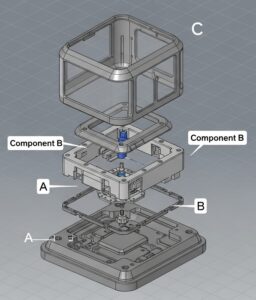
Designing products to strategically navigate patent claims to minimize infringement risk. Design around the claims: this is the most common engineering response. With a clear understanding of the claims, you can design your product to specifically avoid infringing them. For example, if a claim requires steps A+B+C, a product that only performs A+C may not infringe. Since the claims are still in flux, this requires ongoing monitoring, but it is a direct way to mitigate future risk.
Develop and file your own patents: create your own intellectual property around the competitor’s technology. You can file patents on improvements or alternative solutions. This creates a strong defensive position and can be used as leverage for future cross-licensing negotiations if their patent is eventually granted.
Expert tip: submit prior art to the patent office not just as a list of references, but accompanied by a meticulously prepared claim chart. A claim chart is a table that breaks down the competitor’s published claims, element by element, in one column. In the adjacent column, you provide pinpoint citations, quotes, and figures from the prior art references that show where each and every one of those elements is disclosed. This “spoon-feeds” the rejection argument to the examiner, making their job incredibly easy.
An examiner is far more likely to use art that is presented in such a clear, compelling, and structured format than to wade through a long list of submitted patents. This dramatically increases the probability that the competitor’s claims will be rejected or significantly narrowed.
Expert tip: in a patent war, a well-funded company can strategically leverage the protracted nature of legal proceedings to defend against a competitor’s blocking patent by engaging in a “never-ending court case” strategy. This involves initiating various legal challenges, such as validity challenges against the blocking patent (e.g., through inter partes review at the patent office or counterclaims in litigation), or by filing multiple, complex infringement lawsuits that require extensive discovery and expert testimony. The objective is to create significant delays, increase the competitor’s legal costs, and tie up their resources, thereby diminishing the commercial value of their blocking patent.
This strategy can buy the defending company crucial time to develop workarounds, negotiate a more favorable settlement, or even wait for the blocking patent to expire, ultimately neutralizing its threat through attrition and strategic procrastination.
3. Defensive and Strategic Preparation
You should also prepare for the possibility that the patent will be granted.

Obtain a Freedom-to-Operate (FTO) opinion: if your product appears to overlap with the pending claims, engage a patent attorney to provide a formal FTO opinion. This analysis assesses the risk that your product would infringe if the patent were to grant. A well-reasoned opinion of non-infringement can be a critical defense against charges of willful infringement, which can lead to triple damages in a lawsuit.
Identify grounds for invalidity: use your prior art search to build a case for why the pending patent would be invalid even if it were granted. Keep this information in your back pocket. If the competitor’s patent grants and they sue you, you will be prepared to file a counterclaim to have the patent invalidated in court or through a post-grant review proceeding at the patent office.
Assess market entry as a calculated risk: you can choose to launch your product while the patent is still pending. This is a business decision. The risk is that if the patent grants with claims that cover your product, you could be liable for damages from the date the application was published. The reward is gaining market share and first-mover advantage.
Expert tip: not just design around the competitor’s pending patent claims, but to patent your design-around solution. As your engineering team develops a commercially viable alternative that avoids the literal language of the competitor’s claims, immediately file your own patent application on that specific alternative. This move transforms a purely defensive tactic into a powerful offensive asset. It creates a “blocking patent” that can prevent the competitor from pivoting to your superior non-infringing design.
If their patent eventually grants and they sue you, you now possess a valuable counter-assertion asset, creating significant leverage for a favorable settlement or a cross-licensing agreement, effectively turning their threat into a business negotiation.
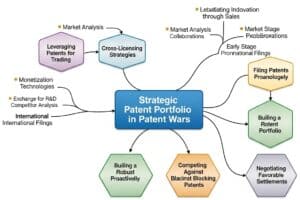
- Prepare something to trade for: while not offensive, this is for sure proactive: in a patent war, you can strategically prepare a portfolio of your own patents to use as leverage for “trading” or cross-licensing, effectively defending against the competitor’s blocking patent. This involves proactively identifying key technologies and innovations within the company’s own research and development, and then aggressively filing patents on these advancements. The goal is to build a robust and diverse patent portfolio that includes patents relevant to the competitor’s products or services, or patents that cover alternative solutions to the technology protected by the blocking patent.
By having your own valuable patents, you can offer to license these patents to the competitor in exchange for a license to the blocking patent, or use them as a bargaining chip to negotiate a more favorable settlement.
Patent Infringement Litigation Costs
The costs associated with patent infringement litigation are substantial and multifaceted, typically running into millions of dollars. These expenses are not a single bill but an accumulation of various fees and services required to navigate the complex legal process from filing a lawsuit to its final resolution. The total cost is heavily influenced by the amount of money at stake, the complexity of the technology, and the legal strategies employed by the parties.
A primary source for this data is the bi-annual “Report of the Economic Survey” from the American Intellectual Property Law Association (AIPLA), which is widely cited in legal and business analysis.
If an amicable settlement is not reached at an earlier stage, for corporate and international cases, the average costs of a complete patent litigation process are typically between $2.3 million and $4 million.
Breakdown of Typical Costs
Patent infringement costs can be broken down into several key categories that contribute to the total expense:
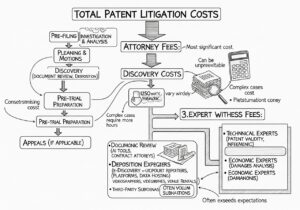
1. Attorney fees: this is the largest component of litigation costs. Law firms bill for the time spent by partners, associates, and paralegals on every aspect of the case. Hourly rates for patent attorneys can range from $200 to over $1,000, depending on experience and location. The work includes legal research, drafting court filings, preparing for and conducting depositions, and arguing motions in court. | 2. Discovery costs: discovery is the formal process of exchanging information and evidence between the parties. It is a notoriously expensive phase of patent litigation, with costs that can reach up to $1 million. This includes producing and reviewing vast quantities of documents, emails, and technical specifications, a process known as e-discovery. |
3. Expert witness fees: because patent cases often involve complex technology, expert witnesses are essential. These experts provide specialized testimony to help the court and jury understand the technical aspects of the invention and whether infringement occurred. Their fees can be substantial, ranging from $200 to over $1,000 per hour for their time spent analyzing the case, preparing reports, and testifying. A single case may require multiple experts covering different technical and financial issues. | 4. Court and administrative fees: these include the initial fees for filing a complaint and other documents with the court
|
4. Other litigation support costs: this category includes expenses for travel, document management, creating court exhibits, and fees for jury consultants. |
Calculation of Damages and Compensation Demands
When a competitor sues for patent infringement, the compensation they demand is based on a calculation of monetary damages designed to compensate them for the financial harm caused by the infringement. U.S. patent law (35 U.S.C. § 284) states that a patent owner is entitled to “damages adequate to compensate for the infringement, but in no event less than a reasonable royalty.” The two primary methods for calculating these damages are lost profits and a reasonable royalty.
Lost profits: this is the preferred but more difficult standard to prove. To claim lost profits, the patent holder must demonstrate that they would have made the sales that the infringer made “but for” the infringement. The most common test for this, known as “the Panduit test“, requires the patent owner to prove these four following factors:
Demand for the patented product.
Absence of acceptable non-infringing substitutes.
Their own manufacturing and marketing capability to exploit the demand.
The amount of profit they would have made.
If the patent owner can prove these factors, they can recover the profits they lost on every sale made by the infringer.
Reasonable royalty: if lost profits cannot be proven, the patent owner is entitled to at least a “reasonable royalty.” This is a payment that would have been made by a willing licensee to a willing licensor in a hypothetical negotiation that would have taken place just before the infringement began. This is the most common form of patent damages. Courts determine the royalty rate by considering a set of 15 established factors, known as the Georgia-Pacific factors. These factors include the royalty rates paid for comparable patents, the nature of the invention, the profits the infringer made, and the commercial relationship between the parties. The final damage award is then calculated by multiplying this royalty rate by the infringer’s total revenue from the infringing product (the “royalty base”).
Eventual “bonus”: in addition to these compensatory damages, a court may also award enhanced damages (up to three times the actual damages) in cases of willful or egregious infringement, and may also order the losing party to pay the winner’s attorney fees in “exceptional” cases.
Indirect and Business Costs
Beyond direct legal expenditures, there are significant indirect costs that can be just as damaging, such as diversion of employee time and focus, business disruption, market value impact, all being out of the scope here.
Conclusion
It’s time for a dedicated patent lawyer or attorney and proactivity in designs.
Also read some of our patent-related articles if not done yet:


The rest of this article is reserved for members
To limit scraping bots (currently 40,000 hits per day!),
we had to restrict access to full articles and tools to registered members only.
to access all the rest.