Product Design, Manufacturing & Innovation Resources
Home » Rideshare Launch Model

Rideshare Launch Model

2000
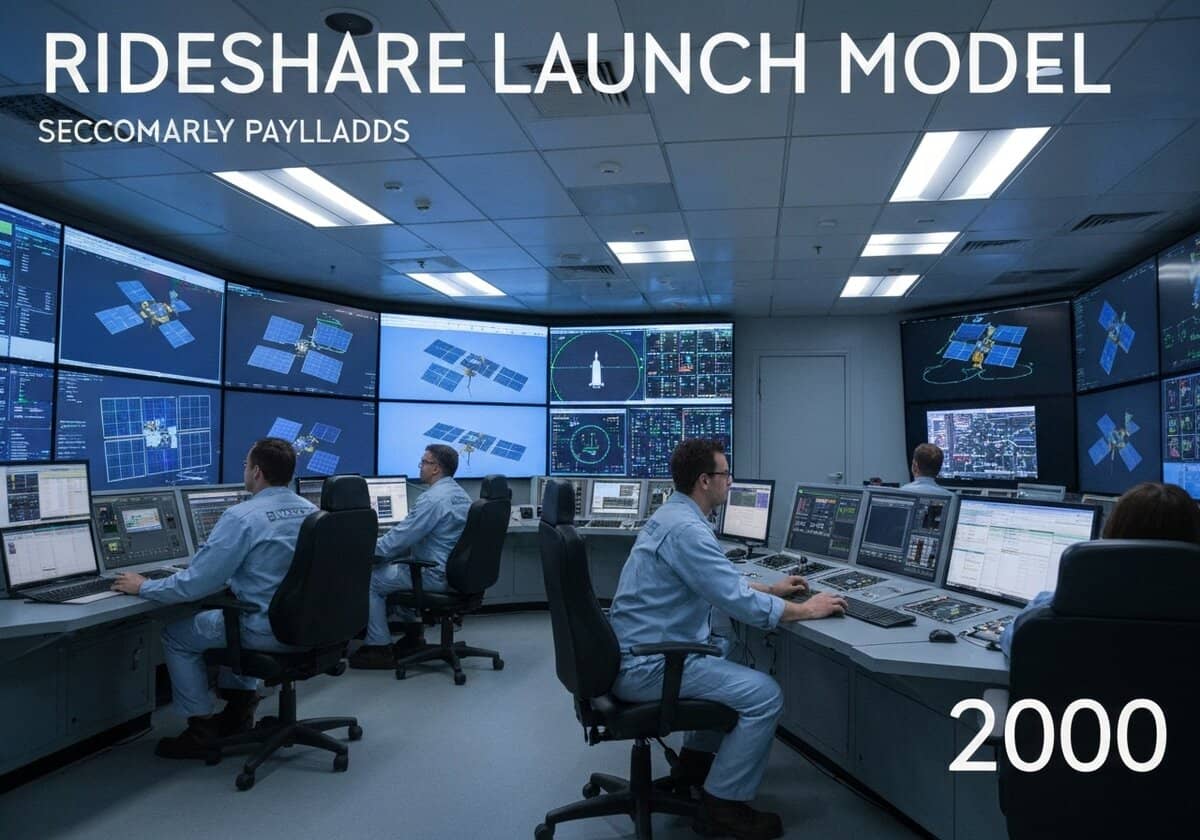
Aerospace control room with engineers monitoring satellite launch.

(generated image for illustration only)

A launch strategy where multiple small satellites are flown as secondary payloads on a rocket whose primary mission is to launch a larger, main satellite. This ‘piggybacking’ approach significantly reduces the cost for small satellite operators, as they only pay for a fraction of the total launch vehicle capacity, making space access more affordable and frequent for smaller players.


The rideshare, or piggyback, launch model addresses the fundamental economic challenge of space access for small operators. A dedicated launch vehicle can cost tens to hundreds of millions of dollars, a price far beyond the budget for a small university or startup satellite. Ridesharing amortizes this cost across many customers. The primary payload owner pays the bulk of the launch cost and dictates the final orbit and launch schedule. Secondary payloads must be ableto accommodate these constraints.

This model created a new market segment for ‘launch brokers’ or ‘aggregators’. These companies act as intermediaries, purchasing a large slot on a rocket (like an Atlas V, Falcon 9, or PSLV) and then selling smaller portions of that capacity to numerous small satellite operators. They handle the complex logistics of payload integration, documentation, and mechanical/electrical interfacing with the launch vehicle. The development of standardized deployers, such as the CubeSat P-POD, was a critical enabler for this model, allowing dozens of satellites to be integrated safely and efficiently. While ridesharing offers low costs, the trade-off is a lack of control over the destination orbit and launch timing, which has in turn spurred the development of dedicated small satellite launch vehicles.

UNESCO Nomenclature: 3302
– Aerospace engineering

Type

Logistical Model

Disruption

Substantial

Usage

Widespread Use

Precursors

  • Ariane structure for auxiliary payloads (asap) developed in the 1980s
  • space shuttle ‘getaway special’ (gas) canister program
  • early amateur radio satellites launched as ballast or secondary payloads
  • economic pressure to reduce the cost of space access

Applications

  • dedicated smallsat launch brokers (e.g., spaceflight industries, exolaunch)
  • isro’s pslv commercial launches, which have deployed hundreds of smallsats
  • spacex’s smallsat program using the falcon 9 rocket
  • development of specialized satellite deployers (e.g., p-pod, isipod, sherpa)
  • launch of large constellations requiring multiple, cost-effective deployments

Patents:

NA

Potential Innovations Ideas

Due to scrapping bot traffic, currently more than 40k per day, this content is reserved to community members.
> Login < or > Register < (100% free) to access this, so as all other restricted content and tools.

Related to: rideshare, piggyback launch, secondary payload, launch vehicle, space access, launch economics, smallsat, constellation, PSLV, Falcon 9.

Historical Context

Rideshare Launch Model

1999-05-01
2000
2000
2000
2003
2010
2013-09-24
1999
2000
2000
2000
2002
2010
2013

(if date is unknown or not relevant, e.g. "fluid mechanics", a rounded estimation of its notable emergence is provided)

Full size images and downloads are only available, 100% free, for registered members.

> Login <