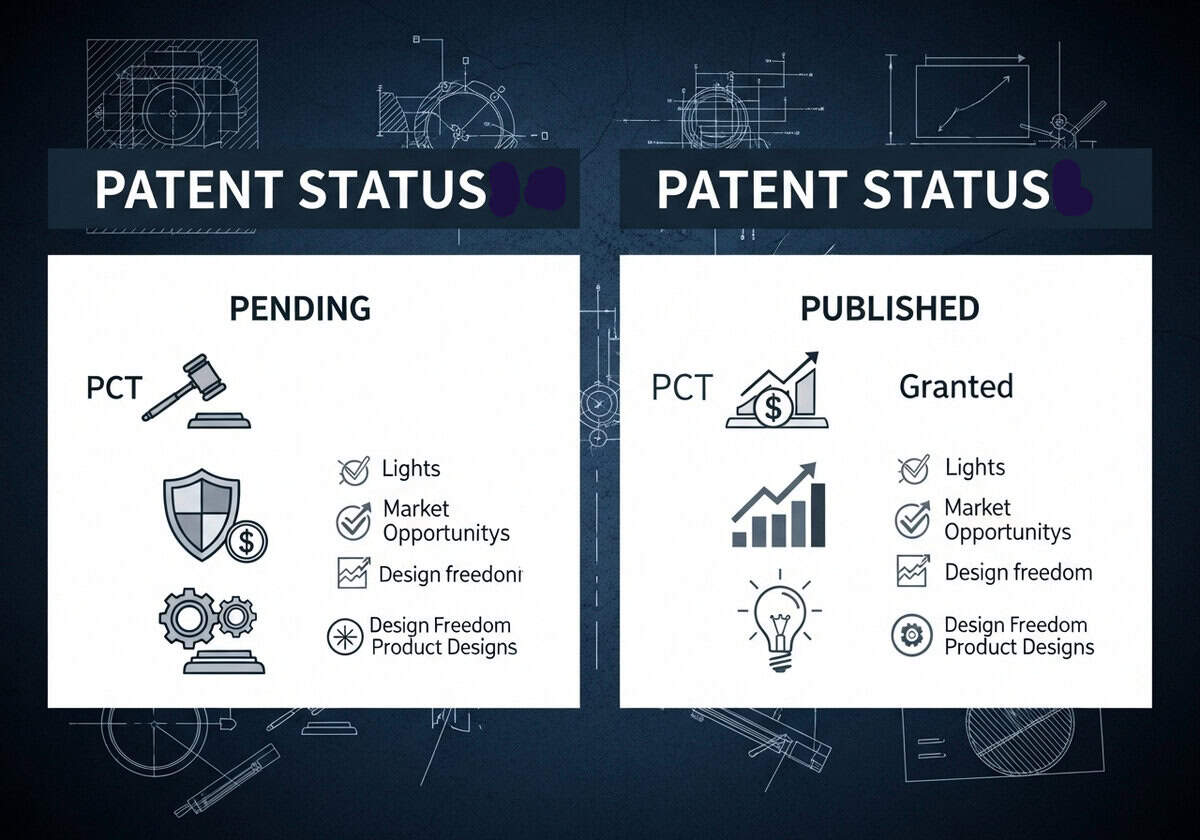
For an engineer or product designer, understanding the specific patent status provides direct insight into design freedom and competitive intelligence. A patent’s current stage dictates the level of legal risk, what can be publicly disclosed, and how to position a new product. Mistaking a published application for a granted patent could lead to building a product that will infringe, resulting in costly redesigns or litigation. Conversely, recognizing that a competitor’s patent is only at the PCT application stage reveals a long timeline before any enforceable rights exist, creating a window of opportunity for market entry or the development of alternative, non-infringing solutions. This knowledge transforms intellectual property from a legal abstraction into a practical guide for technical and strategic decision-making.
Each patent status carries a distinct set of possibilities and limitations described in detail below. The “patent pending” status, for example, allows a company to market an invention and deter copycats while the application is still under review. A “granted patent” shifts the focus to enforcement and marking products with the patent number to secure full damages against infringers.
Key Takeaways

- PCT application enables global patent filing strategy.
- Published applications provide early disclosure for prior art.
- A granted patent confers legal rights for enforcement.
- Understand differences in legal patent status and protection scope.
- Follow systematic process from priority to grant efficiently.
The PCT Application as an International Pathway
A Patent Cooperation Treaty (PCT) application serves as an international mechanism for patenting inventions across multiple jurisdictions.

This pathway allows inventors to secure their intellectual property rights in several countries through a single application, which simplifies the initial steps in protecting innovations globally. By filing a PCT application, applicants effectively postpone the high costs associated with filing in individual countries while retaining the option to pursue patents later on in different markets. The PCT has been adopted by 155 contracting states, which increases its importance as a strategic tool for international business and trade.
The PCT application process bifurcates into two main phases: the international phase and the national phase. During the international phase, applicants receive an International Search Report (ISR) that outlines potential prior art. This process enables inventors to evaluate the viability of their inventions before incurring additional expenses in foreign patent offices. Once the ISR is received, applicants can decide in which member states to pursue their patent rights, allowing for strategic market entry decisions.
An important aspect of the PCT system is also its unifying feature, which aggregates data and promotes information sharing among member states, leading to enhanced opportunities for technology licensing.
The early international filing date provided by the PCT is advantageous because it establishes priority, allowing inventors to claim their invention dates before later filings in national jurisdictions.
The traditional approach: consider filing a PCT application if you anticipate wanting patent rights in multiple countries, as it maximizes your options and provides essential time to assess commercial viability before committing to national filings.
Expert tip: strategically use the Chapter II demand for International Preliminary Examination to obtain a positive patentability report before entering the national phase.
Many applicants file a PCT application, receive the initial search report and written opinion, and then simply wait for the 30-month deadline to enter the national phase. An expert approach, however, treats the international phase as a dry run for actual examination. If the initial written opinion raises objections, instead of waiting to fight the same battle in ten different countries, you can file a “Chapter II demand.” This allows you to submit arguments and claim amendments directly within the PCT system under Article 34. The goal is to resolve the examiner’s objections and persuade them to issue a positive International Preliminary Report on Patentability (IPRP). A favorable IPRP is a powerful tool; it can be used to accelerate examination and increase the likelihood of allowance in many national offices through the Patent Prosecution Highway (PPH) program, saving immense time and money by solving the core patentability issues once, at a centralized level.
(refer to the big comparison table below for all the PCT, pending patent, published patent and granted patent comparison)
The rest of this article is reserved for members
To limit scraping bots (currently 40,000 hits per day!),
we had to restrict access to full articles and tools to registered members only.
to access all the rest.