Product Design, Manufacturing & Innovation Resources
Home » Computer-Aided Design (CAD)

Computer-Aided Design (CAD)

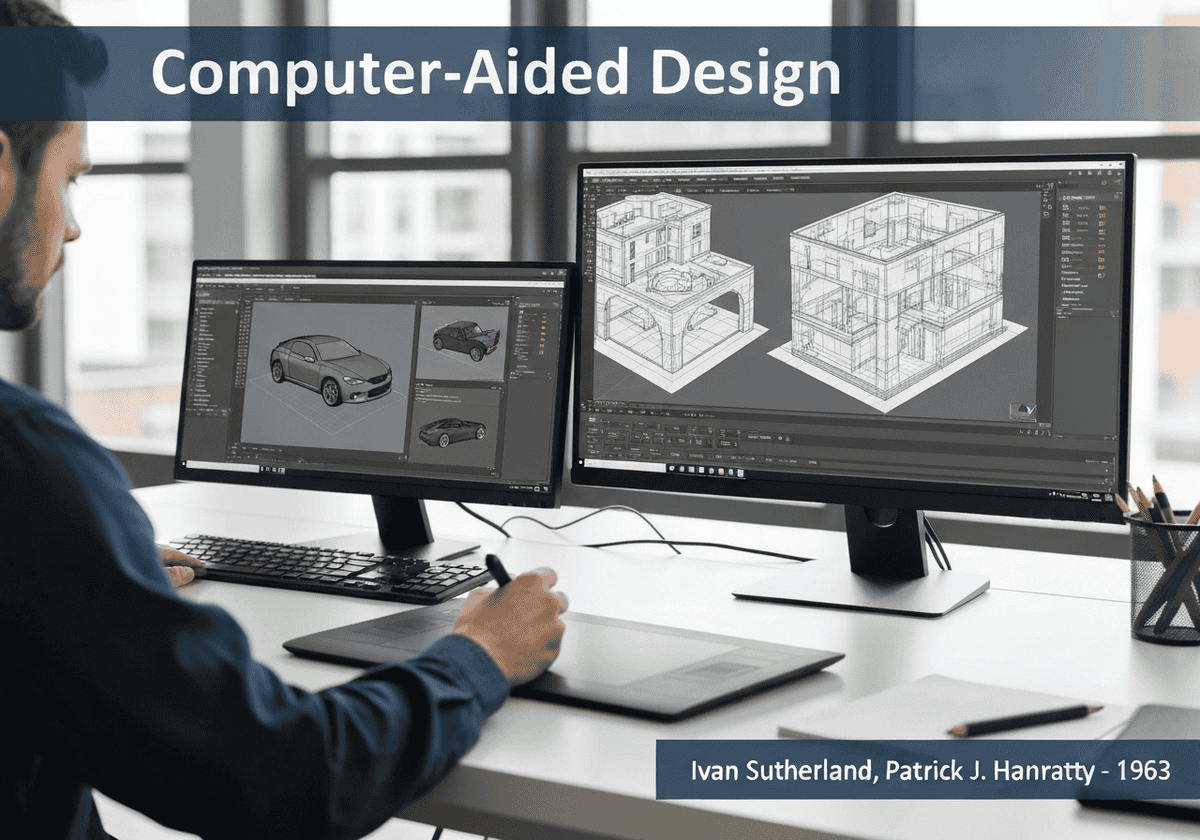
1963
  • Ivan Sutherland
  • Patrick J. Hanratty
Computer workstation with CAD software displaying 3D architectural and automotive designs.

(generated image for illustration only)

The use of computer systems to assist in the creation, modification, analysis, or optimization of a design. CAD software allows product designers and engineers to create precise 2D and 3D models, replacing manual drafting. This technology dramatically increases productivity, improves the quality of design, and facilitates better communication through detailed visualizations and simulations.


Computer-Aided Design (CAD) revolutionized the field of product design by digitizing the entire drafting and modeling process. Before CAD, engineers and designers relied on manual drafting with tools like pencils, rulers, and compasses, a time-consuming and error-prone process. The breakthrough came with systems like Ivan Sutherland’s Sketchpad in 1963, which demonstrated the potential of interactive computer graphics. Modern CAD software provides a vast toolkit for designers. They can create complex 3D solid and surface models with parametric features, meaning the model’s geometry can be updated automatically if a dimension is changed. This is crucial for iterative design. Beyond simple modeling, CAD is often integrated into broader systems. Computer-Aided Engineering (CAE) uses CAD models to run simulations, such as finite element analysis (FEA) to test structural strength or computational fluid dynamics (CFD) to analyze airflow, without building a physical prototype. Computer-Aided Manufacturing (CAM) uses the same CAD data to generate instructions for manufacturing machinery like CNC mills or 3D printers. This seamless digital thread from design to analysis to manufacturing is a cornerstone of modern product development, enabling rapid prototyping and mass customization.

UNESCO Nomenclature: 3307
– Computer Technology

Type

Software/Algorithm

Disruption

Revolutionary

Usage

Widespread Use

Precursors

  • the invention of the digital computer
  • developments in computer graphics and display technology
  • the light pen input device
  • traditional engineering drawing and descriptive geometry principles

Applications

  • architectural blueprints and 3d building models
  • automotive body and engine design
  • aerospace engineering for aircraft and spacecraft
  • consumer product design, from smartphones to furniture
  • creating models for 3d printing

Patents:

NA

Potential Innovations Ideas

Due to scrapping bot traffic, currently more than 40k per day, this content is reserved to community members.
> Login < or > Register < (100% free) to access this, so as all other restricted content and tools.

Related to: cad, computer-aided design, 3d modeling, sketchpad, ivan sutherland, digital prototyping, cam, cae.

Historical Context

Computer-Aided Design (CAD)

1960
1960
1960
1963
1965-12-21
1970
1970
1960
1960
1960
1962
1964
1970
1970
1970

(if date is unknown or not relevant, e.g. "fluid mechanics", a rounded estimation of its notable emergence is provided)

Related Invention, Innovation & Technical Principles

Full size images and downloads are only available, 100% free, for registered members.

> Login <