Product Design, Manufacturing & Innovation Resources
Home » First Practical Visible-Spectrum (Red) LED

First Practical Visible-Spectrum (Red) LED

1962-10-09
  • Nick Holonyak Jr.
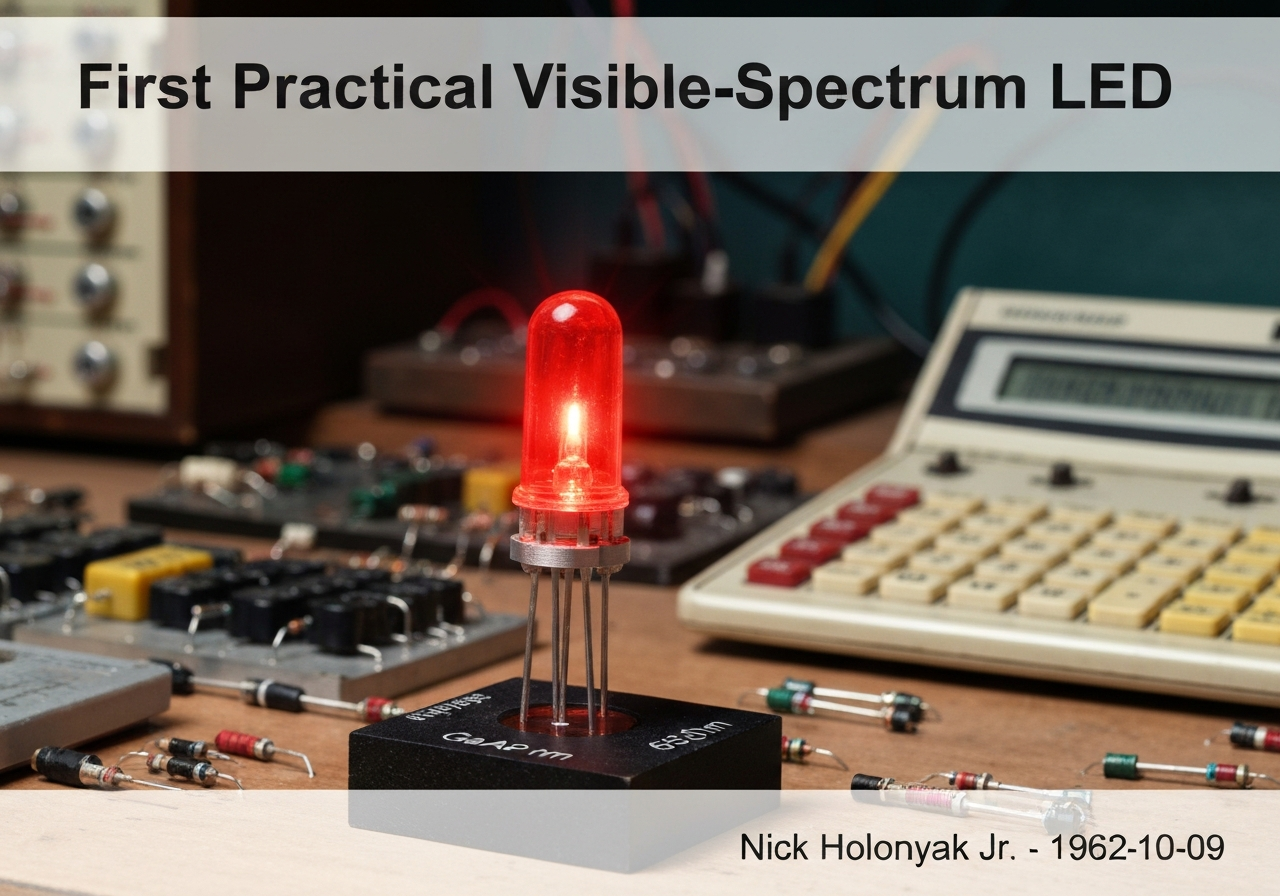
Gallium Arsenide Phosphide LED emitting red light, pivotal in opto-electronics.

(generated image for illustration only)

The first practical visible-spectrum LED was invented in 1962. This device, based on a Gallium Arsenide Phosphide (GaAsP) semiconductor substrate, emitted red light at a wavelength of approximately 650 nm. While its initial efficiency was low, it was the first LED bright enough for practical use, launching the industry of solid-state indicators and displays like those in early calculators.

Working at General Electric, Nick Holonyak Jr. successfully created the first light-emitting diode that produced light in the visible part of the spectrum, specifically red light. This was a significant advancement over previous semiconductor diodes that only emitted invisible infrared light. Holonyak’s device used a ternary alloy, Gallium Arsenide Phosphide (GaAsP), grown on a Gallium Arsenide (GaAs) substrate. The creation of this alloy was a materials science challenge, but it allowed for a band gap large enough to produce red photons.

The invention was a proof of concept that solid-state devices could generate useful visible light. Its initial brightness was about 0.001 lumens, and it was expensive to produce. However, its robustness, small size, and low power consumption compared to incandescent bulbs made it ideal for indicator applications. This breakthrough directly led to the development of seven-segment displays that dominated the calculator and digital watch markets in the 1970s, replacing older technologies like Nixie tubes. It marked the beginning of the transition from vacuum tube and incandescent technologies to solid-state optoelectronics.

UNESCO Nomenclature: 3308
– Electronics

Type

Physical Device

Disruption

Substantial

Usage

Widespread Use

Precursors

  • development of gallium arsenide (gaas) technology
  • vapor-phase epitaxy for crystal growth
  • understanding of p-n junctions in compound semiconductors
  • earlier work on infrared leds by james r. biard and gary pittman in 1961

Applications

  • calculator displays (e.g., HP-35)
  • digital watch displays
  • indicator lights on electronic equipment
  • early optical data transmission links
  • traffic lights

Patents:

NA

Potential Innovations Ideas

Due to scrapping bot traffic, currently more than 40k per day, this content is reserved to community members.
> Login < or > Register < (100% free) to access this, so as all other restricted content and tools.

Related to: red led, Nick Holonyak, gallium arsenide phosphide, gaasp, general electric, seven-segment display, indicator light, visible spectrum, optoelectronics.

Historical Context

First Practical Visible-Spectrum (Red) LED

1960
1960
1960
1962-10-09
1964
1970
1970
1960
1960
1960
1962
1963
1965-12-21
1970
1970

(if date is unknown or not relevant, e.g. "fluid mechanics", a rounded estimation of its notable emergence is provided)

Full size images and downloads are only available, 100% free, for registered members.

> Login <