The Fire Tetrahedron Model
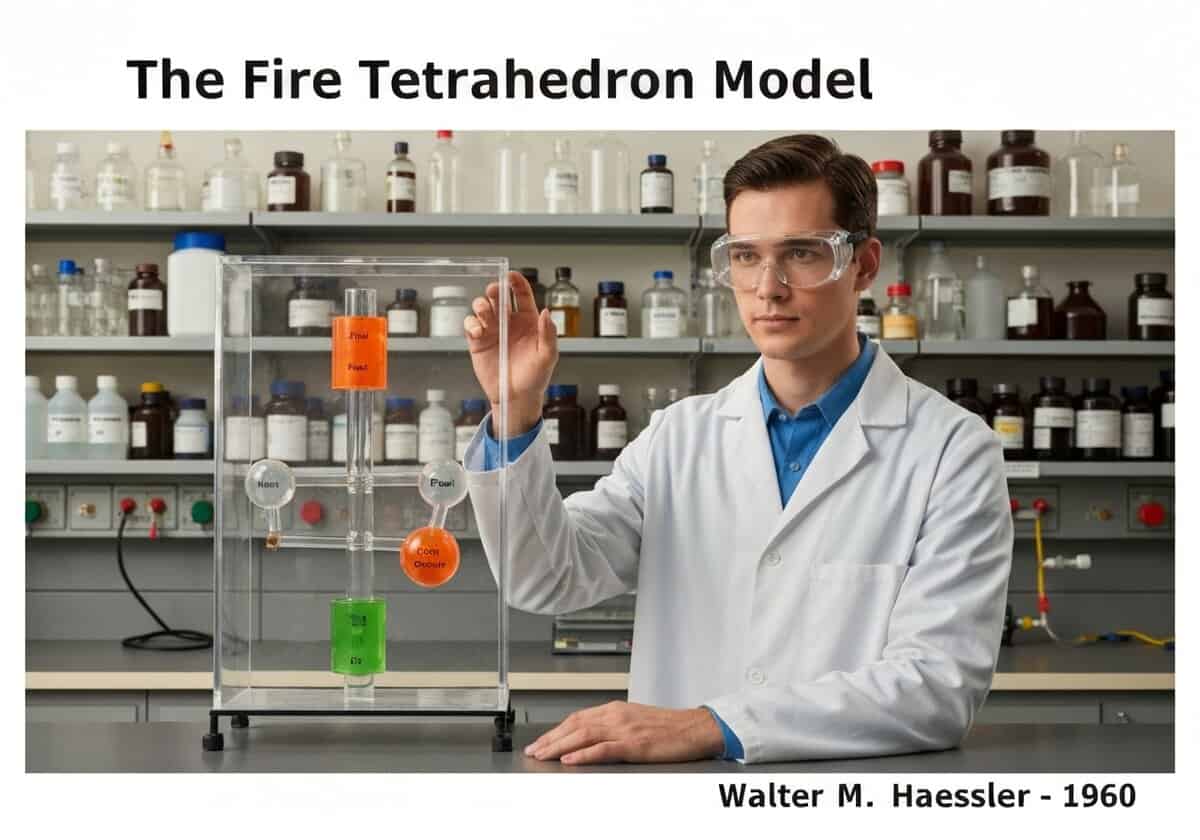
The fire tetrahedron is an advanced model that adds a fourth element to the classic fire triangle: a sustained chemical chain reaction. This fourth element represents the process where the heat produced by the combustion reaction is sufficient to sustain the fire by creating further flammable vapors and radicals. This model better explains flaming combustion.
While the fire triangle is sufficient for explaining the initiation of combustion, the fire tetrahedron provides a more complete model for understanding sustained, flaming fires. It incorporates the three elements of the triangle—heat, fuel, and an oxidizing agent—and adds a fourth face: the uninhibited chemical chain reaction. In a flaming fire, the initial heat causes the fuel to pyrolyze, releasing flammable vapors. These vapors mix with the oxidizer and combust, releasing more heat. A portion of this newly generated heat radiates back to the fuel, causing it to release more vapors, thus creating a self-sustaining cycle. This cycle involves highly reactive, short-lived molecules called free radicals (e.g., H•, O•, OH•). The fire tetrahedron model highlights that a fire can be extinguished not only by removing heat, fuel, or oxygen but also by interrupting this chemical chain reaction. This is the principle behind many modern extinguishing agents, such as dry chemical powders and halocarbon clean agents. These agents work by chemically interfering with the free radicals, effectively poisoning the fire and stopping the chain reaction, even if sufficient heat, fuel, and oxygen are still present.
Note: while this 4th element does make complex cases more comprehensive -chemical powders and halocarbon clean agents-, it can still be viewed a classic 3 triangle case, where this 4th element is just adding or suppressing the root cause of one of the 3 others.
UNESCO Nomenclature: 3305
– Chemical engineering
Precursors
- the fire triangle model
- discovery of free radicals in chemical reactions
- nikolay semyonov’s work on chain reaction theory
- development of halon and other chemical extinguishing agents
Applications
- development of chemical fire extinguishers (e.g., halon, dry chemical)
- advanced firefighting strategies
- fire investigation and analysis
- chemical process safety
- research in combustion chemistry
Potential Innovations Ideas
Due to scrapping bot traffic, currently more than 40k per day, this content is reserved to community members.
> Login < or > Register < (100% free) to access this, so as all other restricted content and tools.
Related to: fire tetrahedron, chemical chain reaction, combustion, free radicals, extinguishment, halon, fire safety, flaming combustion, pyrolysis, flame inhibition.