Product Design, Manufacturing & Innovation Resources
Home » The BOD/COD Ratio as a Biodegradability Index

The BOD/COD Ratio as a Biodegradability Index

1960
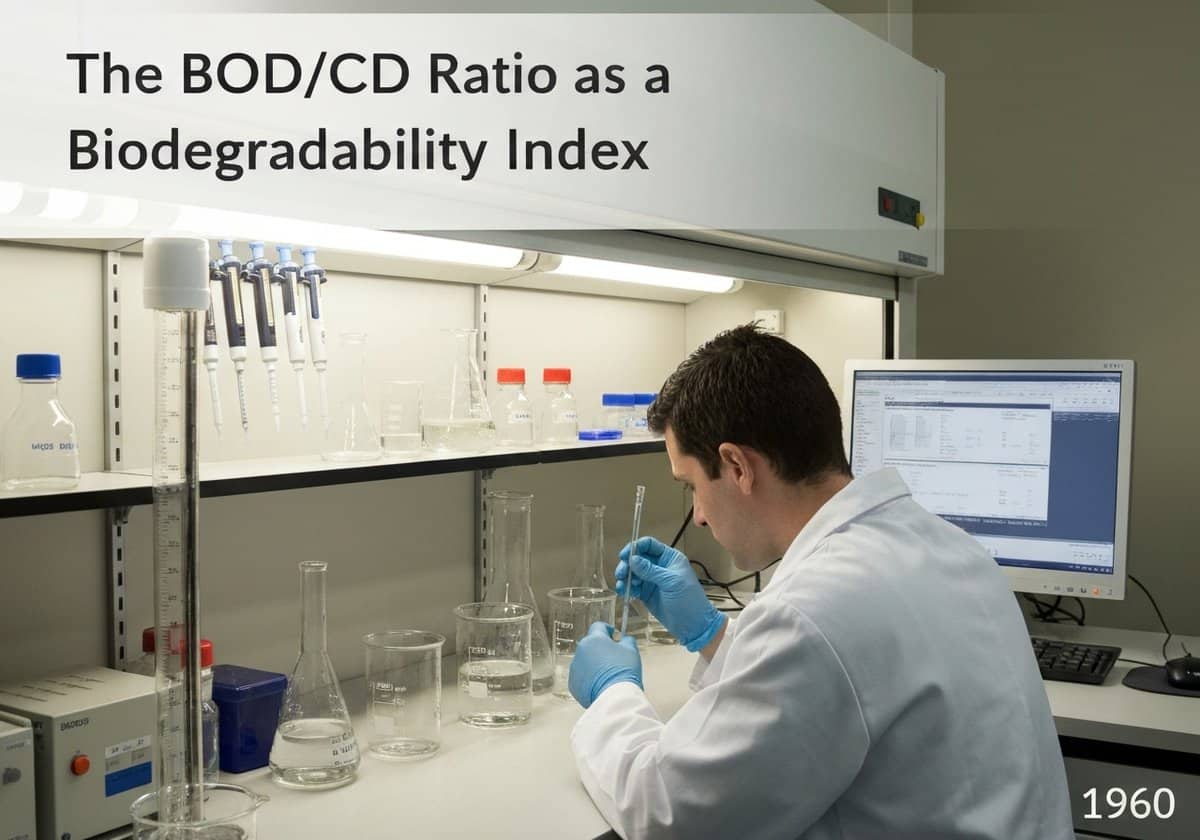
Technician measuring BOD and COD in wastewater samples for biodegradability assessment.

(generated image for illustration only)

The ratio of Biochemical Oxygen Demand (BOD) to Chemical Oxygen Demand (COD) is a key indicator of the biodegradability of organic pollutants in wastewater. COD measures nearly all chemically oxidizable organic material, while BOD measures only the fraction that microorganisms can readily degrade. A higher BOD/COD ratio indicates a more biodegradable effluent, suitable for biological treatment.


Chemical Oxygen Demand (COD) uses a strong chemical oxidant (like potassium dichromate in sulfuric acid) to oxidize both biodegradable and non-biodegradable (recalcitrant) organic matter. The BOD test, by contrast, relies on biological oxidation. Consequently, the COD value is almost always higher than the BOD value for the same sample. The BOD/COD ratio provides valuable insight into the nature of the wastewater. A ratio greater than 0.5 is typically considered to indicate that the wastewater is readily biodegradable and well-suited for biological treatment methods like activated sludge. A ratio below 0.3 suggests the presence of a significant fraction of recalcitrant or toxic compounds that may inhibit microbial activity, indicating that biological treatment alone may be ineffective. In such cases, advanced oxidation processes (AOPs) or other chemical/physical treatments might be required, either as a primary treatment or as a pre-treatment step to break down complex molecules and improve the BOD/COD ratio before biological treatment.

UNESCO Nomenclature: 3308
– Civil engineering

Type

Analytical Method

Disruption

Substantial

Usage

Widespread Use

Precursors

  • development of the bod test
  • development of the cod test method (initially in 1949 by d. w. moore)
  • advances in industrial chemistry, which produced a wider range of non-biodegradable pollutants
  • growth of environmental engineering as a discipline focused on wastewater treatability

Applications

  • assessing the treatability of industrial wastewater
  • selecting the appropriate wastewater treatment technology (biological vs. chemical)
  • monitoring changes in wastewater composition over time
  • evaluating the effectiveness of pre-treatment processes designed to enhance biodegradability

Patents:

NA

Potential Innovations Ideas

Due to scrapping bot traffic, currently more than 40k per day, this content is reserved to community members.
> Login < or > Register < (100% free) to access this, so as all other restricted content and tools.

Related to: BOD/COD ratio, biodegradability, chemical oxygen demand, biochemical oxygen demand, wastewater treatment, industrial effluent, treatability, recalcitrant compounds, activated sludge, pollution index.

Historical Context

The BOD/COD Ratio as a Biodegradability Index

1960
1960
1960
1960
1960
1963
1965-12-21
1960
1960
1960
1960
1960
1962
1964
1970

(if date is unknown or not relevant, e.g. "fluid mechanics", a rounded estimation of its notable emergence is provided)

Related Invention, Innovation & Technical Principles

Full size images and downloads are only available, 100% free, for registered members.

> Login <