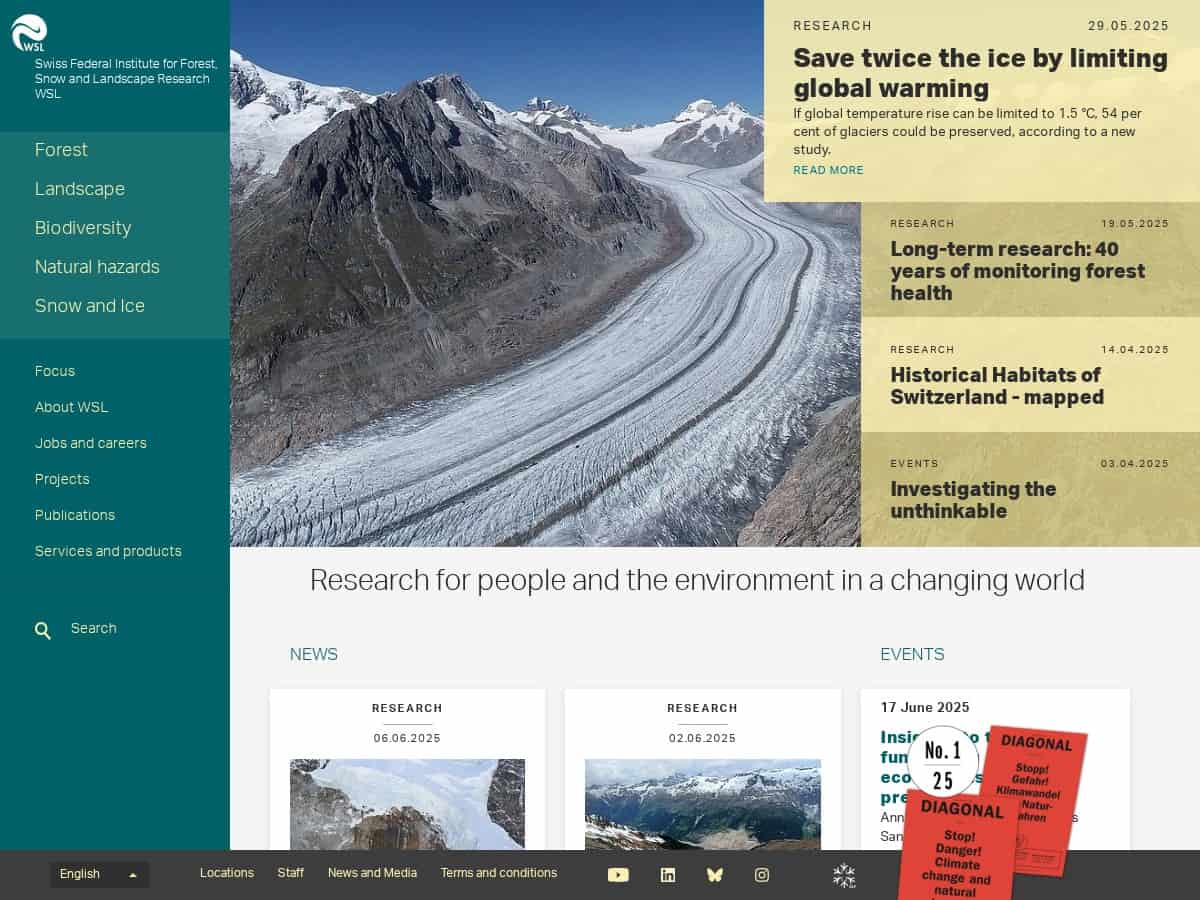
Forestry Science, Snow and Avalanche Research, Landscape Ecology, Natural Hazards
The Swiss Federal Institute for Forest, Snow and Landscape Research, known as WSL, is a federal research institute and part of the ETH Domain, with its headquarters in Birmensdorf near Zurich. Its roots lie in 1885, when a central station for experimental forestry was founded in Zurich, first housed at the Federal Polytechnic, now ETH.
Snow and avalanche research joined the institute in 1989, when the Institute for Snow and Avalanche Research SLF, based in Davos, became part of WSL. Further sites operate in Lausanne, in Ticino and in Sion, so that work on forests, mountains and landscapes can be carried out close to the Swiss regions concerned.
Research is organised around five areas: forests, biodiversity, landscape, natural hazards, and snow and ice. The SLF is responsible for the Swiss avalanche bulletin, which it issues during the winter season, and the institute has adopted Strategy 2035 to guide its priorities.
Domains taught:
Agriculture, AI and Machine Learning, Bioengineering, Bioinformatics, Chemistry, Civil Engineering, Computer Vision, Data Analytics, Ecology and Sustainability, Engineering, Fluid Dynamics, Geotechnics, Marine Science, Materials, Mathematics, Mechanical Engineering, Metrology, Nanotechnologies, Physics, Process Control, Project Management, Quality, Robotics, Signal Processing, Statistics, Structural Engineering, Telecommunications, Thermodynamics
Diplomas*:
Doctor, Master
Status:
Public
Partnerships:
Part of the ETH Domain. Collaborates with ETH Zurich, EPFL, and other universities for research and teaching. Strong international network in environmental research. Works closely with federal and cantonal authorities.
Research:
Research in forest ecology, mountain ecosystems, biodiversity, climate change impacts, snow physics, avalanche dynamics, landslide research, ecological engineering, and landscape dynamics. Hosts the SLF Institute for Snow and Avalanche Research.
Famous Alumnis:
N/A
International recognition**:
Number of staff***:
600
Current students***:
100
Foreign students***:
20%
Cumulative former students***:
300
Pros
Leading international research institute in its specialized environmental and natural hazard fields. Unique expertise and long-term monitoring. Important for postgraduate training.
Cons
Primarily a research institute. Degrees awarded via collaborating universities.
Best For
PhD students and researchers specializing in forestry, snow and avalanche science, landscape ecology, or natural hazard management.
Eawag - Eidgenössische Anstalt für Wasserversorgung, Abwasserreinigung und Gewässerschutz is another publicly funded Swiss institute devoted to aquatic research, working in the same federal research landscape.
Empa - Eidgenössische Materialprüfungs- und Forschungsanstalt, located in Dübendorf, is a public research institution focused on materials science and nanotechnology.
Paul Scherrer Institut in Villigen is a public research institute covering materials science, energy research and life sciences.
Université de Lausanne offers life sciences, geosciences and environmental science, where WSL also keeps a site.
Universität Potsdam in Germany is a public university with earth and environmental sciences among its strengths.
University of Tromsø – The Arctic University of Norway is public and lists Arctic research and marine biology.
Memorial University of Newfoundland (Canada) is a public institution whose specialties include marine and ocean technology and earth sciences.
*our own picks (our criteria: a mix between domains, diploma delivered, reputation and size), but obviously too many criteria for an apple-to-apple ranking.
FAQ
What is WSL and what does it study?
It is the Swiss Federal Institute for Forest, Snow and Landscape Research, a research institute that works on forests, biodiversity, landscape, natural hazards, and snow and ice.
How old is the institute?
Its earliest predecessor was founded in 1885 as a central station for experimental forestry in Zurich. The institute has grown since then through additions such as the snow and avalanche institute.
Where are the WSL sites?
Headquarters are in Birmensdorf near Zurich, and the SLF is in Davos. Other sites are in Lausanne, in the canton of Ticino and in Sion.
When did snow research become part of WSL?
The Institute for Snow and Avalanche Research SLF joined WSL in 1989. The SLF is based in Davos.
Who publishes the Swiss avalanche bulletin?
The SLF in Davos is responsible for it, and the institute describes the bulletin as its best-known service. It is issued during the winter season.
How is WSL linked to ETH?
WSL belongs to the ETH Domain, the Swiss federal group of universities and research institutes. This places it alongside ETH institutions while keeping its own research programme and staff.
Can I enrol as a student at WSL?
WSL is a research institute rather than a university, but its website describes teaching and continuing-education activities. For doctoral or master's projects, contact the research unit concerned and the partner university.
*: without any judgment of the quality, readers are strongly encouraged to check the official status of the exact diploma envisioned as many universities have a mix of recognized diplomas, not recognized, “co-delivered,” “equivalent to”, “some pathways” (…), can change over time, and can be named differently from one country to another.
**: international reputation: is based on some criteria that do not mean much in some domains or specialties (number of researchers, of scientific publications, on budget ….). Our approximate 1-4 scale:
known locally
known locally and internationally
is listed in some of the world university’s classifications
is listed among the 20 firsts in some of world university’s classifications
***: estimated numbers, based on online sources and/or feedbacks. The numbers can vary greatly depending on school organisation (ex.: school is part of a group, it employs internal staff or external consultants or has public staff without employing them …). Refer to all the links provided to have accurate and updated numbers.
Innovation.world is not affiliated with this school/university. We recommend to contact them directly on their website for any special request.
To complete or correct any information here or share your opinion, please comment below or > send us a direct message <.