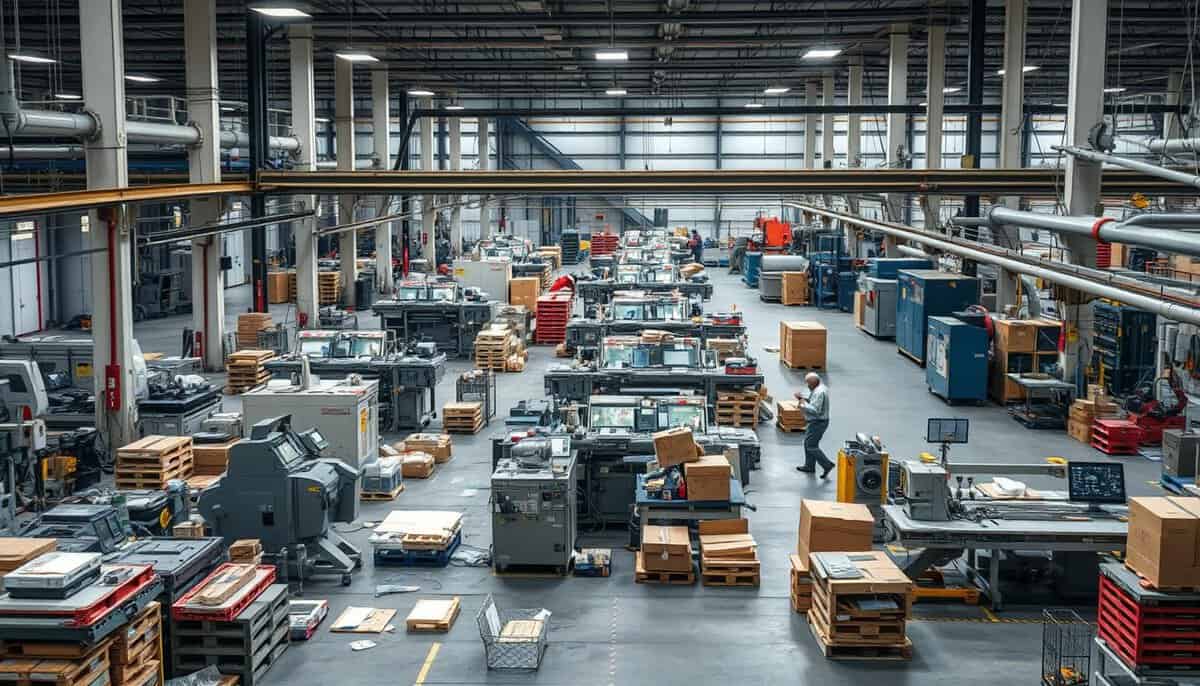
Did you know that a company’s inventory waste might lock away 30-40% of its cash? This is just one issue in リーン生産方式これは、利益と効率を損なう7種類の無駄の1つです。これらのアイデアは、大野耐一氏のものです。 トヨタ生産方式これらには、輸送、在庫、動作、待ち時間、過剰生産、過剰加工、不良品、そして8番目に最近追加された従業員の潜在能力の未活用が含まれます。目標は、製造において付加価値を生み出さない活動を見つけて排除することです。
リーン生産方式は、無駄を削減し、持続可能で効率的な生産を促進することを目的としています。あらゆる種類の無駄は資源を消費し、製品やサービスにほとんど役立たないコストを生み出します。これらの無駄に取り組むことで、企業は業務運営を大幅に改善できます。経費を削減し、生産品質を向上させることができるのです。
主なポイント
- 在庫の無駄は、企業の運転資金の30~40%を滞留させる可能性がある。
- 生産工程における待ち時間は、総生産時間の最大90%を非付加価値時間として費やすことにつながる可能性がある。
- 製造現場における生産コスト全体のうち、過剰生産が占める割合は約15~30%に及ぶ可能性がある。
- 欠陥が発生すると、特定の業界においては、総売上高の5~20%にも及ぶ再加工コストが発生する可能性がある。
- 従業員の潜在能力が活用されないと、業界によっては10~30%の生産性損失につながる可能性がある。
リーン生産方式と廃棄物削減の概要
リーン生産方式は、 リーンプロセスによる無駄 生産量を高く維持しながら。それは トヨタ 生産システム(TPS)は、新郷重雄氏と大野耐一氏のおかげで実現しました。常にプロセスを改善していくことに重点を置いており、これは「カイゼン」として知られる概念です。
要は、無駄をなくし、品質を向上させ、コストを削減し、時間を節約することです。これによって製造効率が向上します。
リーン生産方式とは何ですか?
リーン生産方式とは、高品質な製品を作り、無駄を排除することです。トヨタのような日本企業がその先駆けとなっています。ジョン・クラフチックは1988年に「リーン生産方式」という言葉を広めました。ジェームズ・ウォマック、ダニエル・T・ジョーンズ、ダニエル・ルースは、1990年の著書でこの概念についてさらに詳しく論じています。
主な目的は、業務プロセスを効率化することです。これにより、人員、資材、時間といった資源の使用量を削減しながら、価値を高めることができます。
リーン生産方式における無駄の理解
無駄、または「ムダ」とは、顧客に価値をもたらさないあらゆるもののことです。トヨタ生産方式によれば、無駄には7種類あります。輸送、在庫、動作、待ち時間、過剰生産、過剰加工、そして不良です。それぞれがコストを増加させ、効率を低下させます。例えば、
- 廃棄物輸送必要以上に資材を移動させると、生産時間とコストが増加する。
- 在庫ロス在庫が多すぎると、価値を生み出すことなく、お金とスペースを浪費するだけです。
- 動作の無駄作業員の動きが非効率的だと、生産性が低下する可能性がある。
- 待ち時間の無駄準備が整っていないときは、すべてが停止します。
- 過剰生産過剰生産は在庫の増加と保管コストの上昇につながる。
- 過剰処理顧客が望まない追加機能は、付加価値を生み出さずに生産コストを増加させる。
- 欠陥不良品は修理するか廃棄する必要があり、材料費と人件費がかさむ。
こうした無駄を効率的に管理する課題に取り組むことで、企業は業務をより円滑に、より安価に、より効率的に行うことができる。
リーン生産方式における輸送廃棄物
リーン生産方式における輸送の無駄とは、工場内で製品や資材を不必要に移動させることを指します。こうした移動は付加価値を生み出しません。この種の無駄は頻繁に発生し、生産速度の低下や効率の悪化につながります。
輸送廃棄物の例
輸送における無駄の例は数多くあります。例えば、フォークリフトを使って製品のパレットを移動させること。また、トラックで異なる作業現場間で製品を輸送することなどが挙げられます。サービス業においては、署名用の紙の書類を社内便で送付することなどがその例です。
Healthcare sees it when patients are moved too much between rooms. These movements are costly and don’t help create value. Thus, they lead to waste in リーン生産方式 practices.
輸送廃棄物を削減するための戦略
廃棄物を削減するには、企業は賢明な戦略を必要とします。例えば、施設のレイアウトを効率化し、各ステーション間の距離を短縮することが挙げられます。コンベアや自動搬送車などの資材搬送システムの改善も効果的です。
また、「5S」活動を取り入れることで、小さな無駄を見つけて排除することができます。これは生産性を大幅に向上させます。こうした取り組みによってプロセスがよりスムーズかつ迅速になり、生産ライン全体にメリットをもたらします。
Inventory Waste: The Hidden Cost
Inventory waste often goes unnoticed in lean waste analysis. It is the excessive stock, materials, or work-in-progress that uses space and money needlessly. It happens in physical business areas and in digital spaces like email or cloud storage. Cutting down on inventory waste is key to improving a business’s efficiency and finances.
it extremely frequent, and a natural behavior to have operators saying: “I currently have a bit of spare time, i will assemble additional products and stock them ASIDE FOR LATER”
Impact of Excess Inventory on Business
Having too much inventory hurts a business in many ways:
- It ties up a lot of working capital that could be used for growth.
- It leads to warehousing costs, including space, insurance, and handling fees.
- It causes stock items to lose value through depreciation or expiration.
- It can result in having to write off or dispose of outdated inventory.
“Inventory is money sitting around in a different form.” – Rhonda Adams
But it’s not just physical goods that can create waste. Digital storage and management costs can also add up. Managing data efficiently is crucial to avoid these extra expenses. So, using lean waste reduction strategies is essential.
Methods to Manage and Reduce Inventory Waste
To tackle inventory waste, lean waste analysis pinpoints where it occurs. Here are some ways to deal with it:
- ジャストインタイム (JIT) Production: Order materials only when necessary, minimizing unused raw materials and products.
- バリューストリームマッピング (VSM): This tool visualizes waste in the production process to eliminate unnecessary stock.
- Engagement of Frontline Workers: Getting suggestions from workers can find new ways to cut inventory waste.
Using these strategies helps cut costs and streamline business operations. Reducing excess inventory lowers both internal and external expenses. This leads to a more profitable and sustainable business.
Reducing Waste in Lean: Motion
In lean manufacturing, motion waste means unnecessary employee movements. These movements can happen because workspaces are set up poorly. Fixing this boosts productivity by cutting down on wasted action.
The main goal in lean is to remove waste, especially actions that don’t add value for the customer. Motion waste can be repetitive tasks or poor production floor routes. By improving layouts, we can get rid of most motion waste.
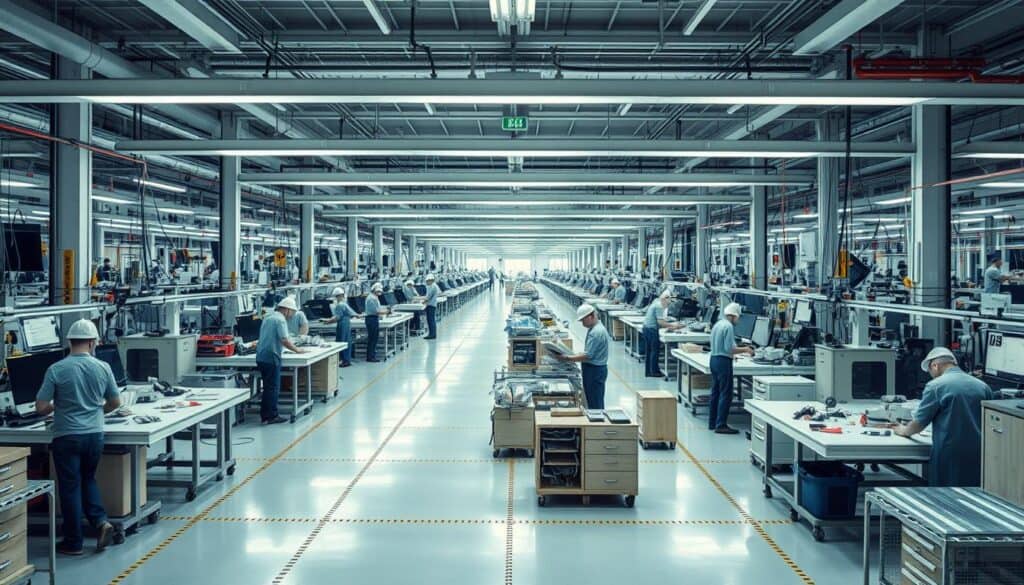
To fight motion waste, lean uses several tactics. Value stream mapping helps by showing processes and spotting wasteful steps. The 5S principles keep places tidy and efficient.
使用 人間工学に基づいた setups also helps reduce motion waste. It makes work easier by limiting how far people have to walk and awkward positions they must avoid. This streamlines production, raising productivity and lowering costs.
Here are some common ways to reduce motion waste:
- Workplace Design: Keep tools close to reduce extra steps.
- Equipment Organization: Place machines to cut down on walking.
- Standardized Work: Make clear rules to simplify movements and boost efficiency.
We aim to make every motion in the workplace efficient. This reduces waste and increases productivity in manufacturing.
See how different lean strategies improve efficiency:
| 戦略 | 応用 | Efficiency Gain |
|---|---|---|
| 5S Organization | Organizing tools and materials | Reduces searching time, enhances layout efficiency |
| Ergonomic Setup | Designing workstations ergonomically | Minimizes physical strain, enhances worker productivity |
| バリューストリームマッピング | Visualizing workflow | Identifies and eliminates motion waste steps |
By focusing on eliminating motion waste, businesses become more efficient. This improves productivity and fulfills customer needs better.
Understanding Waiting Waste and How to Eliminate It
Waiting waste is a big problem in old-style manufacturing. It happens when there is idle time between production steps. This inactivity uses up a lot of money, making things more expensive. Lean manufacturing tries to cut down or get rid of this waste by planning and working together better.
Causes of Waiting Waste
There are many types of waiting waste. For example, parts or full products can be stuck waiting, or workers might wait for materials. Other times, machines are not used, or finished goods sit too long before shipping. Reasons include unexpected downtime, jams in production, long setup times, or making too much based on guesses. These issues slow down the process, highlighting the need for better waste management.
Implementing Solutions to Reduce Waiting Waste
To fix these issues, companies can change how they do things to keep production moving smoothly. They should have clear instructions and train workers in different jobs. By improving how jobs are scheduled and kept up, waiting times drop. This helps lessen waste. Smart Factory Analytics can give tips on making these improvements in both the factory and the office.
The eight wastes, with waiting waste included, are important for companies to focus on. Cutting out waiting waste helps in many areas. It’s key for bettering profit and lowering costs. So, managing lean waste is very important for strategy.
The Problem with Overproduction
Overproduction is the biggest issue among the seven wastes in lean manufacturing. Toyota, the car maker, found it to be the main kind of waste in their system. It means making more goods than customers need right now. This creates too much inventory, which uses up money in stock, raw materials, and goods not yet sold. Companies might end up with goods made for an entire year just sitting there.
Overproducing leads to big losses for businesses. For instance, companies might have to write off 5% of their stock because it’s outdated. There was this one company that almost went under. They were losing money for three years because they made too much. The money needed to fix this problem was very small compared to the extra goods they had.
Many things cause overproduction waste. If it takes a long time to set up machines, companies make lots of items at once to use the machines well. Sometimes, if they don’t trust their machines or suppliers, they make extra just to be safe.
But there are ways to stop overproduction using lean manufacturing ideas. Knowing the value stream, making goods just in time, using the Kanban system, and making setup times shorter with SMED can help a lot. These methods can greatly lower or even get rid of overproduction.
- Lean Manufacturing Solutions:
- Understanding Value Stream
- Just-in-Time Manufacturing
- Kanban System Implementation
- SMED Technique for Setup Time Reduction
Overproducing doesn’t just mean having too much stock. It brings more problems, like needing more space, materials, energy, and work. This goes against the idea of making what’s needed when it’s needed.
| Consequences of Overproduction | 詳細 |
|---|---|
| Capital Tied Up | Stock, Raw Materials, Work in Progress, Finished Goods |
| Product Obsolescence | 5% or More Stock Written Off Annually |
| Excess Inventory | Over One Year’s Production in Stock |
| Operational Inefficiencies | Long Machine Setup Times |
| Loss of Business | Company Closure after Three Years of Losses |
It’s vital to reduce waste from overproduction. When companies match their production closely with what customers want and predict demand better, they can avoid the unnecessary costs and inefficiencies of overproducing.
Overprocessing: Doing More Than Necessary
Overprocessing happens when the work done exceeds what the customer needs. This often leads to using more resources or materials than necessary, which can make things less efficient and increase costs. Lean Manufacturing suggests making processes simpler, more standard, and error-free to stop this waste. This approach makes operations smoother and reduces expenses.
Identifying Overprocessing in Your Operations
To fight overprocessing, it’s key to look closely at how things are made and what customers really want. Overprocessing can show up as painting parts no one sees, making things shinier than needed, or using tighter tolerances than necessary. Doing a waste walk, or gemba walk, can spotlight where too much processing happens. This allows for a closer look at each step.
Steps to Minimize Overprocessing Waste
There are key steps to cut down on overprocessing waste:
- Implementing Standard Operating Procedures (SOP): set clear rules and expectations to keep things consistent and avoid doing more than needed.
- Reviewing Designs with Value Engineering: look for ways to take out parts or steps that don’t add value for the customer.
- Analyzing Process Routes: check the steps taken to make a product to find expensive or complex processes that could be made simpler or replaced.
These actions follow Lean Manufacturing ideas to help eliminate waste in lean practices and create a culture where improvement is continuous.
Defects: The Obvious Waste
Defects stand out as a big issue in the lean manufacturing world. They cost a lot and show us where we’re inefficient. Now, with Industry 4.0 and the Industrial Internet of Things (IIoT), we can tackle these problems better. Achieving an Overall Equipment Effectiveness (OEE) of 80 is the goal, yet many are at 60 or more.
To cut down on defects, integrating quality control is key. Using data analytics helps find and fix key defects. This is crucial for constant improvement. The Pareto principle shows us that most defects come from a few process issues. By focusing on these main problems, we can make the product better and operations more efficient.
The True Cost of Defects
Defects cost more than just materials and time. They also lead to unhappy customers and harm the brand. In some industries, like poultry, products are sorted by quality from premium to C-grade. Even though defective items can be sold through scratch and dent retailers, their earnings are lower. Generally, you multiply the scrap cost by ten to see the real loss.
Quality Control Measures to Reduce Defects
Using quality control measures is crucial for reducing waste in lean manufacturing. Defects often come from poor standards, weak documentation, or not enough quality checking. Tools like autonomation and Pokayoke are crucial in stopping defects. Removing defects improves quality, makes operations smoother, cuts costs, and boosts profits.

| Issue | 原因 | インパクト | Solution |
|---|---|---|---|
| Lack of Process Standards | Non-standard operations | High defect rate | Implement standardized procedures |
| Poor Documentation | Undefined processes | Inconsistent output quality | Establish clear documentation practices |
| Inadequate Quality Controls | Insufficient monitoring | Missed defects | Enhance quality control measures |
By tackling these common issues and improving quality control, manufacturers can significantly cut down on waste. They achieve better efficiency this way.
Case Studies of Lean Manufacturing Waste Reduction
Across different sectors, リーン原則 have shown great success in cutting waste. This has led to significant cost savings and better efficiency. This section highlights examples through lean waste analysis. It shows how industries have effectively minimized waste.
A mid-sized appliance manufacturer in North America faced higher raw material costs and lower market share. They used Value Stream Mapping (VSM) to find unnecessary activities. By managing inventory better and enhancing production, they cut waste and increased market share by 5%.
A U.S. healthcare equipment provider saw rising production costs and shrinking profit margins. They found too much transportation was a big problem through lean waste analysis. A new centralized distribution system reduced transportation waste, which cut production costs by 7% and improved profits.
An electricity distribution company dealt with increasing operational costs. Lean waste analysis helped them see the need for more efficient administrative processes and scheduling. Making these changes cut operational costs significantly, enhancing their financial stability.
An aerospace equipment manufacturer faced a 20% rise in inefficiencies. Using lean methodologies, they updated their manufacturing and added quality controls. This reduced defects and boosted productivity, balancing the initial rise in inefficiencies.
A transportation company providing scenic tours faced high fuel and maintenance costs. They used lean principles to focus on reducing movement waste and keeping equipment well-maintained. This greatly lowered their operational costs and improved their financial situation.
A garden equipment company in North America was inefficient and losing market share. Lean analysis showed overproduction was a big issue. Adopting a demand-based pull system reduced this waste, enhancing market response and efficiency.
A leather goods manufacturer experienced higher raw material and labor costs. Lean principles helped by reducing unnecessary inventory and making labor processes more efficient. This effectively managed the cost pressures and protected their profits.
A textile mill specializing in specialty fabrics struggled with inefficiency and competition, reducing profits by 20%. Implementing in-line quality control and Total Productive Maintenance (TPM) reduced defects and machine downtime. This improved productivity and restored profitability.
These case studies waste reduction show how lean manufacturing tackles waste in various industries. It promotes sustainable growth and better efficiency.
Creating a Waste Reduction Team
A dedicated team is crucial for waste reduction in any lean management effort. This team streamlines work, focusing on finding and eliminating waste. It leverages collective knowledge to improve operations significantly.

Best Practices for Building an Effective Team
To build an effective waste reduction team, follow these best practices:
- Cross-Functional Collaboration: gather team members from different departments for a range of views and skills.
- Clear Role Definitions: make sure everyone knows their role and what they need to do in reducing waste.
- Continuous Training: update the team on new techniques and strategies with regular training sessions.
- プロセス・マッピング: use process mapping as a visual tool to spot and understand waste areas.
- Involvement of Process Owners: involving those in charge of processes helps make fast decisions and apply improvements.
Roles and Responsibilities within the Team
It’s vital to define everyone’s role in the waste reduction team:
- Team Leader: the leader guides the team, sets goals, and aligns them with the company’s objectives.
- Process Analysts: they map processes and look for areas that are not efficient.
- Improvement Specialists: these members focus on creating strategies to cut down waste found by analysts.
- Data Analysts: they watch the team’s progress, analyze data, and report on strategy success.
- Trainers: responsible for team training, ensuring skills are up-to-date with the latest in lean management.
Following these practices and defining roles well, a lean management team can greatly improve productivity and efficiency. This allows for better waste reduction strategies within the company.
Unused Employee Potential: A Critical Eighth Waste
In the more recent years, a 8th waste was frequently added to the traditional 7 lean wastes.
Unused employee potential is a big waste in lean waste management. Organizations miss out on growth and innovation by not using their employees’ skills fully.
How Employee Potential is Often Wasted
Many factors lead to wasting employee potential. Research by Hosseini et al. shows that fear makes some companies limit employee growth. They worry skilled employees will leave for better jobs or ask for more money. Companies not rewarding talent see fewer good ideas succeed. Preventing employee growth can cause more staff to leave. This also means companies have to pay more for some positions.
Tapping into Employee Potential for Maximum Efficiency
Using talent well can make employees happier and more likely to stay. For example, IBEW electricians from Local Union 20 are proud of their work. Leaders should respect employees’ skills, give them what they need, and clear instructions. This can help save a lot of time.
- Encourage skills development through continuous training programs.
- Introduce task variation to keep work interesting and use different skills.
- Involve staff in decision-making processes for better insights and ownership.
- Recognize and use individual strengths and talents.
| 要素 | Impact of Not Addressing | Improvement Strategy |
|---|---|---|
| Limited Employee Development | Higher turnover rates and need for higher compensation | Offer regular training and advancement opportunities |
| Resistance to Talent Rewarding | Less effective ideas turned into productive outcomes | Implement a culture of recognizing and rewarding talents |
| Under-utilization of Skills | Lower morale and engagement | Utilize clear and simple directions, respect employee expertise |
Empowering employees helps make the most of their training. It ensures that the organization benefits from their unique skills and views. By focusing on this, companies can improve their lean waste management. They can also make their employees much more efficient.
結論
Our guide on lean waste reduction has taught us a lot. We’ve seen how cutting out inefficiency is key in many operations. Knowing the seven main wastes—like unneeded transport and excess inventory—helps lean followers fix these issues. This makes work more productive and valuable.
We also talked about new lean ideas, including the value of everyone’s skills. Finding and stopping wasteful actions is essential, no matter the field. Whether in making things or managing projects, tools like 現場 walks and 5 whys are great. They uncover hidden waste, letting companies make their work smoother.
In the end, sticking to lean manufacturing ideas is crucial for any company that wants to grow and beat their competition. By focusing on getting better all the time and using all employees’ talents, firms can do more than just cut waste. They create a culture of ongoing innovation and top-notch operations.
よくある質問
リーン生産方式における7つの無駄とは何ですか?
リーン生産方式における7つのムダは、大野耐一氏のトヨタ生産方式に由来する。それは、輸送、在庫、動作、待ち時間、過剰生産、過剰加工、不良品、すなわちTIMWOODである。さらに、従業員の潜在能力を十分に活用していないという8つ目のムダも存在する。
組織はどのようにして無駄を効果的に管理できるのか?
無駄を最小限に抑えるには、ジャストインタイム(JIT)生産方式、継続的な改善努力、従業員研修などが効果的です。また、無駄を徹底的に分析し、無駄削減のための専門チームを編成することで、効率を大幅に向上させることができます。
リーン生産方式において、輸送における無駄とみなされるものは何ですか?
輸送における無駄とは、製品や資材が場所内で過剰に移動することを指します。これは製品にとって何のメリットもありません。長い輸送経路、過剰な積み替え、不適切なレイアウトなどが、この無駄の原因となります。
リーン生産方式において、過剰在庫が無駄とみなされるのはなぜですか?
在庫が多すぎると、費用がかさみ、場所を取るだけでなく、商品が使われなくなる可能性もあります。企業は資源をより賢く活用する方が賢明です。ジャストインタイム(JIT)生産方式のような戦略は、在庫の無駄を削減するのに役立ちます。
リーン生産方式において、動作の無駄が生じる原因は何ですか?
動作の無駄は、作業エリアの配置が適切でない場合に発生し、人々が必要以上に動き回る原因となります。作業スペースをより効率的に設計することで、この種の無駄を削減できます。
リーン生産方式において、待ち時間という無駄をどのように排除できるでしょうか?
作業の流れをスムーズにし、スケジューリングを改善し、設備を良好な状態に保ち、生産ラインのバランスを確保することで、待ち時間の無駄を削減できます。これにより、作業の遅延や停止につながる問題を回避できます。
過剰生産とは何か、そしてリーン生産方式においてなぜ有害なのか?
過剰生産とは、顧客の需要よりも多くの製品を生産することです。これは在庫過剰と保管コストの増加につながります。顧客の実際のニーズに合わせて生産量を調整し、需要予測を改善することで、これを防ぐことができます。
リーン生産方式において、過剰加工を特定し削減するにはどうすればよいでしょうか?
過剰加工とは、顧客が要求した以上の作業を製品に施してしまうことを指します。これは、製造工程と顧客の要望を綿密に分析することで見抜くことができます。工程を簡素化し、顧客のニーズに忠実に従うことで、過剰加工を減らすことができます。
リーン生産方式における欠陥に伴う真のコストとは?
欠陥は材料と時間の無駄を意味し、顧客が不満を抱く可能性があり、企業の 評判 不具合が発生する可能性はあります。不具合の発生確率を下げるためには、厳格な品質管理を行い、工程を綿密に監視し、従業員を適切に訓練することが不可欠です。
事例研究は、リーン生産方式における無駄の削減を理解する上でどのように役立つのでしょうか?
事例研究では、リーン原則がいかに無駄の削減に役立ってきたかが示されています。様々な業界における事例を通して、これらの原則の活用によるメリットが明らかにされています。
効果的な廃棄物削減チームを構築するための最善策は何ですか?
異なる部署からチームを編成し、全員が自分の役割を理解していることを確認する 仕事そして、彼らを継続的に育成していく。チームはあらゆることを監視し、改善策を見つけ、組織全体の向上に貢献すべきだ。
組織は、従業員の潜在能力を未活用な状態から引き出し、効率性を向上させるにはどうすればよいか?
従業員を意思決定プロセスに参加させ、研修を提供し、業務内容を多様化することで、各従業員の得意分野を見極めましょう。従業員一人ひとりの真の能力を活かすことで、業務全体がより円滑に運営されるようになります。
製造業における廃棄物削減に関する外部リンク
国際規格
(リンクにカーソルを合わせると、コンテンツの説明が表示されます)
用語集
Gemba Walk: リーダーが実際に業務が行われている現場を訪れ、プロセスを観察し、従業員と交流し、改善の機会を特定することで、継続的な改善と問題解決の文化を醸成する経営手法。
Industrial Internet of Things (IIoT): 産業環境における相互接続されたデバイスとセンサーのネットワークであり、データを収集、交換、分析することで、業務効率の向上、意思決定の改善、製造、サプライチェーン、その他の産業プロセスにおける自動化を実現する。
Integrated Development Environment (IDE): コードエディタ、デバッガ、コンパイラ、ビルド自動化ツールなど、ソフトウェア開発に必要な包括的な機能を提供するソフトウェアアプリケーション。これらの機能はすべて単一のインターフェースに統合されており、生産性の向上と開発プロセスの効率化を実現します。
Internet of Things (IoT): センサー、ソフトウェア、その他の技術が組み込まれた相互接続されたデバイスのネットワークであり、インターネットを介してデータを収集および交換することを可能にし、さまざまなプロセスやシステムの自動化、監視、および制御を容易にする。
Just In Time (JIT): 製造工程で必要な時に必要な分だけ商品を受け取ることで在庫コストを削減し、無駄を最小限に抑え、効率性を向上させることを目的とした生産戦略。
Just-In-Time (JIT): 製造工程において必要な時に材料や部品が正確に届くようにスケジュールを組むことで在庫コストを削減し、無駄を最小限に抑え、効率性を向上させる生産戦略。
Overall Equipment Effectiveness (OEE): 製造プロセスの効率性を評価するために用いられる指標で、稼働率、性能率、品質率を掛け合わせて算出される。これにより損失を特定し、生産性と業務効率の向上に繋げることができる。
Single Minute Exchange of Dies (SMED): リーン生産方式の手法の一つで、設備のセットアップ時間を10分未満に短縮し、生産工程間の切り替えを迅速化し、プロセスを合理化してダウンタイムを最小限に抑えることで、全体的な効率性を向上させることを目的としています。
Standard Operating Procedure (SOP): a set of step-by-step instructions created to help workers carry out routine operations consistently and efficiently, ensuring compliance with regulations and quality standards.
Total Productive Maintenance (TPM): 生産性の最大化、ダウンタイムの削減、継続的な改善とチームワークによる設備総合効率の向上を目指し、全従業員を巻き込み、積極的かつ予防的な対策を重視した、設備メンテナンスに対する包括的なアプローチ。
Toyota Production System (TPS): 廃棄物の削減、継続的な改善、効率的な生産フローを重視し、ジャストインタイムや自働化などの技術を活用して品質と業務効率を向上させる製造方法論。
Value Engineering (VE): プロジェクトの機能分析、コスト削減、パフォーマンス向上を通じて、品質や信頼性を損なうことなくプロジェクトの価値を高めるための体系的な手法。費用対効果の高い代替案を特定し、実行するために、学際的なチームワークが不可欠である。
Value Stream Mapping (VSM): プロセスにおける材料と情報の流れを分析・最適化し、付加価値のある活動と付加価値のない活動を特定することで、効率性を向上させ、無駄を削減するために使用される視覚的なツール。
Work in Progress (WIP): 原材料、労働力、および一定の段階までに発生した間接費など、生産工程において部分的に完成した品目。これらの資産はまだ完成品ではなく、生産効率の追跡や在庫管理に不可欠です。
































