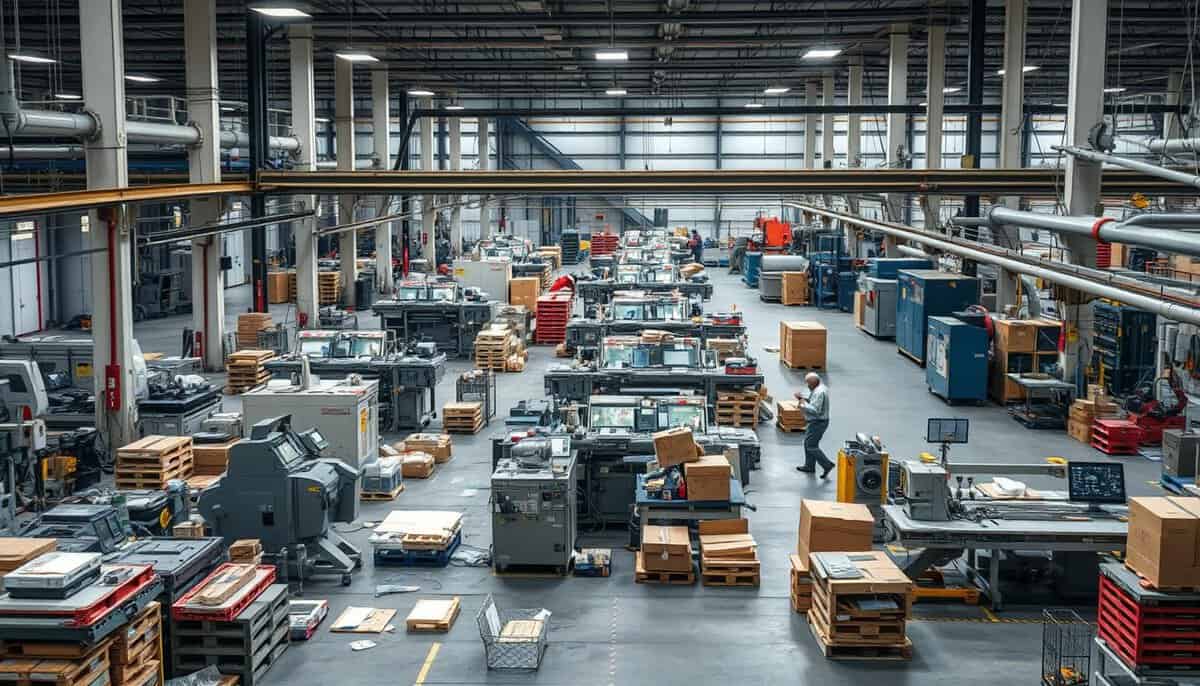
Did you know that a company’s inventory waste might lock away 30-40% of its cash? This is just one issue in 精益制造这是损害利润和效率的七种浪费类型之一。这些观点来自大野耐一。 丰田生产系统. .它们包括运输、库存、运动、等待、过度生产、过度加工、缺陷,以及最近的第 8 个 "未利用的员工潜能"。其目标是找到并消除在制造业中不增值的活动。.
精益生产旨在减少浪费,促进可持续的高效生产。每种类型的浪费都会消耗资源,并产生对产品或服务无益的成本。通过解决这些浪费问题,公司可以大大改善其运营方式。他们可以减少开支,提高生产质量。.
关键要点
- 库存浪费会占用公司高达 30-40% 的营运资金。.
- 生产过程中的等待时间可能导致总生产时间中有高达 90% 的时间不增值。.
- 生产过剩约占制造业所有生产成本的 15-30%。.
- 在某一行业,缺陷导致的返工成本可高达总销售额的 5-20%。.
- 未使用的员工潜能可造成 10-30% 的生产力损失,具体取决于行业。.
精益生产和浪费简介
精益生产旨在减少 精益流程浪费 同时保持高产量。它始于 丰田 生产系统 (TPS),这要归功于 Shigeo Shingo 和 Taiichi Ohno。其重点是不断改进流程,这一概念被称为 ‘Kaizen’。.
这一切都是为了减少浪费、提高质量、降低成本和节省时间。这使得生产更加高效。.
什么是精益生产?
精益生产就是要制造优质产品,杜绝浪费。丰田等日本公司在这方面处于领先地位。1988 年,约翰-克拉夫西克(John Krafcik)使 “精益生产 ”一词流行起来。詹姆斯-沃马克(James Womack)、丹尼尔-琼斯(Daniel T. Jones)和丹尼尔-罗斯(Daniel Roos)在 1990 年出版的书中对此有更多论述。.
主要目标是简化流程。这样既能提高价值,又能减少人力、材料和时间等资源的使用。.
了解精益生产中的浪费
浪费,或 “muda”,是指任何不能为客户带来价值的东西。根据丰田生产方式,有七种浪费类型:运输、库存、运动、等待、过度生产、过度加工和缺陷。每一种都会增加成本,降低效率。例如
- 废物运输搬运超出实际需要的物料会增加生产时间和成本。
- 库存废物库存过多既浪费资金又占用空间,却没有创造价值。
- 运动废物工人行动效率低下会降低生产效率。
- 等待废物当事情还没准备就绪时,一切都会停止。
- 生产过剩生产过多意味着额外的库存和更高的仓储成本。
- 过度处理:客户不需要的额外功能会增加生产成本,但不会增加价值。
- 缺陷有缺陷的产品需要修理或丢弃,这会增加材料和人工成本。
通过解决这些精益浪费管理问题,公司可以使运营更加顺畅、成本更低、效率更高。
精益生产中的运输浪费
精益生产中的运输浪费是指在工厂内不必要地移动产品和物料。这些移动不会增加价值。这类浪费频繁发生,导致生产速度减慢、效率降低。
运输废物实例
运输废物的例子有很多。一种是使用叉车搬运产品托盘。另一个例子是卡车在不同的工作地点之间运输产品。在服务业,浪费可以表现为通过部门间邮件发送需要签字的纸质表格。.
Healthcare sees it when patients are moved too much between rooms. These movements are costly and don’t help create value. Thus, they lead to waste in 精益生产 practices.
减少运输垃圾的策略
为了减少浪费,企业需要明智的策略。他们可以提高设施布局的效率,缩短站与站之间的距离。更好的物料处理,如使用传送带或自动车辆,也会有所帮助。.
此外,采用 “5S ”做法可以发现并清除较小的浪费。这大大提高了生产率。这些步骤使流程更加顺畅和快捷,使整个生产线受益匪浅。.
Inventory Waste: The Hidden Cost
Inventory waste often goes unnoticed in lean waste analysis. It is the excessive stock, materials, or work-in-progress that uses space and money needlessly. It happens in physical business areas and in digital spaces like email or cloud storage. Cutting down on inventory waste is key to improving a business’s efficiency and finances.
it extremely frequent, and a natural behavior to have operators saying: “I currently have a bit of spare time, i will assemble additional products and stock them ASIDE FOR LATER”
Impact of Excess Inventory on Business
Having too much inventory hurts a business in many ways:
- It ties up a lot of working capital that could be used for growth.
- It leads to warehousing costs, including space, insurance, and handling fees.
- It causes stock items to lose value through depreciation or expiration.
- It can result in having to write off or dispose of outdated inventory.
“Inventory is money sitting around in a different form.” – Rhonda Adams
But it’s not just physical goods that can create waste. Digital storage and management costs can also add up. Managing data efficiently is crucial to avoid these extra expenses. So, using lean waste reduction strategies is essential.
Methods to Manage and Reduce Inventory Waste
To tackle inventory waste, lean waste analysis pinpoints where it occurs. Here are some ways to deal with it:
- 准时制 (JIT) Production: Order materials only when necessary, minimizing unused raw materials and products.
- 价值流图 (VSM): This tool visualizes waste in the production process to eliminate unnecessary stock.
- Engagement of Frontline Workers: Getting suggestions from workers can find new ways to cut inventory waste.
Using these strategies helps cut costs and streamline business operations. Reducing excess inventory lowers both internal and external expenses. This leads to a more profitable and sustainable business.
Reducing Waste in Lean: Motion
In lean manufacturing, motion waste means unnecessary employee movements. These movements can happen because workspaces are set up poorly. Fixing this boosts productivity by cutting down on wasted action.
The main goal in lean is to remove waste, especially actions that don’t add value for the customer. Motion waste can be repetitive tasks or poor production floor routes. By improving layouts, we can get rid of most motion waste.
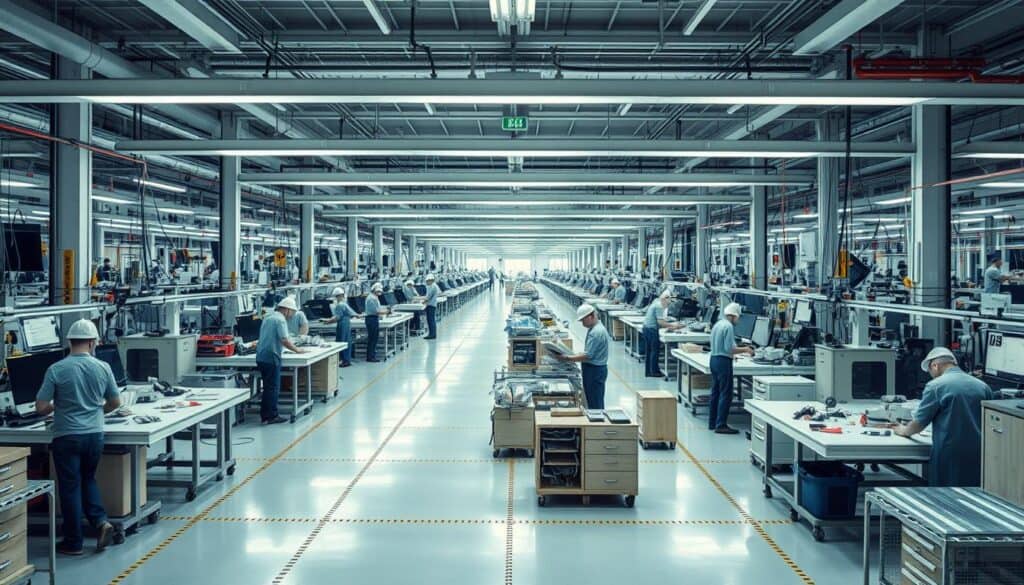
To fight motion waste, lean uses several tactics. Value stream mapping helps by showing processes and spotting wasteful steps. The 5S principles keep places tidy and efficient.
使用 人类工程学的 setups also helps reduce motion waste. It makes work easier by limiting how far people have to walk and awkward positions they must avoid. This streamlines production, raising productivity and lowering costs.
Here are some common ways to reduce motion waste:
- Workplace Design: Keep tools close to reduce extra steps.
- Equipment Organization: Place machines to cut down on walking.
- Standardized Work: Make clear rules to simplify movements and boost efficiency.
We aim to make every motion in the workplace efficient. This reduces waste and increases productivity in manufacturing.
See how different lean strategies improve efficiency:
| 战略 | 应用 | Efficiency Gain |
|---|---|---|
| 5S Organization | Organizing tools and materials | Reduces searching time, enhances layout efficiency |
| Ergonomic Setup | Designing workstations ergonomically | Minimizes physical strain, enhances worker productivity |
| 价值流图 | Visualizing workflow | Identifies and eliminates motion waste steps |
By focusing on eliminating motion waste, businesses become more efficient. This improves productivity and fulfills customer needs better.
Understanding Waiting Waste and How to Eliminate It
Waiting waste is a big problem in old-style manufacturing. It happens when there is idle time between production steps. This inactivity uses up a lot of money, making things more expensive. Lean manufacturing tries to cut down or get rid of this waste by planning and working together better.
Causes of Waiting Waste
There are many types of waiting waste. For example, parts or full products can be stuck waiting, or workers might wait for materials. Other times, machines are not used, or finished goods sit too long before shipping. Reasons include unexpected downtime, jams in production, long setup times, or making too much based on guesses. These issues slow down the process, highlighting the need for better waste management.
Implementing Solutions to Reduce Waiting Waste
To fix these issues, companies can change how they do things to keep production moving smoothly. They should have clear instructions and train workers in different jobs. By improving how jobs are scheduled and kept up, waiting times drop. This helps lessen waste. Smart Factory Analytics can give tips on making these improvements in both the factory and the office.
The eight wastes, with waiting waste included, are important for companies to focus on. Cutting out waiting waste helps in many areas. It’s key for bettering profit and lowering costs. So, managing lean waste is very important for strategy.
The Problem with Overproduction
Overproduction is the biggest issue among the seven wastes in lean manufacturing. Toyota, the car maker, found it to be the main kind of waste in their system. It means making more goods than customers need right now. This creates too much inventory, which uses up money in stock, raw materials, and goods not yet sold. Companies might end up with goods made for an entire year just sitting there.
Overproducing leads to big losses for businesses. For instance, companies might have to write off 5% of their stock because it’s outdated. There was this one company that almost went under. They were losing money for three years because they made too much. The money needed to fix this problem was very small compared to the extra goods they had.
Many things cause overproduction waste. If it takes a long time to set up machines, companies make lots of items at once to use the machines well. Sometimes, if they don’t trust their machines or suppliers, they make extra just to be safe.
But there are ways to stop overproduction using lean manufacturing ideas. Knowing the value stream, making goods just in time, using the 看板 system, and making setup times shorter with 铁匠 can help a lot. These methods can greatly lower or even get rid of overproduction.
- Lean Manufacturing Solutions:
- Understanding Value Stream
- Just-in-Time Manufacturing
- Kanban System Implementation
- SMED Technique for Setup Time Reduction
Overproducing doesn’t just mean having too much stock. It brings more problems, like needing more space, materials, energy, and work. This goes against the idea of making what’s needed when it’s needed.
| Consequences of Overproduction | 细节 |
|---|---|
| Capital Tied Up | Stock, Raw Materials, Work in Progress, Finished Goods |
| Product Obsolescence | 5% or More Stock Written Off Annually |
| Excess Inventory | Over One Year’s Production in Stock |
| Operational Inefficiencies | Long Machine Setup Times |
| Loss of Business | Company Closure after Three Years of Losses |
It’s vital to reduce waste from overproduction. When companies match their production closely with what customers want and predict demand better, they can avoid the unnecessary costs and inefficiencies of overproducing.
Overprocessing: Doing More Than Necessary
Overprocessing happens when the work done exceeds what the customer needs. This often leads to using more resources or materials than necessary, which can make things less efficient and increase costs. Lean Manufacturing suggests making processes simpler, more standard, and error-free to stop this waste. This approach makes operations smoother and reduces expenses.
Identifying Overprocessing in Your Operations
To fight overprocessing, it’s key to look closely at how things are made and what customers really want. Overprocessing can show up as painting parts no one sees, making things shinier than needed, or using tighter tolerances than necessary. Doing a waste walk, or 现场考察, can spotlight where too much processing happens. This allows for a closer look at each step.
Steps to Minimize Overprocessing Waste
There are key steps to cut down on overprocessing waste:
- Implementing Standard Operating Procedures (SOP): set clear rules and expectations to keep things consistent and avoid doing more than needed.
- Reviewing Designs with Value Engineering: look for ways to take out parts or steps that don’t add value for the customer.
- Analyzing Process Routes: check the steps taken to make a product to find expensive or complex processes that could be made simpler or replaced.
These actions follow Lean Manufacturing ideas to help eliminate waste in lean practices and create a culture where improvement is continuous.
Defects: The Obvious Waste
Defects stand out as a big issue in the lean manufacturing world. They cost a lot and show us where we’re inefficient. Now, with Industry 4.0 and the Industrial Internet of Things (物联网), we can tackle these problems better. Achieving an Overall Equipment Effectiveness (OEE) of 80 is the goal, yet many are at 60 or more.
To cut down on defects, integrating quality control is key. Using data analytics helps find and fix key defects. This is crucial for constant improvement. The Pareto principle shows us that most defects come from a few process issues. By focusing on these main problems, we can make the product better and operations more efficient.
The True Cost of Defects
Defects cost more than just materials and time. They also lead to unhappy customers and harm the brand. In some industries, like poultry, products are sorted by quality from premium to C-grade. Even though defective items can be sold through scratch and dent retailers, their earnings are lower. Generally, you multiply the scrap cost by ten to see the real loss.
Quality Control Measures to Reduce Defects
Using quality control measures is crucial for reducing waste in lean manufacturing. Defects often come from poor standards, weak documentation, or not enough quality checking. Tools like autonomation and Pokayoke are crucial in stopping defects. Removing defects improves quality, makes operations smoother, cuts costs, and boosts profits.

| Issue | Cause | 影响 | 解决方案 |
|---|---|---|---|
| Lack of Process Standards | Non-standard operations | High defect rate | Implement standardized procedures |
| Poor Documentation | Undefined processes | Inconsistent output quality | Establish clear documentation practices |
| Inadequate Quality Controls | Insufficient monitoring | Missed defects | Enhance quality control measures |
By tackling these common issues and improving quality control, manufacturers can significantly cut down on waste. They achieve better efficiency this way.
Case Studies of Lean Manufacturing Waste Reduction
Across different sectors, 精益原则 have shown great success in cutting waste. This has led to significant cost savings and better efficiency. This section highlights examples through lean waste analysis. It shows how industries have effectively minimized waste.
A mid-sized appliance manufacturer in North America faced higher raw material costs and lower market share. They used Value Stream Mapping (VSM) to find unnecessary activities. By managing inventory better and enhancing production, they cut waste and increased market share by 5%.
A U.S. healthcare equipment provider saw rising production costs and shrinking profit margins. They found too much transportation was a big problem through lean waste analysis. A new centralized distribution system reduced transportation waste, which cut production costs by 7% and improved profits.
An electricity distribution company dealt with increasing operational costs. Lean waste analysis helped them see the need for more efficient administrative processes and scheduling. Making these changes cut operational costs significantly, enhancing their financial stability.
An aerospace equipment manufacturer faced a 20% rise in inefficiencies. Using lean methodologies, they updated their manufacturing and added quality controls. This reduced defects and boosted productivity, balancing the initial rise in inefficiencies.
A transportation company providing scenic tours faced high fuel and maintenance costs. They used lean principles to focus on reducing movement waste and keeping equipment well-maintained. This greatly lowered their operational costs and improved their financial situation.
A garden equipment company in North America was inefficient and losing market share. Lean analysis showed overproduction was a big issue. Adopting a demand-based pull system reduced this waste, enhancing market response and efficiency.
A leather goods manufacturer experienced higher raw material and labor costs. Lean principles helped by reducing unnecessary inventory and making labor processes more efficient. This effectively managed the cost pressures and protected their profits.
A textile mill specializing in specialty fabrics struggled with inefficiency and competition, reducing profits by 20%. Implementing in-line quality control and 全面生产维护 (TPM) reduced defects and machine downtime. This improved productivity and restored profitability.
These case studies waste reduction show how lean manufacturing tackles waste in various industries. It promotes sustainable growth and better efficiency.
Creating a Waste Reduction Team
A dedicated team is crucial for waste reduction in any lean management effort. This team streamlines work, focusing on finding and eliminating waste. It leverages collective knowledge to improve operations significantly.

Best Practices for Building an Effective Team
To build an effective waste reduction team, follow these best practices:
- Cross-Functional Collaboration: gather team members from different departments for a range of views and skills.
- Clear Role Definitions: make sure everyone knows their role and what they need to do in reducing waste.
- Continuous Training: update the team on new techniques and strategies with regular training sessions.
- 绘制流程图: use process mapping as a visual tool to spot and understand waste areas.
- Involvement of Process Owners: involving those in charge of processes helps make fast decisions and apply improvements.
Roles and Responsibilities within the Team
It’s vital to define everyone’s role in the waste reduction team:
- Team Leader: the leader guides the team, sets goals, and aligns them with the company’s objectives.
- Process Analysts: they map processes and look for areas that are not efficient.
- Improvement Specialists: these members focus on creating strategies to cut down waste found by analysts.
- Data Analysts: they watch the team’s progress, analyze data, and report on strategy success.
- Trainers: responsible for team training, ensuring skills are up-to-date with the latest in lean management.
Following these practices and defining roles well, a lean management team can greatly improve productivity and efficiency. This allows for better waste reduction strategies within the company.
Unused Employee Potential: A Critical Eighth Waste
In the more recent years, a 8th waste was frequently added to the traditional 7 lean wastes.
Unused employee potential is a big waste in lean waste management. Organizations miss out on growth and innovation by not using their employees’ skills fully.
How Employee Potential is Often Wasted
Many factors lead to wasting employee potential. Research by Hosseini et al. shows that fear makes some companies limit employee growth. They worry skilled employees will leave for better jobs or ask for more money. Companies not rewarding talent see fewer good ideas succeed. Preventing employee growth can cause more staff to leave. This also means companies have to pay more for some positions.
Tapping into Employee Potential for Maximum Efficiency
Using talent well can make employees happier and more likely to stay. For example, IBEW electricians from Local Union 20 are proud of their work. Leaders should respect employees’ skills, give them what they need, and clear instructions. This can help save a lot of time.
- Encourage skills development through continuous training programs.
- Introduce task variation to keep work interesting and use different skills.
- Involve staff in decision-making processes for better insights and ownership.
- Recognize and use individual strengths and talents.
| 因素 | Impact of Not Addressing | Improvement Strategy |
|---|---|---|
| Limited Employee Development | Higher turnover rates and need for higher compensation | Offer regular training and advancement opportunities |
| Resistance to Talent Rewarding | Less effective ideas turned into productive outcomes | Implement a culture of recognizing and rewarding talents |
| Under-utilization of Skills | Lower morale and engagement | Utilize clear and simple directions, respect employee expertise |
Empowering employees helps make the most of their training. It ensures that the organization benefits from their unique skills and views. By focusing on this, companies can improve their lean waste management. They can also make their employees much more efficient.
结论
Our guide on lean waste reduction has taught us a lot. We’ve seen how cutting out inefficiency is key in many operations. Knowing the seven main wastes—like unneeded transport and excess inventory—helps lean followers fix these issues. This makes work more productive and valuable.
We also talked about new lean ideas, including the value of everyone’s skills. Finding and stopping wasteful actions is essential, no matter the field. Whether in making things or managing projects, tools like 现场 walks and 5 个为什么 are great. They uncover hidden waste, letting companies make their work smoother.
In the end, sticking to lean manufacturing ideas is crucial for any company that wants to grow and beat their competition. By focusing on getting better all the time and using all employees’ talents, firms can do more than just cut waste. They create a culture of ongoing innovation and top-notch operations.
常问问题
精益的七大浪费是什么?
精益生产的七大浪费源自大野耐一的丰田生产方式。它们分别是运输、库存、动作、等待、过度生产、过度加工和缺陷,简称TIMWOOD。此外,还有第八大浪费,即未能充分发挥员工的潜力。
组织如何有效管理精益浪费?
通过准时制(JIT)生产、持续改进和培训员工,管理精益浪费是可行的。此外,深入分析浪费现象并成立专门小组来减少浪费,也能大大提高效率。.
什么是精益生产中的运输浪费?
运输废物是指产品或材料在一个地方的移动量过大。这对产品没有任何帮助。路线过长、转运次数过多、布局不合理等问题都可能造成这种浪费。.
为什么在精益生产中多余库存被视为浪费?
过多的库存会耗费资金、占用空间,还可能导致物品无人使用。企业最好更明智地使用资源。及时生产(JIT)等策略有助于减少库存浪费。.
精益生产环境中造成运动浪费的原因是什么?
如果工作区域设置不合理,导致人们的移动次数超过需要,就会造成移动浪费。提高工作空间的效率并对其进行更好的设计,可以减少这类浪费。.
如何在精益生产中消除等待浪费?
通过使工作流程更顺畅、更好地安排时间、保持设备完好以及确保生产线平衡,可以减少等待浪费。这样就能避免延误或停工问题。.
什么是生产过剩,为什么对精益生产有害?
生产过剩意味着生产的产品多于客户的需求。这会导致多余的产品和更高的仓储成本。使生产与客户的实际需求保持一致并改进预测,可以避免这种情况的发生。.
如何在精益生产中识别并减少过度加工?
过度加工是指产品的加工量超过了客户的要求。仔细观察生产步骤和客户需求,就能发现这一问题。简化流程和坚持客户需求可以减少过度加工。.
精益生产中与缺陷相关的真实成本是多少?
瑕疵意味着材料和时间的浪费,客户可能会不高兴,而公司的 名声 可能会受到影响。要降低缺陷发生的几率,关键是要有强有力的质量控制,密切关注流程,并对员工进行良好的培训。.
案例研究如何帮助理解精益减少浪费?
案例研究展示了精益原则如何真正帮助减少浪费。他们举例说明了在各行各业使用这些原则的好处。.
建立有效减少废物团队的最佳做法是什么?
组建一支来自不同部门的团队,确保每个人都知道自己的职责。 工作并持续对他们进行培训。团队应该监督一切,寻找改进方法,并帮助整个组织不断进步。
企业如何挖掘员工的潜力以提高效率?
让员工参与决策、提供培训、混合任务,看看每个人最擅长做什么。发挥每个员工的真正能力,会让整个运营更加顺畅。.
有关减少制造业废物的外部链接
(将鼠标悬停在链接上即可查看内容描述)
常用术语表
Gemba Walk: 一种管理实践,涉及领导者访问实际工作地点以观察流程,与员工互动并发现改进机会,培养持续改进和解决问题的文化。
Industrial Internet of Things (IIoT): 工业环境中互连的设备和传感器网络,用于收集、交换和分析数据,以提高运营效率、改善决策并实现制造、供应链和其他工业流程的自动化。
Integrated Development Environment (IDE): 一款软件应用程序,提供全面的软件开发功能,包括代码编辑器、调试器、编译器和构建自动化工具,所有功能都集成在一个界面中,以提高生产力并简化开发过程。
Internet of Things (IoT): 一个由嵌入传感器、软件和其他技术的互连设备组成的网络,使它们能够通过互联网收集和交换数据,促进各种流程和系统的自动化、监控和控制。
Just In Time (JIT): 一种生产策略,旨在通过仅在制造过程中需要时接收货物来降低库存成本,从而最大限度地减少浪费并提高效率。
Just-In-Time (JIT): 一种生产策略,通过安排材料和组件在制造过程中需要时精确到达,从而降低库存成本,最大限度地减少浪费,提高效率。
Overall Equipment Effectiveness (OEE): 用于评估制造流程效率的指标,通过将可用性、性能和合格率相乘得出。它可以识别损失,从而提高生产力和运营效率。
Single Minute Exchange of Dies (SMED): 一种精益制造技术,旨在将设备设置时间缩短至十分钟以内,实现生产运行之间的更快转换,并通过简化流程和最大限度地减少停机时间来提高整体效率。
Standard Operating Procedure (SOP): 一套分步说明,旨在帮助工人持续高效地执行日常操作,确保遵守法规和质量标准。
Total Productive Maintenance (TPM): 一种强调主动和预防措施的整体设备维护方法,让所有员工参与,通过持续改进和团队合作最大限度地提高生产力、减少停机时间并提高整体设备效率。
Toyota Production System (TPS): 一种强调减少浪费、持续改进和高效生产流程的制造方法,利用准时制生产和自働化等技术来提高质量和运营效率。
Value Engineering (VE): 一种系统化的方法,通过分析项目功能、降低成本、提升性能,在不牺牲质量或可靠性的前提下提升项目价值。它需要跨学科团队合作,以识别和实施具有成本效益的替代方案。
Value Stream Mapping (VSM): 一种可视化工具,用于分析和优化流程中的物料和信息流,识别增值和非增值活动,以提高效率并减少浪费。
Work in Progress (WIP): 生产过程中部分完成的物品,包括原材料、人工以及达到一定程度的间接成本。这些资产尚未成为成品,对于跟踪生产效率和库存管理至关重要。