Product Design, Manufacturing & Innovation Resources
Home » Conservation of Mass

Conservation of Mass

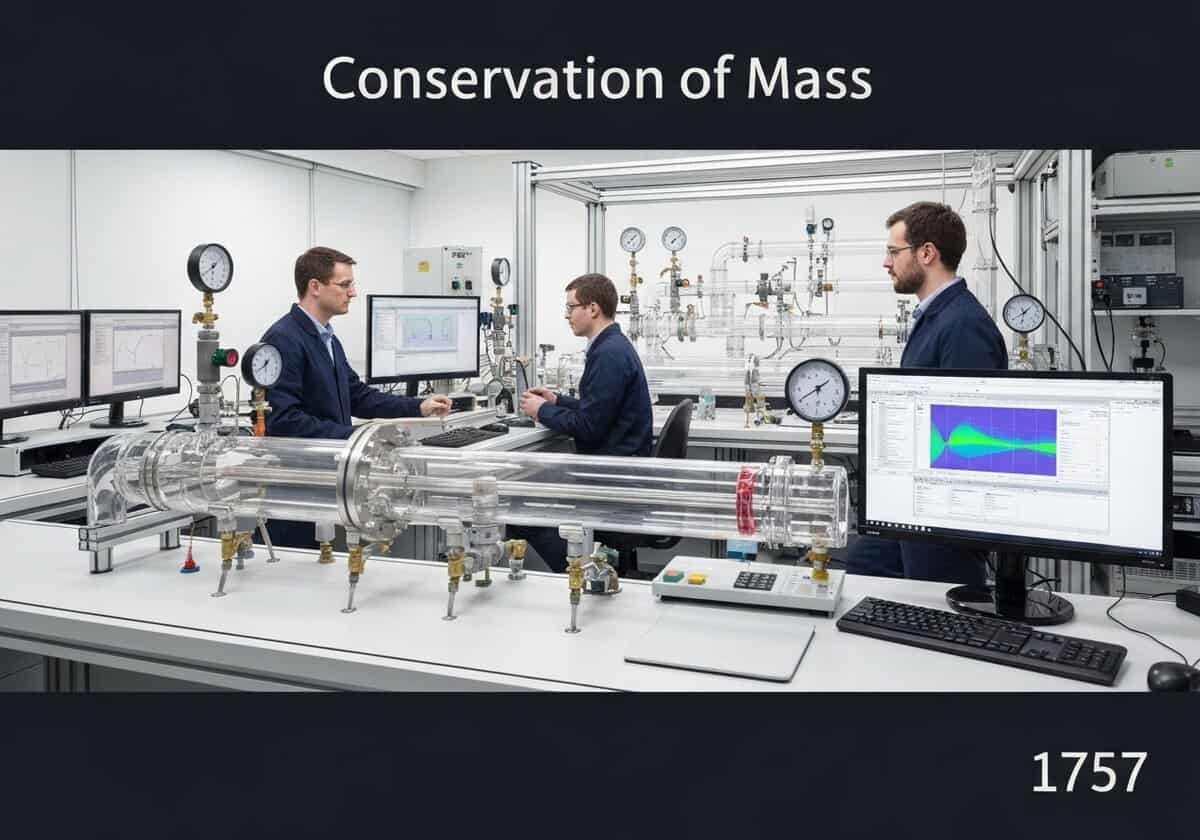
1757
Fluid dynamics laboratory with engineers analyzing flow in pipelines, emphasizing mass conservation principles.

(generated image for illustration only)

In continuum mechanics, the principle of mass conservation states that the mass of a closed system must remain constant over time. For a fluid, this is expressed by the continuity equation. In its Eulerian differential form, it is written as \(\frac{\partial \rho}{\partial t} + \nabla \cdot (\rho \mathbf{u}) = 0\), where \(\rho\) is the density and \(\mathbf{u}\) is the velocity field.

The conservation of mass is a fundamental principle in physics, and its mathematical formulation within continuum mechanics is known as the continuity equation. This equation provides a precise statement about how the density of a material changes in space and time. The equation \(\frac{\partial \rho}{\partial t} + \nabla \cdot (\rho \mathbf{u}) = 0\) applies at every point within the continuum. The term \(\frac{\partial \rho}{\partial t}\) represents the rate of change of density at a fixed point (the local or unsteady term), while the term \(\nabla \cdot (\rho \mathbf{u})\) is the divergence of the mass flux (\(\rho \mathbf{u}\)), representing the net rate of mass flowing out of an infinitesimal volume around that point.

The equation essentially states that if the density at a point is increasing, it must be because more mass is flowing into the infinitesimal volume than is flowing out, and vice versa. For a special case known as an incompressible flow, the density \(\rho\) of a fluid parcel is assumed to be constant as it moves. In this case, the continuity equation simplifies significantly to \(\nabla \cdot \mathbf{u} = 0\). This simplified form is widely used in modeling liquids like water and in low-speed aerodynamics. The continuity equation is one of the core governing equations, alongside the conservation of momentum and energy, used in virtually all analyses in fluid dynamics and solid mechanics.

UNESCO Nomenclature: 2209
– Fluid dynamics

Type

Physical Law

Disruption

Foundational

Usage

Widespread Use

Precursors

  • The philosophical principle of conservation of matter
  • Development of vector calculus and the divergence theorem
  • Leonhard Euler’s formulation of fluid motion equations
  • Daniel Bernoulli’s work on fluid dynamics

Applications

  • design of pipelines and HVAC systems to ensure proper flow rates
  • aerospace engineering for calculating air density changes around aircraft
  • hydrology for modeling river flow and groundwater movement
  • meteorology for forecasting weather patterns based on air mass movement

Patents:

NA

Potential Innovations Ideas

  • self-regulating ‘smart pipes’ that adjust their diameter to maintain constant mass flow under varying pressure
  • urban planning software that models pedestrian flow using continuity equations to prevent crowd congestion
  • ai-powered logistics systems that treat goods in a supply chain as a continuous flow to optimize inventory
  • advanced fire suppression systems that use continuity equations to predict smoke and heat propagation in real-time
  • biological models that use continuity equations to describe tumor growth and cell population dynamics
  • financial market models that treat trading volume and capital as a conserved quantity in a flow field
  • waste management systems that model landfill material compaction and gas generation using continuum principles
  • data traffic management algorithms for computer networks based on the principles of fluid continuity
Related to: continuity equation, conservation of mass, fluid dynamics, density, velocity field, incompressible flow, divergence, mass flux.

Historical Context

Conservation of Mass

1687
1738
1750
1757
1788
1800
1800
1687
1687
1738
1750
1785
1788
1800
1800

(if date is unknown or not relevant, e.g. "fluid mechanics", a rounded estimation of its notable emergence is provided)

10th year anniversary

Full size images and downloads are only available, 100% free, for registered members.

> Login <