Product Design, Manufacturing & Innovation Resources
Home » Coulomb’s Law

Coulomb’s Law

1785
  • Charles-Augustin de Coulomb
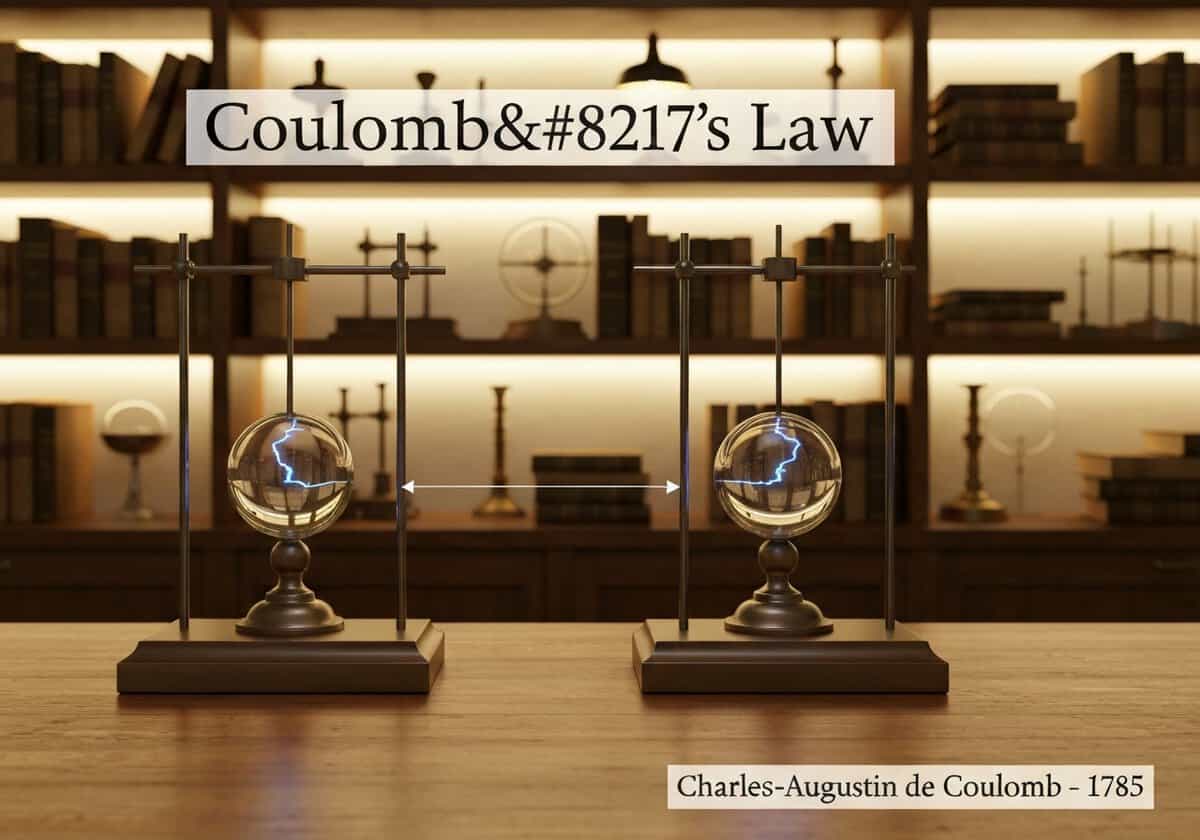
Antique electrostatic apparatus demonstrating Coulomb's Law in a vintage laboratory.

(generated image for illustration only)

Coulomb’s Law quantifies the electrostatic force between two stationary, electrically charged particles. The force is directly proportional to the product of the magnitudes of the charges and inversely proportional to the square of the distance between them. The formula is \(F = k_e \frac{q_1 q_2}{r^2}\). This force can be either attractive or repulsive.

Coulomb’s Law is a fundamental principle of electrostatics, analogous in its inverse-square form to Newton’s Law of Universal Gravitation. The constant of proportionality, \(k_e\), is known as Coulomb’s constant and is approximately \(8.987 \times 10^9 \text{ N}\cdot\text{m}^2\cdot\text{C}^{-2}\). It is often expressed in terms of the vacuum permittivity, \(\varepsilon_0\), as \(k_e = 1/(4\pi\varepsilon_0)\). The permittivity reflects the ability of a material (or vacuum) to transmit electric fields. The vector form of the law, \(\mathbf{F}_{12} = k_e \frac{q_1 q_2}{r_{12}^2} \hat{\mathbf{r}}_{12}\), provides both the magnitude and direction of the force exerted by charge \(q_1\) on charge \(q_2\).

This law is foundational for describing the interactions that hold atoms together, as the force between the positively charged nucleus and negatively charged electrons is governed by this principle. It also underpins the concept of the electric field, where a charge \(q\) creates a field \(\mathbf{E}\) in the space around it, and any other charge \(Q\) placed in this field experiences a force \(\mathbf{F} = Q\mathbf{E}\). While extremely accurate for macroscopic distances and static charges, its classical form requires modification in quantum mechanics and for rapidly moving charges, where relativistic effects become significant.

UNESCO Nomenclature: 2205
– Electricity and Magnetism

Type

Physical Law

Disruption

Foundational

Usage

Widespread Use

Precursors

  • discovery of electric charge and its properties (attraction/repulsion)
  • experiments by Henry Cavendish (unpublished)
  • Joseph Priestley’s suggestion of an inverse-square law for electricity
  • Newton’s law of universal gravitation (as a mathematical analogue)

Applications

  • electrostatics
  • design of electrical components like capacitors
  • understanding atomic and molecular bonding
  • particle accelerators
  • inkjet printers

Patents:

NA

Potential Innovations Ideas

Due to scrapping bot traffic, currently more than 40k per day, this content is reserved to community members.
> Login < or > Register < (100% free) to access this, so as all other restricted content and tools.

Related to: Coulomb’s law, electrostatics, electric force, point charge, inverse-square law, electric field, charge, permittivity, force, Coulomb.

Historical Context

Coulomb’s Law

1687
1738
1750
1785
1788
1800
1800
1687
1738
1750
1757
1788
1800
1800
1800

(if date is unknown or not relevant, e.g. "fluid mechanics", a rounded estimation of its notable emergence is provided)

Related Invention, Innovation & Technical Principles

Full size images and downloads are only available, 100% free, for registered members.

> Login <