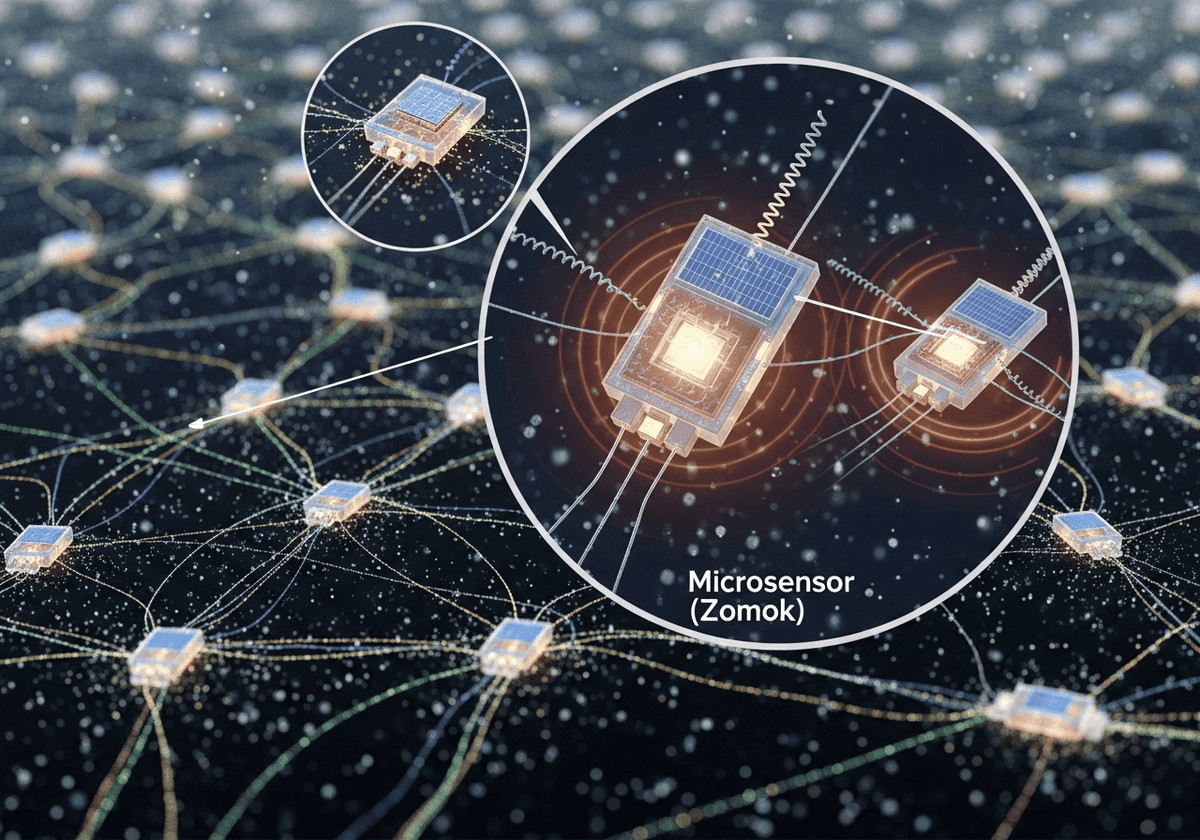

Smart Dust consists of networks of millimeter- or micrometer-scale wireless microsensors and actuators integrating microelectromechanical systems (MEMS), ultralow-power microcontrollers, and ambient energy harvesting to enable distributed sensing and computation. Core technologies include microscale communication protocols, microfabrication techniques, sensor fusion algorithms, and scalable ad-hoc networking architectures. Applications span environmental monitoring, industrial automation, and ubiquitous computing, relying on self-organization, micropower management, and secure data transmission within dense, spatially distributed node arrays. Our continuously updated compilation below presents the latest peer-reviewed publications and patents detailing advances in microsystem integration, nanomaterials, microtransceiver design, and system-level optimization driving the evolution of Smart Dust platforms.
This is our latest selection of worldwide publications and patents in english on Smart Dust, between many scientific online journals, classified and focused on micro sensor, nano network, wireless microsystem, micro robot, ultra low power, micro electromechanical system, MEMS, distributed computing, ambient energy harvesting, microscale communication, sensor fusion, micro actuator, nano power, microscale processing, wireless sensor node, micro fabrication, environmental monitoring, ubiquitous computing, microsystem integration, nanorobotic, ad-hoc network, micro power management, nanomaterial, microscale energy, microcontroller, microscale antenna, scalable sensing and microsystem security.
Device and method for synchronized memory
Patent published on the 2026-07-02 in WO under Ref WO2026142858 by MICROCHIP TECH INCORPORATED [US] (Kumar Ravindra [us])
Abstract: A microcontroller is provided comprising a processor, a data bus interface, a random access memory (RAM) including a plurality of pages, and a non-transitory computer readable memory including instructions, that when executed on the processor, after the microcontroller writes data to a first page of the plurality of pages, send a first interrupt to a host CPU external to the microcontroller; and process a second interrupt triggered by the host CPU, the second interrupt indicating a write by the [...]
Our summary: A microcontroller includes a processor and RAM with multiple pages. It sends an interrupt to a host CPU after writing data to a page. The system processes a second interrupt from the CPU indicating a write to another page.
synchronized memory, microcontroller, interrupt handling, RAM
Patent
Post processing machine for 3d printed objects
Patent published on the 2026-07-02 in US under Ref US20260186466 by IMAM ABDULRAHMAN BIN FAISAL UNIV [SA] (Al Khuwaitem Khadijah [sa], Hazirat Zati [sa], El-wakeel Hala [sa], Ghazwi Maryam [sa])
Abstract: A post processing machine for 3D printed objects includes a housing having an inner chamber with a hermetically sealable door and a rotatable platform. A microcontroller controls a motor through a motion controller to rotate the platform, while coordinating multiple spray nozzles and a camera for surface treatment. The microcontroller executes a two-stage process: first smoothing surface of the object by coordinating solvent spray, water spray, and continuous image capture until matching a desir[...]
Our summary: The post-processing machine automates the finishing of 3D printed objects through a controlled two-stage process. It utilizes a microcontroller to manage solvent and paint application while capturing images for quality verification. The system integrates remote computing for analysis and coordination of operations.
3D printing, post-processing, automation, surface treatment
Patent
Vertical mems probe having tethering structure and manufacturing method thereof
Patent published on the 2026-07-02 in US under Ref US20260186021 by WITHMEMS CO LTD [KR] (Lee Sanghyeop [kr], Koo Hwang-sub [kr], Bang Ho Sub [kr], Cha Jaewoo [kr], Yoo Seok Hwan [kr], Bu Jong-uk [kr])
Abstract: Proposed are a vertical MEMS probe having a tethering structure and a manufacturing method thereof. The probe includes a pin including a contact portion that contacts at least one of two ends thereof and an elastic portion that withstands a contact load applied to the contact portion by an elastic restoring force between the two ends, a housing having a penetration portion that exposes the contact portion to an outside, and configured to cover the elastic portion, and a tether configured to conn[...]
Our summary: The document describes a vertical MEMS probe featuring a tethering structure and its manufacturing method. The probe includes a pin with a contact portion and an elastic portion to withstand contact loads. A housing covers the elastic portion while exposing the contact portion, and a tether connects different components of the probe.
MEMS, probe, tethering structure, manufacturing method
Patent
Ai digital agent for sports communication system
Patent published on the 2026-07-02 in US under Ref US20260189882 by DIGIWRIST TECH INC [US] (Powell Milton [us], Beer Gerhard De [us])
Abstract: The disclosed invention is directed to a communication system for communication between members of a team during a competition including a wireless computer device in one-way wireless communication with a receiver device worn by a member of a team during the competition, wherein the wireless computer device includes a detachable transmitter module including a microcontroller; memory storage; a modulator; an antenna; and firmware; a power supply; a user interface comprising: a button or switch; a[...]
Our summary: The invention describes a wireless communication system for team members during competitions. It includes a computer device with a detachable transmitter module and a wearable receiver. The system features AI integration for enhanced communication and functionality.
AI, communication system, wireless device, sports technology
Patent
Automatic sensor fusion in a digital twin
Patent published on the 2026-07-02 in US under Ref US20260187320 by PASSIVELOGIC INC [US] (Harvey Troy Aaron [us])
Abstract: Various embodiments relate to a method, apparatus, and machine-readable storage medium for simulating a sensor value including one or more of the following: receiving a real sensor value from a sensor device at a first location within a system; propagating the real sensor value through a digital twin simulation of the system from a first simulated location associated with the first location to a second simulated location associated with a second location within the system, wherein propagating co[...]
Our summary: This content describes a method for simulating sensor values in a digital twin. It involves receiving real sensor data and propagating it through a simulation using physics-based transfer functions. The process culminates in generating a virtual sensor value for a different location within the system.
sensor fusion, digital twin, simulation, virtual sensor
Patent
Autonomous vehicle transportation hub or environmental monitoring
Patent published on the 2026-07-02 in US under Ref US20260185850 by AURORA OPERATIONS INC [US] (Bagnell James Andrew [us], Mease Colin [us], Leu Jason [us], Urmson Christopher Paul [us], Anderson Sterling J [us])
Abstract: [0000] Perception data is captured by an autonomous vehicle during the operation of the autonomous vehicle proximate a transportation hub, and in some instances, is used to determine status information about a transportation hub such as storage location (e.g., parking space) availability, the locations and/or identities of various freight carriers within a transportation hub, and other activities occurring within a transportation hub, e.g., queues of vehicles, incidents, etc. In other instances,[...]
Our summary: Perception data is collected by autonomous vehicles near transportation hubs to assess storage availability and monitor activities. This data can be shared between vehicles to enhance situational awareness. The integration of perception data improves operational efficiency within transportation hubs.
autonomous vehicles, transportation hub, perception data, environmental monitoring
Patent
Real-Time Axle-Load Sensing and AI-Enhanced Braking-Distance Prediction for Multi-Axle Heavy-Duty Trucks
Published on 2026-02-03 by Duk Sun Yun, Byung Chul Lim @MDPI
Abstract: Accurate braking-distance prediction for heavy-duty multi-axle trucks remains challenging due to the large gross vehicle weight, tandem-axle interactions, and strong transient load transfer during emergency braking. Recent studies on tire–road friction estimation, commercial-vehicle braking control (EBS/AEBS), and weigh-in-motion (WIM) sensing have highlighted that unmeasured vertical-load dynamics and time-varying friction are key sources of prediction uncertainty. To address thes[...]
Our summary: This study presents a framework for real-time axle-load sensing and AI-enhanced braking-distance prediction for heavy-duty trucks. It integrates dynamic load estimation with friction sensing and machine learning to improve prediction accuracy. The results show significant enhancements in braking-distance predictions compared to traditional methods, supporting advanced driver-assistance and safety management systems.
Axle-Load Sensing, Braking-Distance Prediction, Machine Learning, Heavy-Duty Trucks
Publication
An Ontology-Based Framework for Semantic Integration and Interoperable Assessment of Green-Synthesized Nanomaterials for Environmental Remediation
Published on 2026-02-03 by Carolina L. Recio-Colmenares, Roxana B. Recio-Colmenares, Francisco E. Castillo-Barrera, Cesar A. Garcia-Garcia @MDPI
Abstract: Green-synthesized nanomaterials have emerged as promising candidates for environmentally sustainable remediation; however, experimental evidence describing their synthesis routes, physicochemical properties, remediation performance, and sustainability-relevant attributes remains fragmented, inconsistently reported, and difficult to integrate across studies. This work addresses this challenge by proposing an ontology-based semantic framework for the interoperable integration of green-synthesized [...]
Our summary: This work proposes an ontology-based framework for integrating green-synthesized nanomaterials and remediation processes. It addresses data fragmentation by providing a unified, FAIR-compliant semantic structure. The framework supports provenance-aware inference and comparative analysis across diverse remediation mechanisms.
Ontology, Nanomaterials, Semantic Integration, Environmental Remediation
Publication