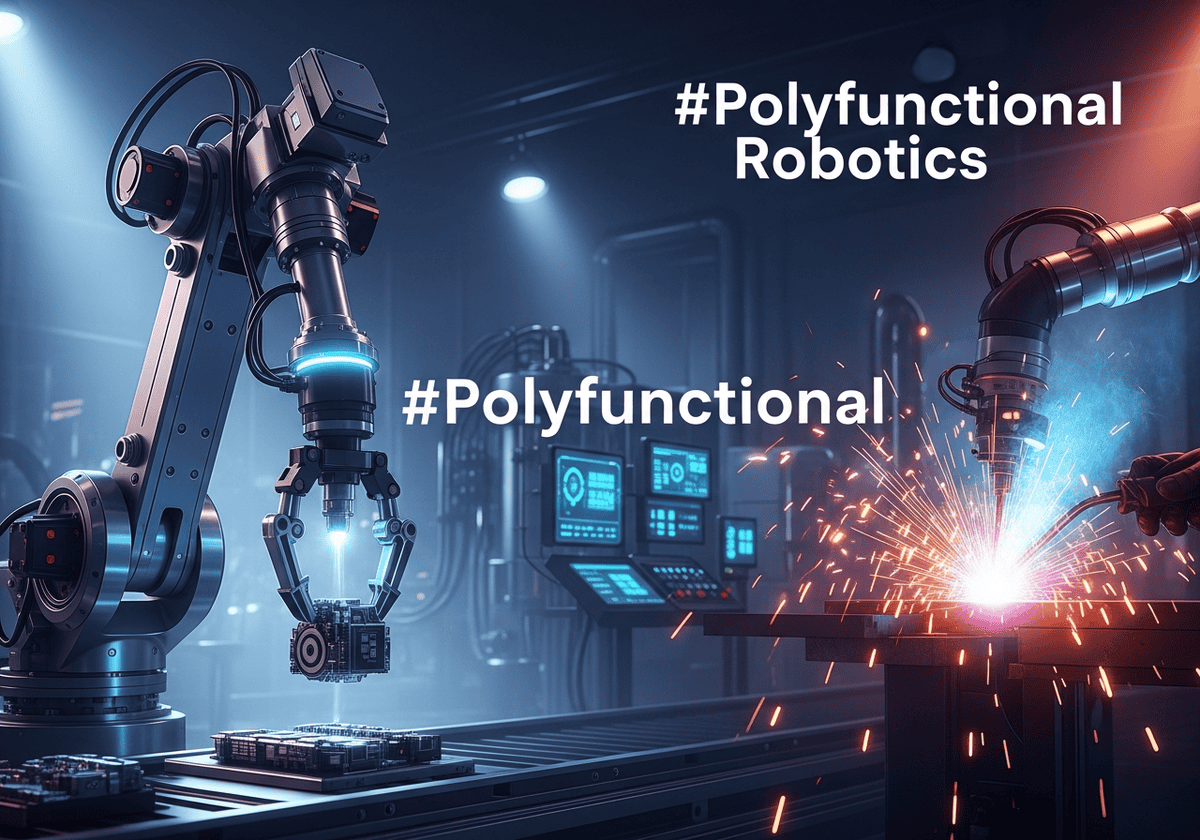

Polyfunctional robotics designates a class of robotic systems engineered to execute multiple distinct operational tasks — grasping, assembly, welding, inspection, material handling — within a single deployable unit, without the dedicated retooling or line reconfiguration that conventional single-purpose industrial robots demand. Where traditional automation optimizes for throughput on a fixed task, polyfunctional architectures prioritize adaptability: modular end effectors, rapid tool-changing mechanisms, reconfigurable kinematics, and increasingly, learned skill libraries that allow a robot to switch functional modes on the fly in response to production variability or new task definitions.
The domain sits at the intersection of mechanical design, motion planning, multi-modal perception, and AI-driven task generalization, drawing from advances in dexterous manipulation, sim-to-real transfer, and foundation models for robotics.
The publications and patents indexed below trace the state of the art across these axes — from hardware modularity and gripper design to task-agnostic control policies and industrial deployment architectures.
This is our latest selection of worldwide publications and patents in english on Polyfunctional Robotics, between many scientific online journals, classified and focused on Polyfunctional robotic, multi-task robot, task-switching robot, reconfigurable robot, versatile manipulator, multi-modal end effector, tool-changing robot, adaptive gripper, modular robot arm, multi-skill robot, robot task generalization, cross-domain robot, general-purpose robot, robot dexterity, multi-functional cobot, robot retooling, multi-process robot, robot skill transfer, flexible automation, robot polyvalence, multi-operation robot, robot toolpath switching, interchangeable robot modules, robot work envelope adaptation, multi-role industrial robot, robot functional flexibility and heterogeneous task execution.
Publication: no recent news on this particular topic. Please try the extensive manual search in the Publication Database linked just above.
Modular reconfigurable robotic exoskeleton system operable in autonomous humanoid and wearable modes
Patent published on the 2026-08-27 in US under Ref US20260249445 by ALSHEN RENAD SULIMAN [SA] (Alshen Abdulaziz Suliman [us], Alshen Abdullah Suliman [sa], Alshen Renad Suliman [sa])
Abstract: A modular reconfigurable robotic exoskeleton system is disclosed that is selectively operable in an autonomous humanoid robot mode and a wearable exoskeleton mode. The system has structural frame constructed from perforated tubular members having perforations at regular intervals that accept standard mechanical fasteners, enabling repositionable mounting of joint assemblies, actuators, sensors, and accessories without welding. Actuators may be repositioned along with the perforations to selectiv[...]
Our summary: The system is a modular reconfigurable robotic exoskeleton operable in both autonomous humanoid and wearable modes. It features a structural frame with perforated tubular members for easy repositioning of components. The AI-enabled control system manages actuators in autonomous mode and coordinates user motion in exoskeleton mode.
robotic exoskeleton, modular design, autonomous operation, AI control
Patent
Singling gripper system and robot system for handling objects
Patent published on the 2026-07-15 in EP under Ref EP4775359 by DELTA ELECTRONICS INDIA PVT LTD [IN] (Raushan Rakesh Kumar [in])
Abstract: The present application discloses a singling gripper system for handling objects comprising a gripper assembly including a gripper unit having at least a set of parallel and opposite adaptive gripper fingers; a pusher unit having a plate. A servo control unit/controller in operative communication with a servomotor is configured to synchronously control motion of the adaptive gripper fingers and the pusher unit with the plate thereby gripping and handling placement of objects. The servo control u[...]
Our summary: The singling gripper system features adaptive gripper fingers and a pusher unit for object handling. A servo control unit synchronizes the motion of the gripper fingers and pusher unit. The system integrates with a robot system for efficient object placement and management.
gripper system, robot system, adaptive fingers, servo control
Patent