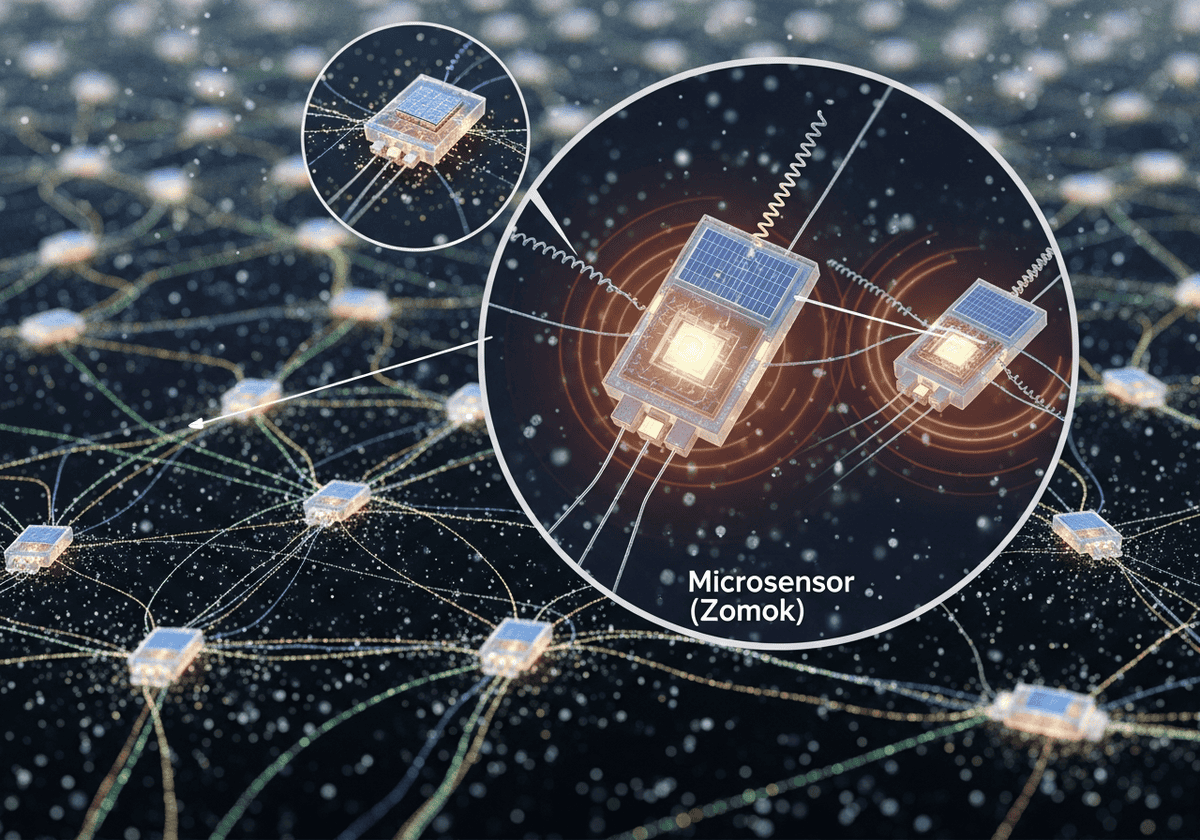

Smart Dust consiste en redes de microsensores y actuadores inalámbricos a escala milimétrica o micrométrica que integran sistemas microelectromecánicos (MEMS), microcontroladores de ultrabajo consumo y captación de energía ambiental para permitir la detección y computación distribuidas. Sus tecnologías principales incluyen protocolos de comunicación a microescala, técnicas de microfabricación, algoritmos de fusión de sensores y arquitecturas de red ad-hoc escalables. Sus aplicaciones abarcan la monitorización ambiental, la automatización industrial y la computación ubicua, basándose en la autoorganización, la gestión de micropotencia y la transmisión segura de datos dentro de matrices de nodos densas y distribuidas espacialmente. Nuestra compilación, continuamente actualizada, presenta las últimas publicaciones y patentes revisadas por pares que detallan los avances en integración de microsistemas, nanomateriales, diseño de microtransceptores y optimización a nivel de sistema que impulsan la evolución de las plataformas Smart Dust.
El polvo inteligente imagina sensores del tamaño de un grano de arena. Las piezas habilitadoras están en MEMS y recolección de energíaLas redes más grandes están en Internet de los objetosy grupos móviles en robótica de enjambreLos datos de ellos se procesan en computación de borde.
Esta es nuestra última selección de publicaciones y patentes mundiales en inglés sobre Polvo Inteligente, entre muchas revistas científicas en línea, clasificadas y centradas en microsensores, redes nano, microsistemas inalámbricos, microrrobots, ultrabajo consumo, sistemas microelectromecánicos, MEMS, computación distribuida, recolección de energía ambiental, comunicación a microescala, fusión de sensores, microactuadores, nanoenergía, procesamiento a microescala, nodos de sensores inalámbricos, microfabricación, monitorización ambiental, computación ubicua, integración de microsistemas, nanorrobótica, redes ad-hoc, gestión de micropotencia, nanomateriales, energía a microescala, microcontroladores, antenas a microescala, detección escalable y seguridad de microsistemas.
Method and apparatus for controlling vehicle
Patent published on the 2026-11-19 in US under Ref US20260367652 by HYUNDAI MOBIS CO LTD [KR] (Choi A Ra [kr])
Abstract: A method of controlling a vehicle according to one embodiment may include performing learning through sensor fusion using at least one weight, determining a level for driving intervention for a user of the vehicle based on an inference probability generated according to the learning, and controlling at least a portion of the vehicle based on the determined level.[...]
Our summary: The method involves learning through sensor fusion with weights. It determines driving intervention levels based on inference probabilities. The vehicle is controlled according to the determined intervention level.
sensor fusion, vehicle control, driving intervention, inference probability
Patent
Io-link safety device
Patent published on the 2026-11-19 in US under Ref US20260367584 by PIZZATO ELETTRICA SRL [IT] (Serafin Diego [it])
Abstract: An IO-Link safety device configured to receive a request from a master device and comprising: a sensor or actuator configured to transmit measurement signals, a first microcontroller and a second microcontroller connected to the sensor and configured to receive the measurement signals and to generate safety data based on the measurement signals, a transceiver configured to receive the request from the master device, a third microcontroller connected to the transceiver to receive the request and [...]
Our summary: An IO-Link safety device communicates with a master device and processes measurement signals. It includes multiple microcontrollers for generating safety data and executing communication protocols. The device ensures unidirectional data flow between components for safety and reliability.
IO-Link, safety device, microcontroller, transceiver
Patent
Apparatus for AIOps-Enabled Incident Isolation and Recovery Automation
Patent published on the 2026-11-19 in US under Ref US20260368030 by MOHAMMED SAMIUDDIN [US] (Mohammed Samiuddin [us], Polamarasetty Venkata Kalyan [us])
Abstract: An apparatus, method, and non-transitory computer-readable medium are disclosed for autonomous incident lifecycle management within complex, distributed computing environments. The architecture comprises a high-throughput data ingestion engine configured to aggregate and normalize heterogeneous telemetry data, which is subsequently analyzed by a machine learning processing unit to establish dynamic behavioral baselines and detect operational anomalies. A topology-aware engine maintains a real-ti[...]
Our summary: The apparatus enables autonomous incident lifecycle management in distributed computing environments. It uses a data ingestion engine and machine learning to detect anomalies and perform root cause analysis. Automated remediation workflows restore system performance without human intervention, continuously improving through feedback and reinforcement learning.
AIOps, incident management, machine learning, automation
Patent
Flame and combustion retardant material based on boron nitride quantum dots
Patent published on the 2026-11-19 in WO under Ref WO2026240717 by MERSIN UENIVERSITESI [TR] (Altürk Rükan Genç [tr], Aktaş Batuhan [tr], Çolak Melis Özge Alaş [tr])
Abstract: The invention discloses the flame retardant and preventive properties of boron nitride quantum dots for use as coatings and fillers in various industries. These properties include the process of synthesis optimization, imparting nanomaterials their retardant and non-flammability properties.[...]
Our summary: The invention presents boron nitride quantum dots as effective flame and combustion retardants. It highlights their use as coatings and fillers across industries. The synthesis optimization enhances their non-flammability and retardant properties.
Boron nitride, flame retardant, quantum dots, nanomaterials
Patent
First-person view (fpv) drone carrier uav
Patent published on the 2026-11-19 in WO under Ref WO2026240743 by STEPURA OLEKSANDR [UA] (Stepura Oleksandr [ua])
Abstract: The invention relates to a field of unmanned aerial vehicles (UAVs) that act as carriers for other UAVs that imply remote control of the UAV based on a first- person view, i.e., FPV drones. The FPV drone carrier UAV comprises a self-powered payload platform that is equipped with a flight control tool and an FPV drone fixation mechanism. The carrier UAV is equipped with a real-time video signal relay device that is arranged on the payload platform and comprises a system for receiving an analog si[...]
Our summary: The invention describes a first-person view (FPV) drone carrier UAV designed to transport other UAVs. It features a self-powered platform with a flight control tool and a video signal relay system. This system enhances the operational range of FPV systems by utilizing real-time video transmission capabilities.
FPV drones, UAV carrier, video signal relay, flight control
Patent
Piezoelectric single crystal transducer element and a method for its manufacturing
Patent published on the 2026-11-19 in US under Ref US20260371933 by CHAIRMAN DEFENCE RES AND DEVELOPMENT ORGANIZATION [IN] (Varadarajan Elangovan [in], Manikandan Chandramohan [in], Natarajan Venkatachalam [in], Ganesamoorthy Sarveswaran [in], Sarguna Ramaiyan Mahadevan [in], Vijayakumar Palanimuthu [in], Edward Prabu Amaladass [in], Awadhesh Mani [in])
Abstract: The present disclosure relates to a piezoelectric single crystal transducer element and a method for its manufacturing. The piezoelectric single crystal transducer element comprises PZN-PT single crystal and at least one metallized layer on the crystal. The transducer element is adapted to use in a high-frequency underwater acoustic transducer as an integral part of underwater SONAR, ultrasound medical transducers, low-field driven actuators, electroacoustic transducers and piezoelectric based M[...]
Our summary: The content discusses a piezoelectric single crystal transducer element made from PZN-PT. It includes a method for manufacturing this transducer element for high-frequency underwater applications. The transducer is suitable for underwater SONAR, ultrasound medical devices, and MEMS applications.
Piezoelectric, single crystal, transducer, manufacturing
Patent
Real-Time Axle-Load Sensing and AI-Enhanced Braking-Distance Prediction for Multi-Axle Heavy-Duty Trucks
Published on 2026-02-03 by Duk Sun Yun, Byung Chul Lim @MDPI
Abstract: Accurate braking-distance prediction for heavy-duty multi-axle trucks remains challenging due to the large gross vehicle weight, tandem-axle interactions, and strong transient load transfer during emergency braking. Recent studies on tire–road friction estimation, commercial-vehicle braking control (EBS/AEBS), and weigh-in-motion (WIM) sensing have highlighted that unmeasured vertical-load dynamics and time-varying friction are key sources of prediction uncertainty. To address thes[...]
Our summary: This study presents a framework for real-time axle-load sensing and AI-enhanced braking-distance prediction for heavy-duty trucks. It integrates dynamic load estimation with friction sensing and machine learning to improve prediction accuracy. The results show significant enhancements in braking-distance predictions compared to traditional methods, supporting advanced driver-assistance and safety management systems.
Axle-Load Sensing, Braking-Distance Prediction, Machine Learning, Heavy-Duty Trucks
Publication
An Ontology-Based Framework for Semantic Integration and Interoperable Assessment of Green-Synthesized Nanomaterials for Environmental Remediation
Published on 2026-02-03 by Carolina L. Recio-Colmenares, Roxana B. Recio-Colmenares, Francisco E. Castillo-Barrera, Cesar A. Garcia-Garcia @MDPI
Abstract: Green-synthesized nanomaterials have emerged as promising candidates for environmentally sustainable remediation; however, experimental evidence describing their synthesis routes, physicochemical properties, remediation performance, and sustainability-relevant attributes remains fragmented, inconsistently reported, and difficult to integrate across studies. This work addresses this challenge by proposing an ontology-based semantic framework for the interoperable integration of green-synthesized [...]
Our summary: This work proposes an ontology-based framework for integrating green-synthesized nanomaterials and remediation processes. It addresses data fragmentation by providing a unified, FAIR-compliant semantic structure. The framework supports provenance-aware inference and comparative analysis across diverse remediation mechanisms.
Ontology, Nanomaterials, Semantic Integration, Environmental Remediation
Publication