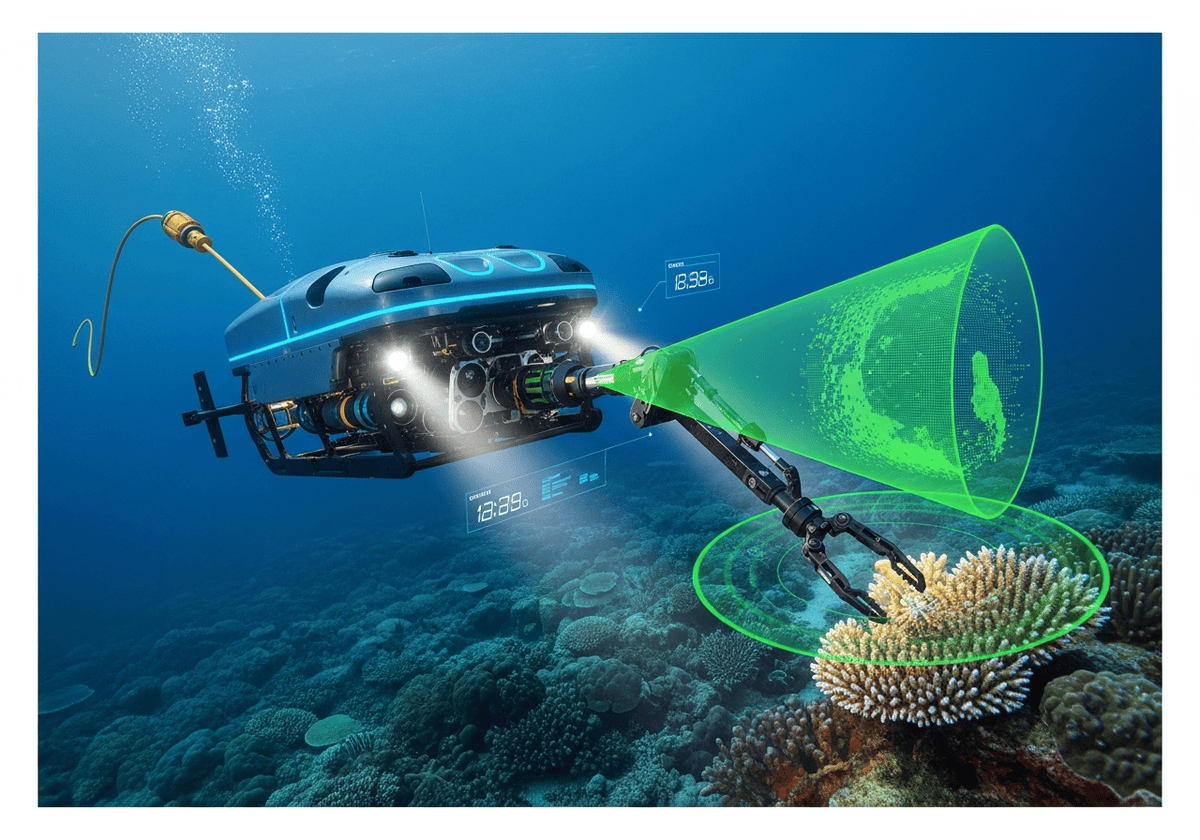

Remotely Operated Underwater Vehicles (ROUVs) and Remotely Operated Vehicles (ROVs) integrate advanced thruster control, tether management, underwater navigation, and sensor fusion to perform precise operations in subsea environments. Critical components include pressure-resistant housings, manipulator systems, sonar imaging, and real-time telemetry enabling inspection, maintenance, and data acquisition at variable depths and complex terrains. Research advances focus on autonomy algorithms, hydrodynamic optimization, power management, and communication protocols to enhance operational endurance and maneuverability. This collection compiles the latest peer-reviewed publications and patents detailing innovations in vehicle design, control architectures, mission planning, and payload integration driving subsea robotic capabilities.
This is our latest selection of worldwide publications and patents in english on Remotely Operated Underwater Vehicle (ROUV) and Remotely Operated Vehicle (ROV), between many scientific online journals, classified and focused on thruster control, underwater navigation, tether management, sonar system, rov manipulator, underwater communication, rov autonomy, pressure housing, rov payload, hydrodynamic, rov mission planning, underwater imaging, underwater vehicle, rov control system, rov power management, rov depth rating, rov buoyancy, rov thruster, rov sonar, rov video streaming, Remotely Operated Underwater Vehicle, Remotely Operated Vehicle, rov positioning, rov obstacle avoidance, rov data acquisition and rov inspection.
Hydrodynamic liquid treatment reactor
Patent published on the 2026-06-25 in WO under Ref WO2026130661 by IFEC HP TECH GMBH [DE] (Meyer Andreas [de])
Abstract: The invention relates to a hydrodynamic liquid treatment reactor, in particular for treating process water, comprising a reactor chamber which is enclosed by a reactor housing and through which the liquid to be treated flows, wherein the reactor chamber has a first end section with at least one liquid inlet which opens into the first end section in the tangential direction, an eddy current section in which the liquid to be treated through the liquid inlet is brought into an eddy flow moving towa[...]
Our summary: The invention describes a hydrodynamic liquid treatment reactor designed for process water. It features a reactor chamber with a tangential liquid inlet that creates an eddy flow. The design includes means for reversing the eddy flow towards the inlet, optimizing the treatment process.
Hydrodynamic reactor, liquid treatment, eddy flow, process water
Patent
Deep learning predictive automation and control system for an air distribution system
Patent published on the 2026-06-18 in WO under Ref WO2026128771 by AIRGLIDE AI INC [US] (Bell David [us], Barry Iyaan [us])
Abstract: A computer-implemented control system and method for dynamically managing airflow in an air lubrication system of a vessel are disclosed. Real-time sensor data including vessel motion, acceleration, and speed-through-water are processed by a controller executing a machine learning model to predict near-future sea-state conditions. The controller accesses and interpolates computational fluid dynamics (CFD) efficiency profiles to determine target airflow values and generate valve and compressor co[...]
Our summary: The system utilizes deep learning for real-time airflow management in an air lubrication system. It processes sensor data to predict sea-state conditions and adjusts airflow accordingly. Continuous refinement of CFD profiles enhances operational efficiency and vessel performance.
deep learning, predictive automation, airflow management, CFD profiles
Patent
Improved stern structure for propeller support for single- or multi-propeller ships
Patent published on the 2026-06-18 in WO under Ref WO2026126092 by SB SINTEC SRL [IT] (Buccini Claudio [it])
Abstract: The invention relates to an aft support structure for a ship propeller, applicable to single- or multi-propeller ships, wherein said aft structure comprises a support for the ship propeller, said support being positioned aft of the propeller and configured to support a boss integral with the support itself and housing a propeller bearing to allow rotation of a propeller hub of the propeller, the support having a hydrodynamically streamlined section aligned with a rudder blade to reduce vortex fo[...]
Our summary: The invention presents an improved aft support structure for ship propellers. It features a streamlined design to minimize resistance and vortex formation. The support is distinct from the rudder, enhancing performance for single- or multi-propeller ships.
stern structure, propeller support, hydrodynamic design, ship propulsion
Patent
Core-shell microparticles comprising a lipophobic active ingredient, dispersion comprising same, and use thereof in textile or cosmetic applications
Patent published on the 2026-06-17 in EP under Ref EP4759294 by UNIV LILLE [FR] (Rault FranÇois [fr], SalaÜn Fabien [fr])
Abstract: The invention relates to microparticles comprising an oil core C and a shell S, wherein• the oil core C comprises a lipophilic active ingredient;• the shell S is a product of a sol-gel reaction of a mixture comprising a tetraalkoxysilane of formula Si(OR1)4, a trialkoxyalkylsilane of formula R2Si(OR3)3 and a particulate surface agent with a carbon content ranging from 0.5 to 50 wt% relative to the total weight of particulate surface agent,R1 being independently a (C1-C6)alkyl, R2 being a (C1[...]
Our summary: The invention describes core-shell microparticles with a lipophilic active ingredient in an oil core and a shell produced via a sol-gel reaction. The shell is formed from a specific mixture of tetraalkoxysilane and trialkoxyalkylsilane. These microparticles have a hydrodynamic diameter of 0.5 to 100 µm and are intended for use in textile or cosmetic applications.
core-shell microparticles, lipophilic active ingredient, sol-gel reaction, textile applications
Patent
Underwater enclosure
Patent published on the 2026-06-10 in EP under Ref EP4755784 by INESC TEC INSTITUTO DE ENGENHARIA DE SIST E COMPUTADORES TECNOLOGIA E CIENCIA [PT] (De Oliveira Martins Alfredo Manuel [pt], Soares De Almeida JosÉ Miguel [pt], Valente De Almeida Carlos Eduardo [pt], Pereira Silva Eduardo Alexandre [pt])
Abstract: The present document discloses an underwater enclosure for holding a pressurised fluid for a variable buoyancy system, comprising: a watertight external shell for withstanding external underwater pressure; an airtight internal shell defining an internal chamber for holding the pressurised fluid and arranged for withstanding pressurised fluid pressure; wherein the internal and external shells are arranged in a spaced arrangement defining an intermediate volume between the internal and external sh[...]
Our summary: The document describes an underwater enclosure designed for a variable buoyancy system. It features a watertight external shell and an airtight internal shell to contain pressurized fluid. Additionally, it outlines the integration of this enclosure within an autonomous underwater vehicle.
underwater enclosure, buoyancy system, pressurized fluid, autonomous vehicle
Patent
Analytical response functions for a compressible thin fluid layer with odd viscosity *
Published on 2026-06-09 by Abdallah Daddi-Moussa-Ider, Yuto Hosaka and Shigeyuki Komura @IOP SCIENCE
Abstract: Fluids composed of chiral active components can exhibit odd viscosity, a property that breaks time-reversal and parity symmetries. We investigate the hydrodynamic response to monopole and dipole singularities in a compressible thin fluid layer with odd viscosity, supported by a conventional lubrication layer. Using the two-dimensional Green’s function in Fourier space, we derive analytical solutions for the flow and pressure fields. These solutions provide a detailed description of the hydrody[...]
Our summary: This study explores the hydrodynamic response of a compressible thin fluid layer with odd viscosity. Analytical solutions for flow and pressure fields are derived using the two-dimensional Green’s function in Fourier space. The findings enhance understanding of particle dynamics and collective behavior in chiral microfluidic systems.
odd viscosity, compressible fluids, hydrodynamic response, Green s function
Publication
Rotary propeller featuring enhanced slot effect through staggered blade configurations
Patent published on the 2026-06-04 in US under Ref US20260153096 by DOWNARD JACOB DORIAN [US] (Downard Jeffrey Brian [us], Downard Abigail Rebecca [us], Downard Jacob Dorian [us])
Abstract: The present invention provides a propeller assembly having staggered pairs of blades arranged to enhance hydrodynamic and aerodynamic efficiency across marine, aerial, energy, and industrial applications. Each propeller incorporates pairs of forward and aft blades configured with controlled rake, skew, and pitch to generate a coherent slot effect, particularly in the outer third of the blade span where linear velocity and thrust are greatest. By aligning the forward blade with the aft blade, the[...]
Our summary: The invention presents a rotary propeller with staggered blade configurations to enhance efficiency. It features controlled rake, skew, and pitch to improve thrust and reduce turbulence. Applications span marine, aerial, and industrial sectors, integrating conventional design parameters for superior performance.
propeller design, staggered blades, hydrodynamic efficiency, thrust optimization
Patent
vortices, bubbles and odd diffusion
Published on 2026-05-29 by Umberto Marini Bettolo Marconi, Alessandro Petrini, Raphael Maire and Lorenzo Caprini @IOP SCIENCE
Abstract: Starting from a microscopic multiparticle Langevin equation, we obtain a hydrodynamic description in terms of density and momentum fields for chiral active particles interacting via standard repulsive and nonlocal odd forces. These odd interactions are reciprocal but non-conservative: they are non-potential forces, as they act perpendicular to the vector joining any pair of particles. As a result, the torques that two particles exert on one another are non-reciprocal. The ensuing macroscopic con[...]
Our summary: This study develops a hydrodynamic model for chiral active particles under non-conservative odd forces. It predicts phenomena such as odd diffusivity, bubble-like structures, and vortices. The findings align with numerical simulations and suggest experimental validation in granular and microbial systems.
chiral active particles, odd viscosity, non-conservative forces, hydrodynamic description
Publication