As the global commitment to combat climate change intensifies, Direct Air Capture (DAC), usually meant for Direct Air Carbon Capture (DACC) emerges as a promising yet controversial technology in the arsenal of carbon dioxide removal (CDR) strategies. This article will dissect the fundamental principles of DAC technology, analyze various approaches such as solid sorbents and liquid solvents, and highlight the current stage of development traversed by key industry players. In addition, it will tackle the energy requirements, the impossible economic viability, and the environmental impact of DAC systems, while also addressing the challenges and misconceptions that may cloud its effectiveness and scalability.
Key Takeaways
- DAC relies on capturing CO2 directly from ambient air.
- Different technologies include solid sorbents and liquid solvents.
- Technology is evolving with major industry participants emerging.
- Very significant energy input is necessary for DAC operations.
- Economic feasibility varies significantly by region and technology.
- Scalability faces misconceptions regarding effectiveness and costs.
- The best waste, is the one you do not produce at first
Fundamental Principles of Direct Air Carbon Capture Technology
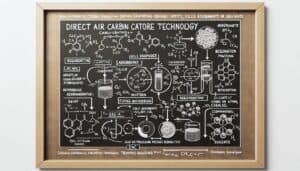
Direct Air Carbon Capture (DAC) technology operates on the principle of chemically capturing carbon dioxide (CO₂) straight from the atmosphere. It typically employs a sorbent or solvent that selectively binds CO₂. Upon saturation, the material is then subjected to a regeneration process, often involving heat or a reduction in pressure, to release the captured CO₂. For instance, systems using solid sorbents might employ a cyclic process where the sorbent is heated to around 100-150 degrees Celsius to release CO₂. This process can be represented by the reaction:
\( {CO}_2 + {Sorbent} {\rightleftharpoons} {Sorbent-CO}_2 {(bound form)} \)
The overall efficiency of DACC systems can vary significantly based on the technology and design employed. Several methods include high-temperature sorbents, aqueous amine-based solvents, and alkaline mineralization. A report by the Global CCS Institute indicated that high-temperature sorbents can capture 90% of CO₂, while amine solutions can achieve similar results with lower energy costs. Each method shows distinct trade-offs in energy input, capture efficiency, and scalability potential, which influences the choice of technology based on the application required.
A notable advancement in DAC technology is the direct capture of CO₂ from ambient air combined with renewable energy sources to offset operational energy requirements. For example, Climeworks, a leading DAC firm, reported a capture cost of $600 per ton of CO₂ in 2021. This figure highlights the current financial challenges while also underlining that with increased investment and innovation, costs may decrease over time.
As of 2025, more real scaled tests have shown that this is arguable.
The rest of this article is reserved for members
To limit scraping bots (currently 40,000 hits per day!),
we had to restrict access to full articles and tools to registered members only.
to access all the rest.