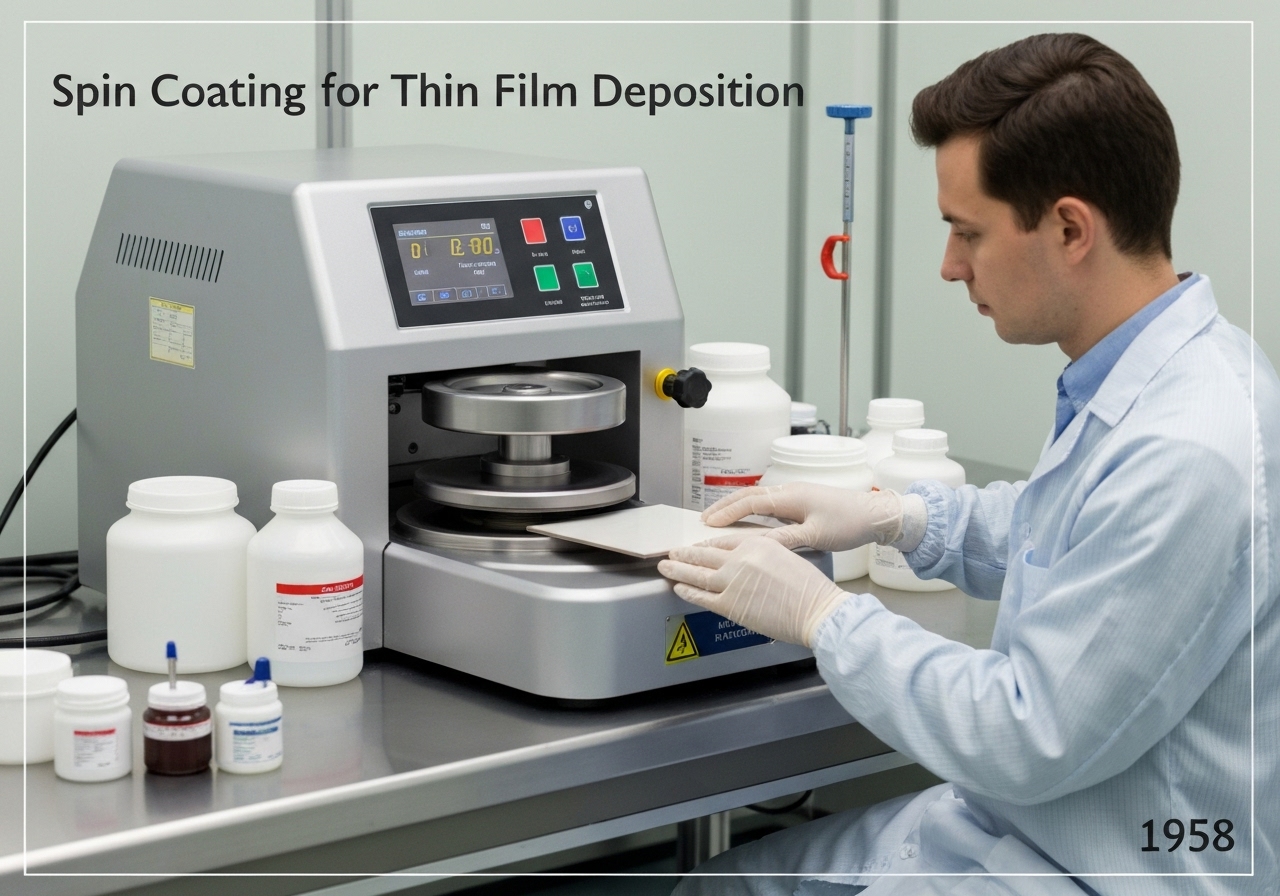
The spin 涂层 process is divided into four main stages: deposition, spin-up, spin-off, and evaporation. In the deposition stage, an excess of the coating fluid is dispensed onto the substrate’s surface. During the spin-up stage, the substrate is rapidly accelerated to its final, desired rotation speed, causing the fluid to flow radially outward due to 离心力. The spin-off stage follows, where the excess fluid is ejected from the substrate’s edge, and the film thins. The final stage is evaporation, where the solvent evaporates from the film, leaving behind the solid coating. The thickness of the resulting film is highly dependent on several parameters. The key relationship was modeled by Emslie, Bonner, and Peck, showing that the final film thickness [latex]h_f[/latex] is proportional to the inverse square root of the angular velocity [latex]\omega[/latex], the initial solution concentration, and the solvent evaporation rate, and is also a function of the fluid 粘度 [latex]\nu[/latex]. The formula is often simplified as [latex]h_f \propto \omega^{-1/2}[/latex]. This technique is favored for its simplicity, speed, and ability to produce highly uniform films with thicknesses ranging from a few nanometers to several micrometers on a laboratory scale. However, it is inherently a batch process and can be wasteful, as a significant portion of the initial solution is flung off the substrate.