Product Design, Manufacturing & Innovation Resources
家 » 平准化生产均衡化

平准化生产均衡化

1960
  • Taiichi Ohno
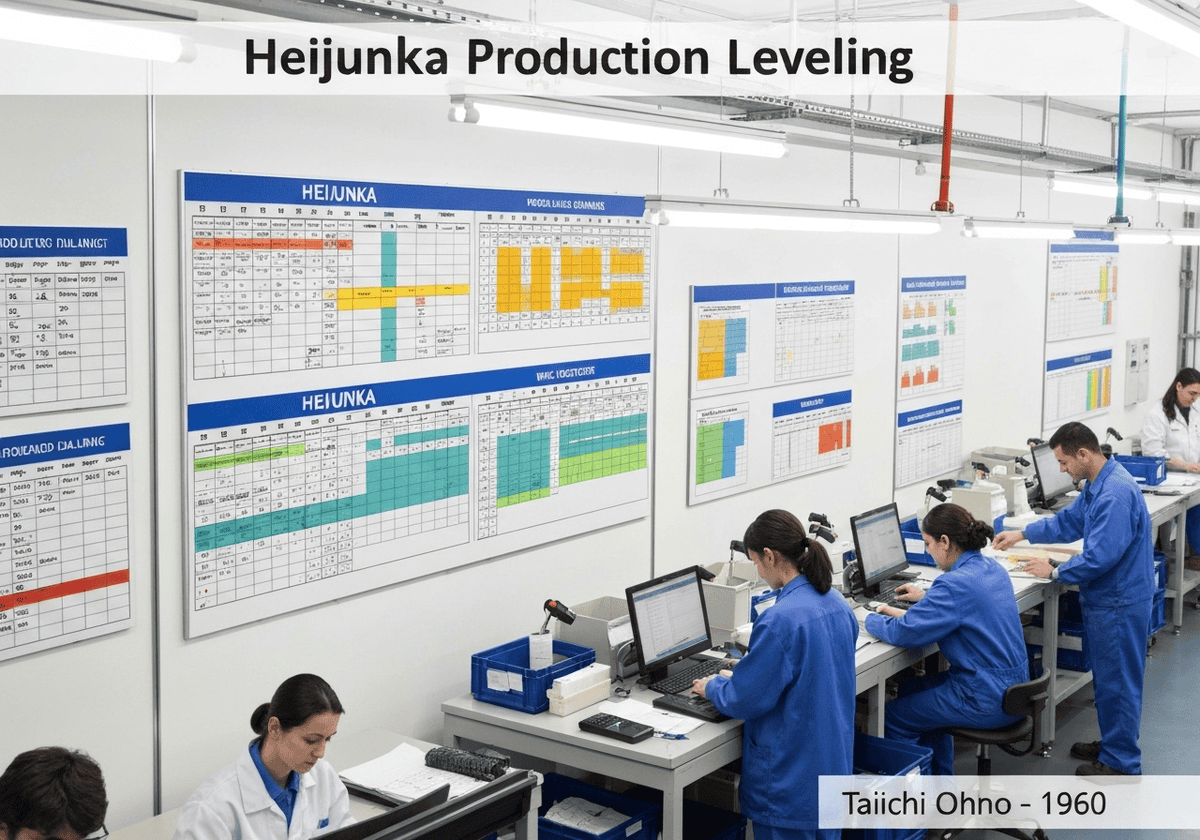
生产设施中的 Heijunka 板演示了生产均衡化原则。

(图片仅供参考)

Heijunka is the principle of production leveling or smoothing within the Toyota Production System. It involves averaging out the production volume and mix over a fixed period to eliminate peaks and valleys in workload. This creates a predictable and stable manufacturing environment, which is a prerequisite for implementing 准时制 (JIT) and standardized work effectively.


Instead of producing products in large batches according to customer orders (e.g., all of Model A, then all of Model B), Heijunka dictates producing a mixed model sequence in smaller batches. For example, if the weekly demand is for 500 of Model A, 300 of Model B, and 200 of Model C, a traditional system might produce all 500 A’s, then 300 B’s, etc. A Heijunka system would create a repeating sequence like A-B-A-C-A-B-A… This levels the demand for upstream processes and suppliers, preventing the “bullwhip effect” where demand fluctuations are amplified up the supply chain.

To achieve this, Toyota developed tools like the “Heijunka box,” a visual scheduling tool used to manage the production of different models. Each slot in the box represents a time interval, and 看板 cards for different products are placed in the slots to dictate the production sequence. This leveling of both volume and mix reduces inventory, shortens lead times, and stabilizes the workload for employees and equipment. It is a crucial enabler of the entire TPS, as the stability it creates is necessary for JIT and 改善 to function properly. Without Heijunka, the fluctuations in demand would require large buffer stocks, undermining the core principles of waste elimination.

UNESCO Nomenclature: 3306
– Industrial Engineering

类型

抽象系统

中断

重大的

用法

广泛使用

前体

  • concepts of production flow from henry ford’s assembly lines
  • need for stability to enable 准时制 生产

应用程序

  • 呼叫中心人员排班以匹配平均呼叫量
  • 敏捷软件开发冲刺规划以保持一致的速度
  • 餐厅厨房准备程序,以顺利应对每日高峰时段
  • 大学课程安排以平衡教室和教师的利用率
  • 电网能源分配以平滑需求峰值

专利:

NA

潜在创新理念

  • 人工智能调度云计算资源以平衡服务器负载
  • 共享乘车服务的动态定价算法,以平滑需求
  • 个性化内容流播放列表,平衡网络带宽使用率
  • 自适应交通灯系统,实时平滑交通流量
  • 自动化仓库机器人,可在整个班次内平衡拣选和包装工作量
  • 项目管理软件可自动平衡多个项目之间的资源分配
  • 为电动汽车车队提供智能充电计划,以平衡电网负荷
  • 软件中的持续部署管道,可以平衡功能发布的流程
Related to: heijunka, production leveling, production smoothing, 精益制造, toyota production system, mixed-model production, workload stability, kanban.

历史背景

平准化生产均衡化

1955
1956
1960
1960
1960
1960
1960
1950
1955
1958
1960
1960
1960
1960
1960

(如果日期未知或不相关,例如“流体力学”,则提供其显著出现的近似估计)

第十年 周年纪念日

只有注册会员才能免费获取完整尺寸的图片和下载内容。

> 登录 <