Product Design, Manufacturing & Innovation Resources
» 压力和应变

压力和应变

1820
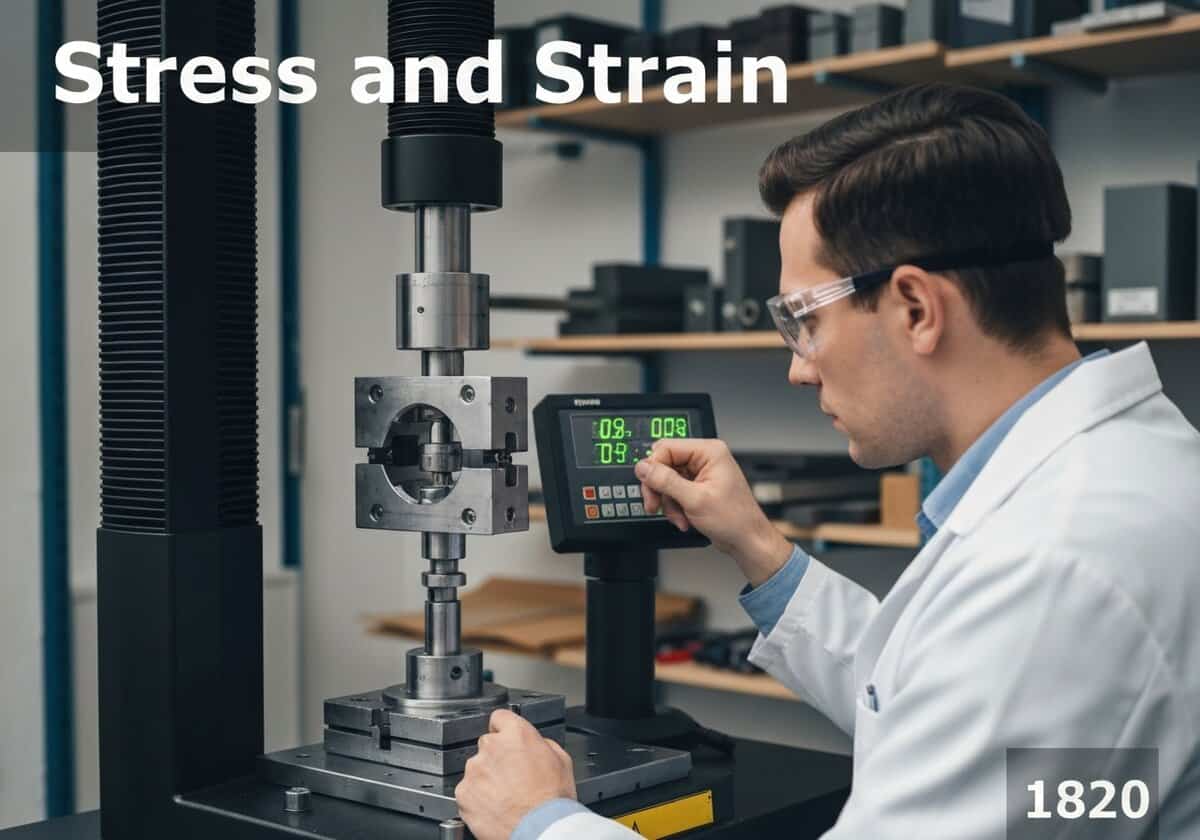
拉伸试验机用于测量固体物理中的应力和应变。

(图片仅供参考)

工程应力([latex]\sigma[/latex])是施加载荷除以原始横截面积([latex]A_0[/latex]),而工程应变([latex]\epsilon[/latex])是长度变化([latex]\Delta L[/latex])除以原始长度([latex]L_0[/latex])。 这些定义——[latex]\sigma = \frac{F}{A_0}[/latex] 和 [latex]\epsilon = \frac{\Delta L}{L_0}[/latex]——是绘制应力-应变曲线的基础,但前提是试样在试验过程中尺寸保持恒定。.


工程应力和应变是材料科学与力学的基础概念,为描述材料对外部力的响应提供了简化而强大的方法。横截面积恒定不变的假设([latex]A_0[/latex])在小变形条件下成立,尤其在弹性区域内。 然而当材料经历显著塑性变形时,其横截面积会发生变化——这种现象在拉伸试验中称为缩颈。这种变化意味着工程应力已无法真实反映材料在最窄点承受的实际应力。同样地,工程应变基于原始长度计算,在大变形条件下其精度可能低于瞬时应变测量值。.

Despite these limitations, the engineering stress-strain curve is widely used in industry and academia. Its key features, such as the yield strength and ultimate tensile strength (UTS), are standard parameters for material specification and design. The curve is relatively easy to generate from a standard tensile test, where a specimen is pulled apart at a constant rate while force and elongation are measured. The initial linear portion of this curve is particularly important as it defines the material’s elastic behavior, governed by Hooke’s Law.

UNESCO Nomenclature: 2211
- 固体物理学

类型

抽象系统

中断

基础

用法

广泛使用

前体

  • 伽利略·伽利莱对材料强度的研究(17世纪)
  • 罗伯特·虎克的弹性定律(1678年)
  • Thomas Young’s definition of the modulus of elasticity (1807)
  • 柯西对应力概念的发展(19 世纪初)

应用程序

  • 建筑物和桥梁的结构分析
  • 齿轮和轴等机械部件的设计
  • 制造业的质量控制
  • 各种工程应用的材料选择

专利:

NA

潜在创新理念

由于机器人流量被拦截(目前每天超过 4 万),此内容仅限社区成员查看。
> 登录 > 或者 > 注册 < (100% 免费)即可访问此内容,以及所有其他受限内容和工具。

相关主题:工程应力、工程应变、拉伸试验、材料性能、材料力学、变形、载荷、横截面积、伸长率、固体力学。.

历史背景

压力和应变

1810
1816
1816-11-16
1820
1820
1822
1824
1808
1811
1816-11-16
1820
1820
1821
1822
1827

(如果日期未知或不相关,例如“流体力学”,则提供其显著出现的近似估计)

只有注册会员才能免费获得 100% 的全尺寸图片和下载。.

> 登录 <