arXiv compared with ResearchGate, SSRN and Google Scholar| arXiv | ResearchGate | SSRN | Google Scholar |
|---|
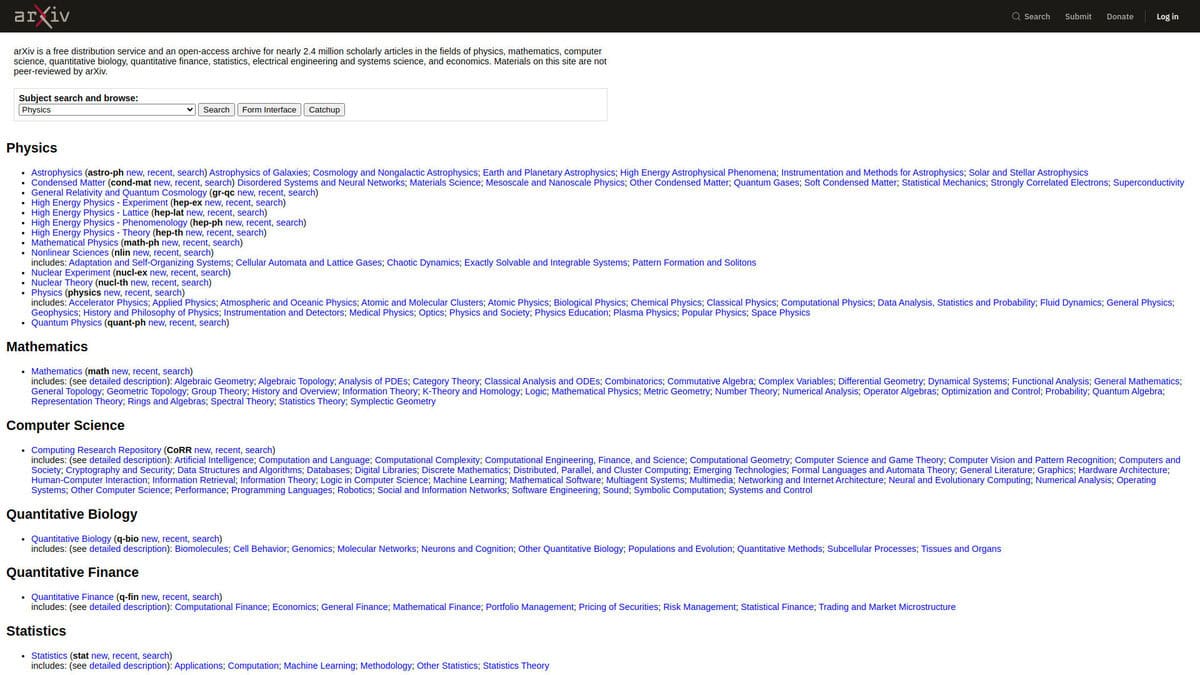
| Role: arXiv is a free, open access archive of nearly 2.4 million articles, with a Submit route for authors and daily listings per category. | Role: ResearchGate is a network for connecting researchers and sharing work. It states more than 25 million members in over 190 countries, among them scientists, engineers and lab technicians. | Role: SSRN is an online repository for scholarly preprints and a research community, founded in 1994 and acquired by Elsevier in 2016. | Role: Google Scholar is a search service, not a repository. It works with publishers to index peer-reviewed papers, theses, preprints, abstracts and technical reports. |
| Subject coverage: The archive covers physics, mathematics, computer science, quantitative biology, quantitative finance, statistics, electrical engineering and systems science, and economics. | Subject coverage: The page names fields such as materials science, agriculture, human health and quantum physics, and describes the audience as researchers across many fields. | Subject coverage: SSRN covers the social sciences and humanities, so it complements arXiv more than it overlaps with its physics and engineering categories. | Subject coverage: Coverage spans all research disciplines. For textbooks and monographs, the publisher guidelines point to Google Book Search instead. |
| Review and quality control: arXiv states that its materials are not peer reviewed by arXiv. Readers must judge preprint claims themselves. | | Review and quality control: SSRN describes its papers as preprints that have not yet been peer reviewed. | Review and quality control: Ranking groups versions of a work, such as preprints, conference papers and journal articles, so that citations to all versions count toward one work. Citation counts factor into rank. |
| Access and cost model: Reading is free and submission needs an account. The service is described as free distribution and lists foundation funders on its home page. | Access and cost model: Researchers can use the network free of charge. The company earns revenue from marketing and scientific recruitment services. | Access and cost model: SSRN uses a freemium model and is described as free to submit and free to download. Revenue comes from institutional repository and conference services, job listings and eJournal subscriptions. | Access and cost model: Publisher full text is treated as the primary version when it can be crawled, and sites must show at least an abstract or the first page to non-subscribers. |
| Programmatic access: arXiv provides public API access to metadata, along with bulk full text via S3, RSS feeds and OAI interoperability. Commercial projects are asked to review the documentation first. | | | |