NIST Chemistry WebBook compared with CRC Handbook, Reaxys and DIPPR| NIST Chemistry WebBook | CRC Handbook | Reaxys | DIPPR |
|---|
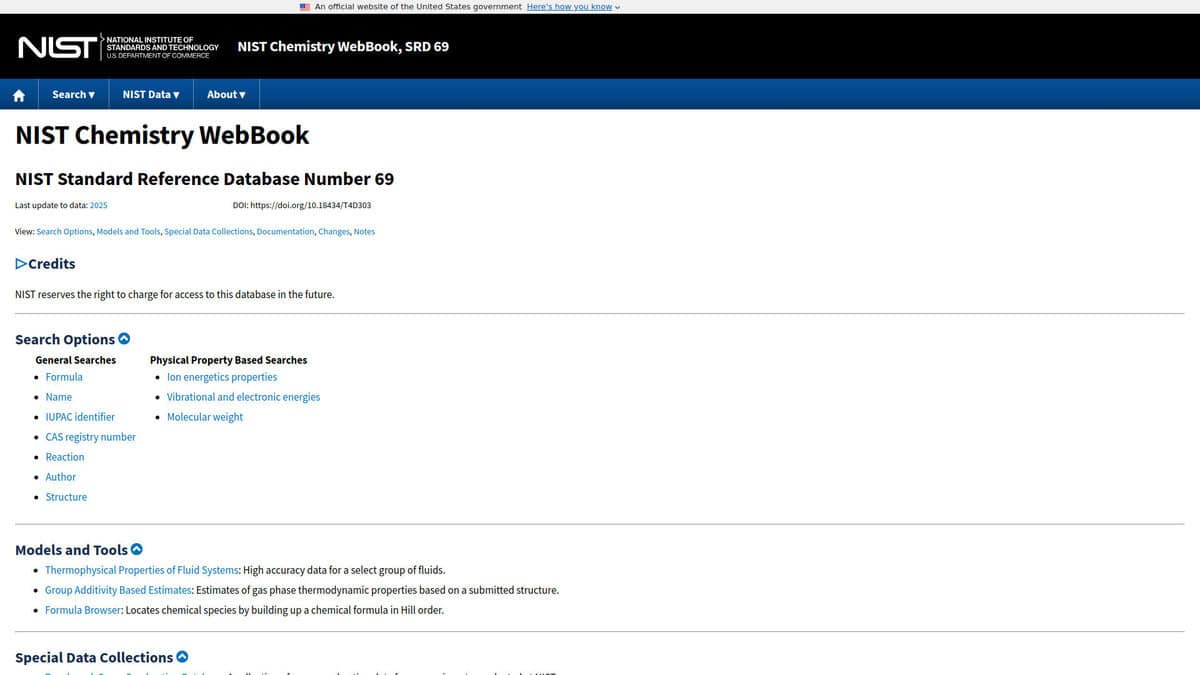
| Content and data types: Thermochemical, thermophysical and ion energetics data for over 40,000 species, plus IR, mass and UV/Vis spectra, retention indexes, Henry law constants and 3D structures. Tools include fluid properties and a group additivity estimate for gas phase properties. | Content and data types: Four parts: data on chemical substances, data for the practice of chemistry and physics, data for modern chemical laboratories, and reference tables with units, constants and nomenclature. It is a broad reference for chemistry and physics, not a spectral or reaction database. | Content and data types: Property, spectral and structure-property data, published reactions and synthesis routes, with a synthesis planner and predictive retrosynthesis. It also indexes journals and patents, which the WebBook does not. | Content and data types: 2,330 substances of industrial priority (as of 2016), with 34 thermodynamic constants and 15 temperature-dependent properties and recommended model parameters. It is narrower than the WebBook but built for process design values. |
| Data evaluation and provenance: Data come from collections of the NIST Standard Reference Data Program and outside contributors. NIST gives no warranty that the data are error-free, and each record has a citation guide with a DOI. | Data evaluation and provenance: The handbook is revised yearly with new data and scientific areas, and reviewed by over 100 subject matter experts. | Data evaluation and provenance: Over 500 million published experimental facts are drawn from the literature, with more than 260 million substances and 73 million reactions indexed. | Data evaluation and provenance: All available data are assessed for accuracy, thermodynamic consistency and reliability within chemical classes. Where no experimental data exist, established prediction methods fill the gap and experts give recommended values. |
| Access and cost model: Open access today. NIST states that it reserves the right to charge for access in the future. | Access and cost model: Sold as a print hardback, and organizations can also hold an online subscription. | Access and cost model: Subscription-based, with institutional options and usage analytics. | Access and cost model: Requires a yearly leasing fee, with standalone and server licences and prices on request. DIPPR is a technical society of AIChE, and DECHEMA distributes the database in Europe. |
| Search and delivery format: Search by name, formula, CAS number, InChI, reaction, author or molecular weight, in the browser. The database was last updated in 2025. | Search and delivery format: Available as a printed book and as an online database with tools. | Search and delivery format: Web platform with on- and off-campus access and structure-based search. | Search and delivery format: Used as a standalone MS-Access database, with the DIADEM software, or with the DETHERM database in its native formats. |