Product Design, Manufacturing & Innovation Resources
Home » Total Quality Management (TQM)

Total Quality Management (TQM)

1980
  • W. Edwards Deming
  • Joseph M. Juran
  • Kaoru Ishikawa
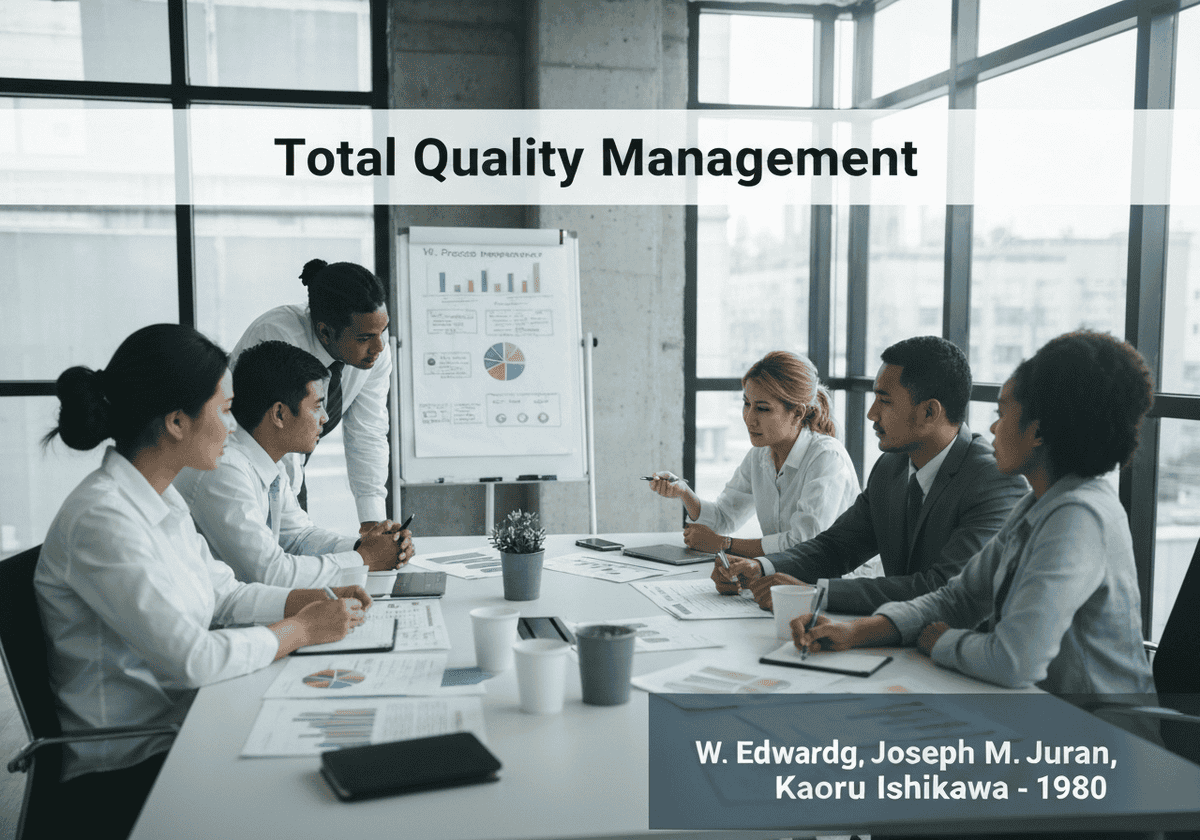
Team collaboration in Total Quality Management meeting focusing on process improvement.

(generated image for illustration only)

Total Quality Management (TQM) is a management philosophy where all members of an organization participate in improving processes, products, services, and the culture in which they work. It aims for long-term success through customer satisfaction. TQM integrates quality-discipline into the culture and activities of a company, moving beyond simple product inspection to a holistic, organization-wide approach.


Total Quality Management (TQM) represents a fundamental shift from traditional management thinking. Instead of viewing quality as the sole responsibility of a specific department (quality control), TQM posits that quality is everyone’s responsibility, from the CEO to the frontline worker. This approach is built on the foundation that preventing defects is more cost-effective than detecting and correcting them after they occur. The core principles of TQM often include a strong customer focus, total employee involvement, a process-centered view, an integrated system, a strategic and systematic approach, continual improvement, fact-based decision making, and effective communication.

The implementation of TQM involves a deep cultural change within an organization. It requires strong leadership to drive the principles throughout all levels. Methodologies like the PDCA cycle are often used to implement continuous improvement initiatives. TQM emphasizes data collection and analysis to understand and improve processes. Tools such as statistical process control (SPC), cause-and-effect diagrams (Ishikawa diagrams), and flowcharts are commonly employed to identify root causes of problems and streamline operations. The ultimate goal is to create a self-sustaining culture of improvement where quality is embedded in every action and decision, leading to higher customer satisfaction, reduced costs, and increased competitiveness.

UNESCO Nomenclature: 3309
– Management sciences

Type

Abstract System

Disruption

Revolutionary

Usage

Widespread Use

Precursors

  • statistical process control (spc) developed by walter shewhart
  • the work of w. edwards deming and joseph m. juran in post-wwii japan
  • quality circles concept
  • early 20th-century scientific management theories

Applications

  • manufacturing process improvement (e.g., toyota production system)
  • healthcare service delivery enhancement
  • software development lifecycle management
  • government and public sector service optimization
  • educational institution administration

Patents:

NA

Potential Innovations Ideas

Due to scrapping bot traffic, currently more than 40k per day, this content is reserved to community members.
> Login < or > Register < (100% free) to access this, so as all other restricted content and tools.

Related to: TQM, continuous improvement, customer satisfaction, employee involvement, process management, quality culture, kaizen, management philosophy.

Historical Context

Total Quality Management (TQM)

1974
1974
1978
1980
1980
1980
1980
1972
1974
1975-06-01
1980
1980
1980
1980
1980

(if date is unknown or not relevant, e.g. "fluid mechanics", a rounded estimation of its notable emergence is provided)

Related Invention, Innovation & Technical Principles

Full size images and downloads are only available, 100% free, for registered members.

> Login <