Product Design, Manufacturing & Innovation Resources
Home » Closed-Loop Control in CNC Systems

Closed-Loop Control in CNC Systems

1980
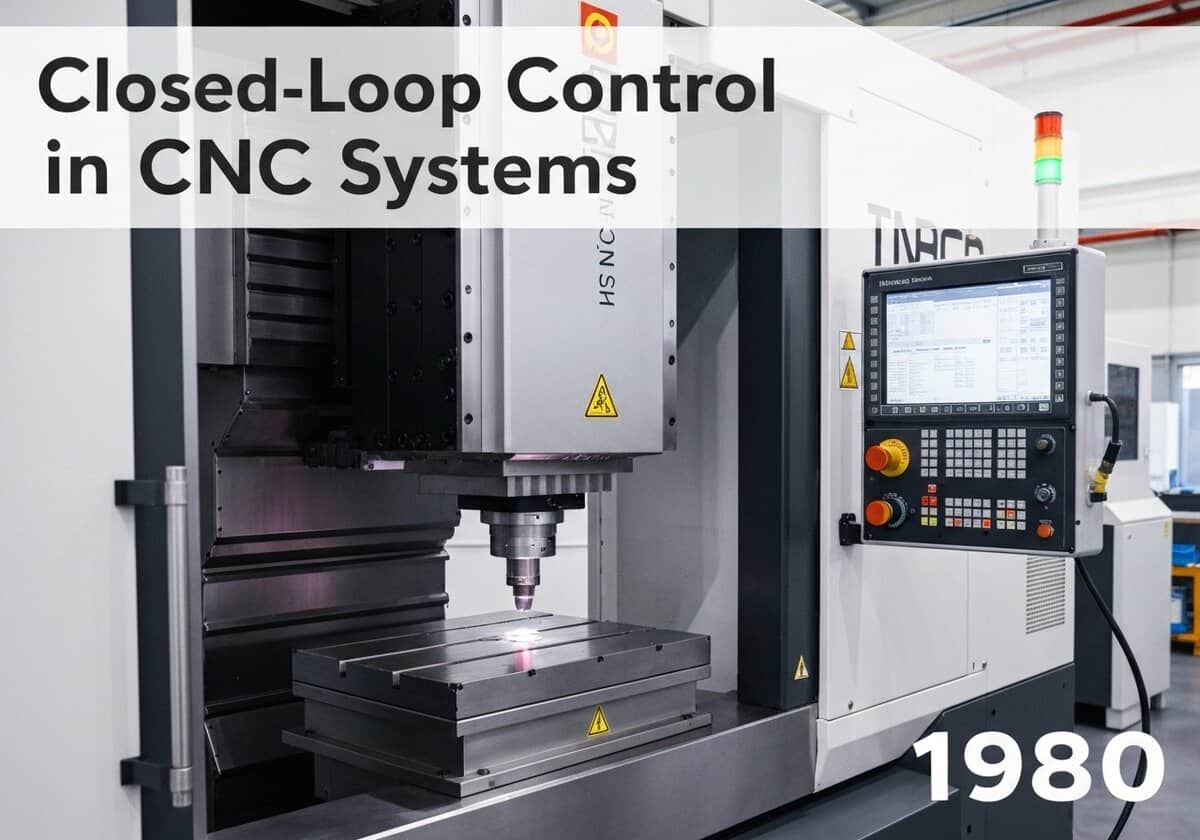
CNC machine with closed-loop control system and feedback devices in automation.

(generated image for illustration only)

High-precision CNC machines employ a closed-loop control system to ensure accuracy. This system uses feedback devices, such as rotary encoders on servomotors or linear scales on the machine axes, to continuously monitor the machine’s actual position. The controller compares this real-time feedback with the commanded position from the program and makes immediate corrections, compensating for errors.


A closed-loop control system is a fundamental concept in automation that provides a high degree of accuracy and reliability, which is critical in CNC applications. Its counterpart, the open-loop system, is simpler and less expensive, typically using stepper motors. In an open-loop system, the controller sends a command (e.g., ‘move 100 steps’) to the motor and assumes the action is completed perfectly, with no way to verify the outcome. This can lead to inaccuracies if the motor stalls, loses steps due to high load, or if there are mechanical imperfections like backlash in the drive screws.

In contrast, a closed-loop system ‘closes the loop’ with a feedback signal. The primary components are the controller, the actuator (typically a servomotor), and a feedback sensor (an encoder or scale). The controller sends a motion command to the servomotor. The encoder, which is physically coupled to the motor’s shaft or the machine’s moving axis, measures the actual movement and sends a stream of position data back to the controller. The controller’s logic, often a PID (Proportional-Integral-Derivative) algorithm, constantly calculates the ‘following error’—the difference between the commanded position and the actual position reported by the encoder. If an error is detected, the controller adjusts the signal to the motor to correct the discrepancy in real-time. This continuous process of command, measurement, comparison, and correction allows the system to compensate for dynamic variables like tool pressure, thermal expansion of machine components, and mechanical wear, resulting in significantly higher precision and repeatability than is possible with open-loop systems.

UNESCO Nomenclature: 3301
– Automation

Type

Abstract System

Disruption

Substantial

Usage

Widespread Use

Precursors

  • the invention of the servomechanism
  • development of control theory, including the PID controller
  • invention of position feedback devices like rotary and linear encoders
  • availability of microprocessors capable of real-time signal processing

Applications

  • high-precision aerospace machining
  • medical device manufacturing
  • semiconductor fabrication equipment
  • high-speed machining centers
  • coordinate-measuring machines (CMM)
  • industrial robotics

Patents:

NA

Potential Innovations Ideas

  • predictive closed-loop systems using AI to anticipate errors before they occur
  • multi-sensor fusion feedback (acoustic, thermal, positional) for holistic machine state awareness
  • decentralized closed-loop control for swarms of manufacturing robots
  • energy-harvesting encoders that power themselves from machine motion
  • quantum-level position sensors for unprecedented accuracy in nanomanufacturing
  • closed-loop systems that adjust for tool wear based on real-time cutting force feedback
  • biometric feedback loops where the machine adapts to a human operator’s physiological state
  • self-healing control systems that can re-route signals around damaged components
  • closed-loop control for soft robotics using flexible, distributed sensors
  • control systems that use ambient environmental data to pre-compensate for thermal drift
Related to: closed-loop, control system, cnc, servomotor, encoder, feedback, pid controller, accuracy, precision, automation.

Historical Context

Closed-Loop Control in CNC Systems

1980
1980
1980
1980
1980
1980
1980
1980
1980
1980
1980
1980
1980
1980
1980

(if date is unknown or not relevant, e.g. "fluid mechanics", a rounded estimation of its notable emergence is provided)

10th year anniversary

Full size images and downloads are only available, 100% free, for registered members.

> Login <