Product Design, Manufacturing & Innovation Resources
Home » Transmission Control Protocol (TCP)

Transmission Control Protocol (TCP)

1974
  • Vint Cerf
  • Robert E. Kahn
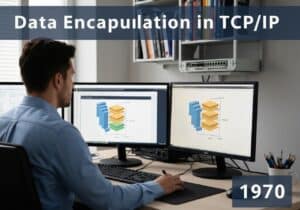
Computer workstation analyzing Transmission Control Protocol in a professional setting.

(generated image for illustration only)

TCP is a core protocol of the Transport Layer, providing reliable, ordered, and error-checked delivery of a stream of bytes between applications running on hosts. It is a connection-oriented protocol, meaning it establishes a connection via a three-way handshake before data transfer begins. This ensures data integrity at the cost of higher overhead compared to UDP. Chat protocols such as IRC run on top of TCP, so the basic irc commands travel as plain text over a TCP connection.

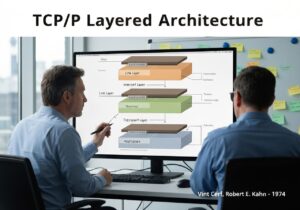
TCP’s reliability is achieved through several mechanisms. It uses sequence numbers to track segments and reorder them if they arrive out of sequence. It requires acknowledgments (ACKs) from the receiver for data segments; if an ACK is not received within a certain time, the segment is retransmitted. A checksum field is used to detect data corruption within segments. Flow control is managed using a sliding window mechanism, where the receiver advertises how much data it can buffer, preventing the sender from overwhelming it. Furthermore, TCP incorporates sophisticated congestion control algorithms (e.g., slow start, congestion avoidance) to prevent the network from being overloaded. The initial connection is established with a three-way handshake (SYN, SYN-ACK, ACK) to ensure both sides are ready to communicate. This robust feature set makes TCP suitable for applications where data integrity is paramount, such as web browsing and file transfers, but its overhead makes it less ideal for real-time applications like streaming or online gaming.

UNESCO Nomenclature: 3307
– Computer science

Type

Software/Algorithm

Disruption

Foundational

Usage

Widespread Use

Precursors

  • arpanet’s network control program (ncp)
  • cyclades’ transport protocol design
  • research in reliable data transfer over unreliable channels

Applications

  • world wide web (http/https)
  • email (smtp, imap, pop3)
  • file transfer protocol (ftp)
  • secure shell (ssh)
  • database connections

Patents:

NA

Potential Innovations Ideas

  • multipath tcp (mptcp) for using multiple network interfaces simultaneously
  • tcp bbr (bottleneck bandwidth and round-trip propagation time) congestion control algorithm
  • ai-driven predictive congestion control to anticipate network bottlenecks
  • tcp extensions for ultra-low latency datacenter networks
  • quantum-resistant encryption integrated directly into the tcp handshake
  • tcp for long-delay satellite and interplanetary links
  • lightweight tcp implementations for resource-constrained iot devices
  • tcp over secure scuttlebutt (ssb) for decentralized applications
  • verifiable-delay tcp to prevent network timing attacks
  • tcp state migration for seamless vm and container live migration
Related to: tcp, transmission control protocol, transport layer, reliable transport, connection-oriented, three-way handshake, flow control, congestion control, sequence number, acknowledgment.

Historical Context

Transmission Control Protocol (TCP)

1970
1970
1972
1974
1975-06-01
1980
1980
1970
1970
1970
1974
1974
1978
1980
1980

(if date is unknown or not relevant, e.g. "fluid mechanics", a rounded estimation of its notable emergence is provided)

10th year anniversary

Full size images and downloads are only available, 100% free, for registered members.

> Login <