Product Design, Manufacturing & Innovation Resources
Home » The Object in OOP (programming)

The Object in OOP (programming)

1967
  • Kristen Nygaard
  • Ole-Johan Dahl
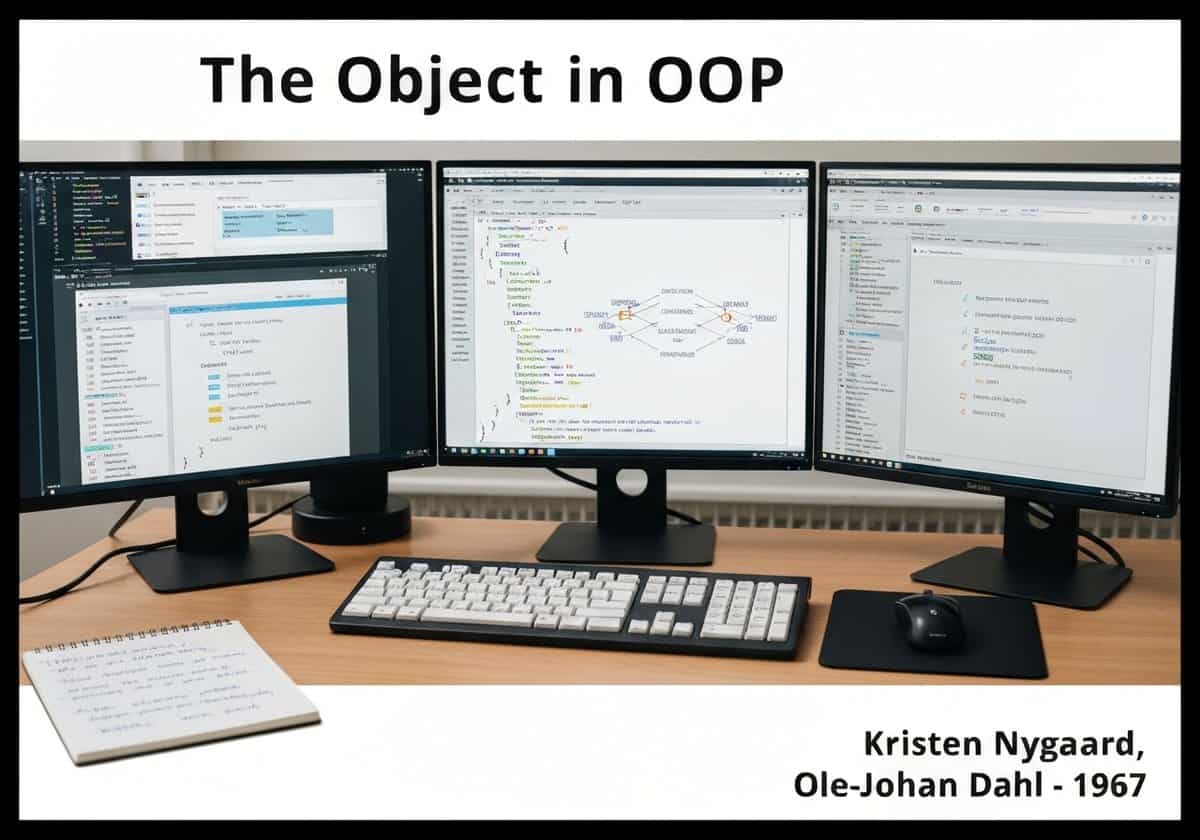
Computer programming workspace showcasing object-oriented programming concepts.

(generated image for illustration only)

In object-oriented programming (OOP), an object is a fundamental entity that bundles data (attributes or properties) and the methods (functions or procedures) that operate on that data. Objects are instances of classes, which act as blueprints. This paradigm models real-world entities, making complex systems easier to manage by grouping related state and behavior together into self-contained units.

The concept of an “object” is the cornerstone of object-oriented programming. Unlike procedural programming, which organizes code around actions or logic, OOP organizes code around data, or “objects”. An object is a self-contained unit that has a state and behavior. The state is represented by its attributes (also called fields, properties, or instance variables), which are essentially data. The behavior is defined by its methods (also called functions or procedures), which are the operations that can be performed on the object’s data. For example, a ‘Car’ object might have attributes like ‘color’, ‘speed’, and ‘fuelLevel’, and methods like ‘accelerate()’, ‘brake()’, and ‘refuel()’.

This bundling of data and methods is a key feature that distinguishes OOP. The class serves as a template or blueprint from which individual objects are created. This process is called instantiation. Each object created from the same class will have the same structure (attributes and methods), but the values of its attributes can be different, representing a unique state. This approach allows programmers to model real-world or abstract entities in a more intuitive way, leading to code that is more modular, reusable, and easier to maintain and debug. The idea originated with the Simula language, designed for creating simulations, where modeling real-world objects was a primary requirement.

UNESCO Nomenclature: 1203
– Computer science

Type

Abstract System

Disruption

Revolutionary

Usage

Widespread Use

Precursors

  • the concept of data structures (records/structs) in earlier languages like cobol and algol
  • subroutines and functions in procedural programming
  • theories of abstract data types (adt)
  • the development of the simula programming language for simulation purposes

Applications

  • graphical user interfaces (guis)
  • simulation and modeling systems
  • relational database management systems (rdbms)
  • web application frameworks like django and ruby on rails
  • game development engines like unity and unreal engine

Patents:

NA

Potential Innovations Ideas

Due to scrapping bot traffic, currently more than 40k per day, this content is reserved to community members.
> Login < or > Register < (100% free) to access this, so as all other restricted content and tools.

Related to: object, class, instance, attribute, method, state, behavior, oop, data bundling, instantiation.

Historical Context

The Object in OOP (programming)

1952
1956
1960
1967
1967
1970
1970
1950
1953
1960
1960
1967
1970
1970
1970

(if date is unknown or not relevant, e.g. "fluid mechanics", a rounded estimation of its notable emergence is provided)

Related Invention, Innovation & Technical Principles

Full size images and downloads are only available, 100% free, for registered members.

> Login <