Product Design, Manufacturing & Innovation Resources
Home » The First Compiler: A-0 System

The First Compiler: A-0 System

1952
  • Grace Hopper
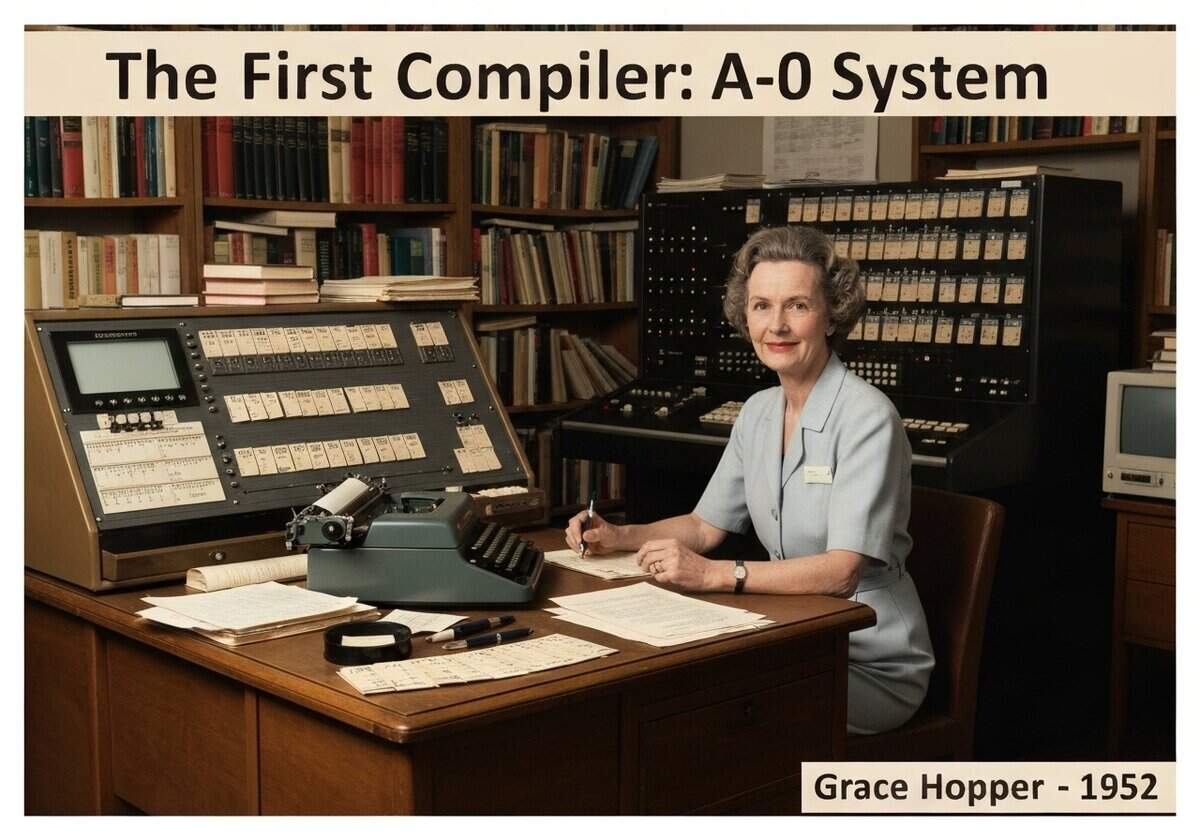
Grace Hopper working on the A-0 System compiler in a 1950s office.

(generated image for illustration only)

The A-0 System, created in 1952 by Grace Hopper, is widely considered the first compiler. It translated a sequence of subroutines and arguments, specified by a mathematical notation, into machine code. This was a foundational step in moving from low-level assembly programming to higher-level, more abstract programming languages, automating the tedious process of manual code translation. Early programming languages research, such as the A-0 System, led to the high-level languages used today.


The A-0 System, developed for the UNIVAC I computer, functioned more like a modern linker or loader than a full compiler as we understand it today. Its primary innovation was automation. Before A-0, programmers had to manually look up the addresses of subroutines from a library and patch them into their main program. This was a slow and highly error-prone process. Hopper’s system automated this by assigning a numeric code to each subroutine in a magnetic tape library.

The programmer would write a program as a sequence of these numeric codes and their arguments. The A-0 System would then read this sequence, look up the corresponding subroutines on the tape, and copy them to the correct locations in memory to form a complete, executable program. While it did not parse complex algebraic expressions or manage control flow structures like a modern compiler, it was the first piece of software that took a high-level specification and automatically generated a low-level executable. This ‘compilation’ of routines was a revolutionary concept that directly led to the development of more sophisticated languages and compilers, including Hopper’s own FLOW-MATIC, which in turn heavily influenced COBOL.

UNESCO Nomenclature: 1203
– Computer science

Type

Software/Algorithm

Disruption

Revolutionary

Usage

Obsolete

Precursors

  • concept of stored-program computers (von neumann architecture)
  • development of subroutines and libraries
  • assembly language as a first step above machine code
  • mathematical notation for problem-solving

Applications

  • development of subsequent compilers like flow-matic
  • creation of the cobol programming language
  • foundation for all modern high-level programming languages
  • automated software development tools

Patents:

NA

Potential Innovations Ideas

  • ai-driven legacy code translators for extinct hardware
  • compilers that generate quantum circuit descriptions from classical code
  • domain-specific language compilers for biological sequence synthesis
  • self-modifying compilers that optimize their own codebase based on usage patterns
  • compilers that output verifiable, formally proven machine code for critical systems
  • natural language to executable code compilers for non-programmers
  • compilers that target neuromorphic hardware architectures
  • on-the-fly compiler generation for dynamically created languages
  • compilers that embed cryptographic proofs of origin within the binary
  • energy-aware compilers that optimize code for minimal power consumption on iot devices
Related to: Grace Hopper, A-0 system, first compiler, compilation, high-level language, automation, programming history, UNIVAC i, flow-matic, Cobol.

Historical Context

The First Compiler: A-0 System

1940
1950
1950
1952
1956
1960
1967
1940
1943
1950
1950
1953
1960
1960
1967

(if date is unknown or not relevant, e.g. "fluid mechanics", a rounded estimation of its notable emergence is provided)

10th year anniversary

Full size images and downloads are only available, 100% free, for registered members.

> Login <