Product Design, Manufacturing & Innovation Resources
Home » MATLAB’s Array-Oriented Syntax

MATLAB’s Array-Oriented Syntax

1970
  • Cleve Moler
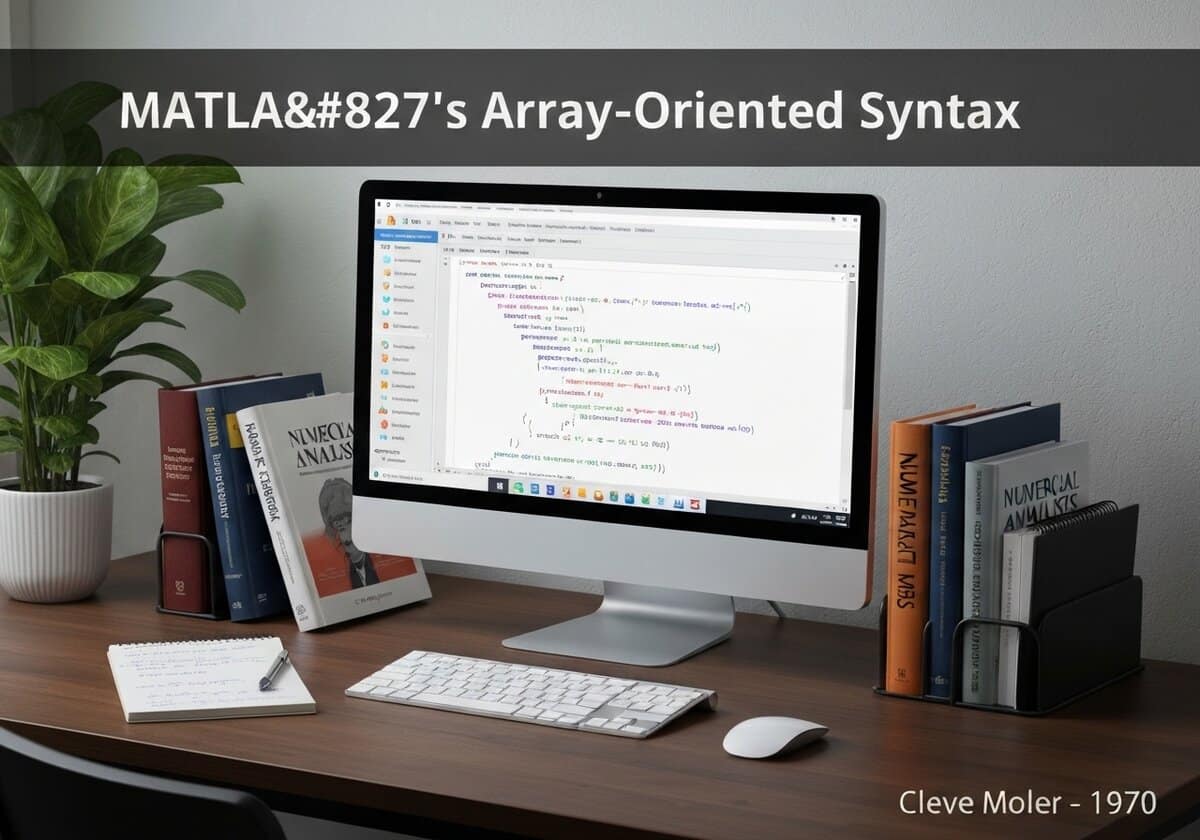
Computer workstation with MATLAB interface showcasing array-oriented syntax in numerical analysis.

(generated image for illustration only)

MATLAB is a matrix-based language where the fundamental data type is the array, not requiring dimensioning. This allows for concise expression of matrix and vector operations. For instance, multiplying two matrices `A` and `B` is simply `C = A * B`, and element-wise multiplication is `C = A .* B`, abstracting away complex loop structures found in other languages. MATLAB is a popular engineering programming language because matrix operations are written in a single line.


The core design philosophy of MATLAB is that all data is treated as an array, with scalars being 1×1 arrays and vectors being 1xN or Nx1 arrays. This paradigm stems from its origin as a high-level interactive shell for the LINPACK and EISPACK Fortran libraries, which were designed for linear algebra. This array-centric syntax dramatically simplifies code for scientific and engineering problems, which are often expressed in terms of matrix and vector mathematics. Operations that would require nested loops and careful index management in languages like C or Java can be expressed in a single, readable line in MATLAB.

For example, solving the system of linear equations \(Ax = b\) is accomplished with the command `x = Ab`, which uses the backslash operator (mldivide). This operator does more than just calculate the inverse of A; it analyzes the matrix A to choose the most stable and computationally efficient algorithm, such as LU decomposition for square matrices or QR decomposition for rectangular systems. This high-level abstraction allows users to focus on the mathematical problem rather than the low-level implementation details. Furthermore, the language encourages ‘vectorization,’ the practice of replacing explicit loops with array expressions. This not only makes code more compact but also significantly faster, as MATLAB’s internal functions are highly optimized, multi-threaded C and Fortran code.

UNESCO Nomenclature: 1202
– Computer science

Type

Software/Algorithm

Disruption

Substancial

Usage

Widespread Use

Precursors

  • Fortran programming language
  • LINPACK numerical software library
  • EISPACK numerical software library
  • APL programming language

Applications

  • signal processing algorithms
  • image processing filters
  • control systems design
  • finite element analysis
  • computational fluid dynamics
  • machine learning model implementation

Patents:

NA

Potential Innovations Ideas

  • a domain-specific language for quantum computing simulations
  • an embedded system code generator for real-time robotic control using matrix operations
  • a high-level financial modeling language for risk analysis based on vectorized portfolio calculations
  • a rapid prototyping tool for developing and testing new wireless communication protocols
  • an educational platform for teaching linear algebra interactively through graphical manipulation of matrices
  • a framework for large-scale climate model analysis using distributed array computations
  • a bioinformatics tool for parallel sequence alignment using matrix representations
  • a real-time audio processing environment for musicians based on signal matrix transformations
  • a generative art system that uses matrix operations to create complex visual patterns
  • a smart grid optimization tool that models power flow as a system of linear equations
Related to: MATLAB, array programming, matrix laboratory, vectorization, numerical computing, linear algebra, syntax, data type, array-oriented, scientific computing.

Historical Context

MATLAB’s Array-Oriented Syntax

1967
1970
1970
1970
1970
1973
1980
1967
1967
1970
1970
1970
1970-01-01
1975-06-01
1980

(if date is unknown or not relevant, e.g. "fluid mechanics", a rounded estimation of its notable emergence is provided)

10th year anniversary

Full size images and downloads are only available, 100% free, for registered members.

> Login <