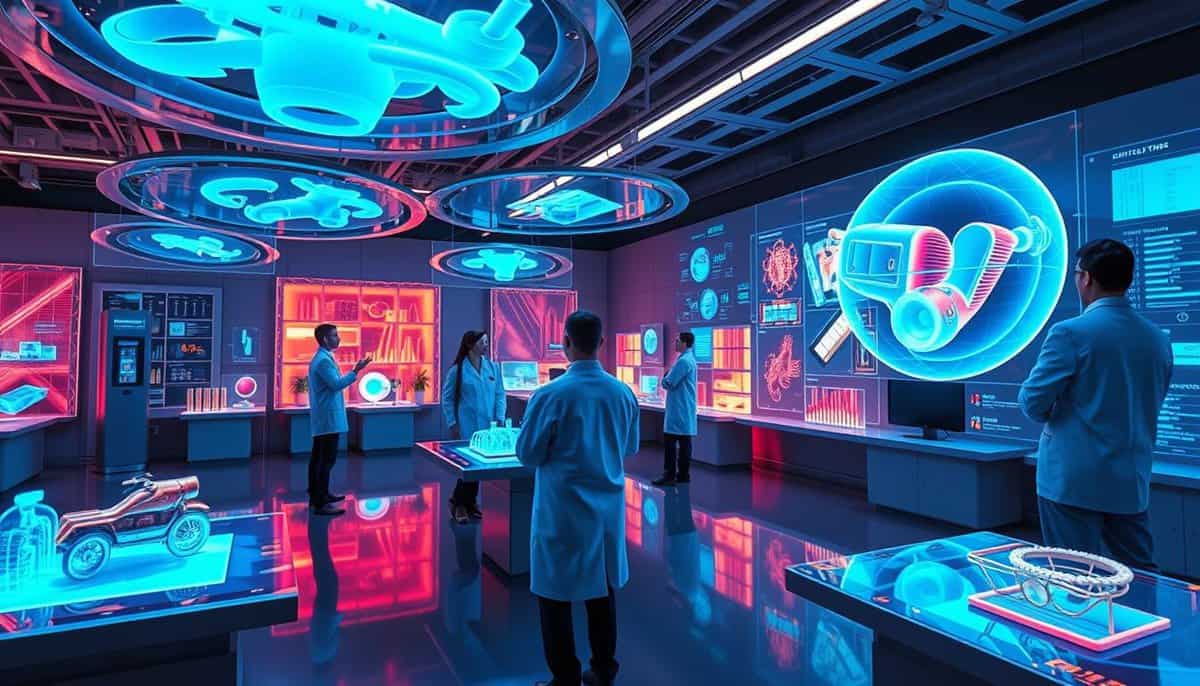
In the next five years, $30 trillion in corporate revenues will rely on new products. This highlights digital twin technology’s huge potential in Research and Development (R&D). With 75% of product development executives focusing on digitization, the digital-twin technology market is set to grow about 60% every year. By 2027, it’s expected to reach $73.5 billion.
Digital twins create virtual copies of physical systems. This allows for better simulation, prediction, and operation. They’re changing how we innovate and making development, cost optimization, and efficiency better. Thanks to this tech, we can get real-time data and predict product performance and market trends accurately.
Key Takeaways
- Digital twins can cut product development time by 20 to 50%, reducing the need for multiple prototypes.
- Using digital twins leads to 25% fewer quality issues and increases sales by 3 to 5%.
- The global market for digital twins is expected to grow 60% yearly, hitting $73.5 billion by 2027.
- Many sectors, like manufacturing and biotech, are using digital twins.
- For businesses navigating supply chain issues, investing in digital twins is crucial. It helps lower costs and boost revenue.
Understanding Digital Twins: A Comprehensive Overview
Digital twins mark a big change in the way industries use and learn about objects. They are virtual models that match real things very closely. This allows for deep insights and better use. They bring together data from many places, like IoT sensors, to mimic the real world well.
The use of IoT in research is key for digital twins. IoT devices gather and analyze data continuously. This makes the models dynamic. For example, in cars, digital twins check how a vehicle is doing in real-time. This helps predict problems and find issues before they happen.
Adding AI and predictive analytics to digital twins is a big step forward. This lets the models better themselves and make decisions alone. This is especially good in areas like aerospace, where details matter a lot. The digital twin market is expected to reach USD 73.5 billion by 2027. This shows how important and widespread they are becoming.
| Industry | Application | Benefits |
|---|---|---|
| Automotive | Vehicle Performance Monitoring | Early Detection of Wear and Tear |
| Aerospace | System Optimization | Enhanced Safety and Efficiency |
| Manufacturing | Process Optimization | Cost Reduction |
| Healthcare | Predictive Maintenance of Equipment | Improved Operational Reliability |
| Urban Planning | Scenario Testing | Infrastructure Optimization |
New real-time data advancements give digital twins quick reaction ability. This helps in quick, smart decision-making in many fields. In urban planning, for example, twins can test out changes to help with sustainable growth.
Cybersecurity is very important with digital twins, as they deal with lots of private data. Strong security, like encryption, helps protect this data. Even though setting up digital twins can be expensive, they pay off in the end. The benefits they bring are worth the costs and effort.
The Evolution and History of Digital Twin Technology
The development of digital twins started as simple models. They are now complex systems that work with AI and machine learning. The path of digital twin technology began in the 1960s. NASA used them first during the Apollo 13 mission. Since that time, the concept has grown and become very popular, especially in the early 2000s.
By 2015, digital twins were key to the “Industry 4.0” revolution. This was a big step in their history. The market’s worth was $6.5 billion in 2021. It may reach $125.7 billion by 2030. This increase comes from their big benefits. They enhance efficiency, save time and money, and make risk assessments better.
Recently, digital twins came back into the spotlight with the 2022 metaverse boom. They give businesses and users a clearer view of our physical world. Their benefits include cutting costs, fewer failures, and smoother operations. This applies in many fields, like aerospace and healthcare.
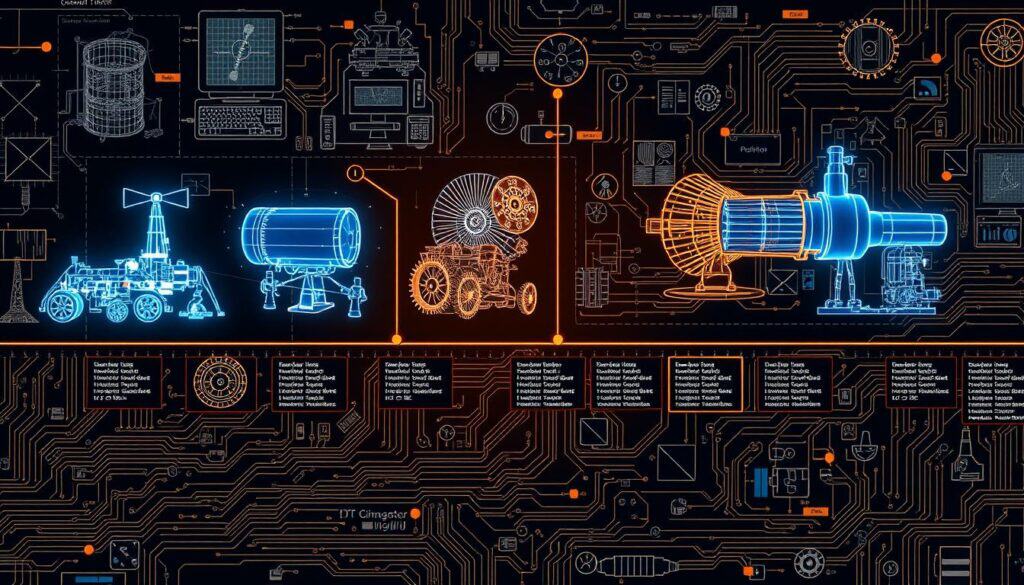
| Year | Milestone |
|---|---|
| 1960s | NASA’s usage during the Apollo 13 mission |
| Early 2000s | Concept gains popularity |
| 2015 | Integration with “Industry 4.0” |
| 2022 | Resurgence during the metaverse boom |
Using digital twins in R&D changes things a lot, but it’s hard too. The big costs at the start and the need for know-how are big challenges. Yet, businesses focus on value. Digital twins offer a smart way to model or test real-life elements. This makes operations run smoothly and continue without stopping.
Also, tech like real-time capture and generative AI helps solve these hard points. They make it quicker and easier to create digital products.
In conclusion, the historical perspective of digital twins shows their growth from ideas to key tools in modern R&D. They have a big future in growing and bringing new things to life.
The rest of this article is reserved for members
To limit scraping bots (currently 40,000 hits per day!),
we had to restrict access to full articles and tools to registered members only.
to access all the rest.
FAQ
What is a digital twin in R&D?
Digital twin in R&D is like virtual copy of a real system. It helps with simulation, prediction, and analysis. This boosts innovation and makes R&D more efficient.
How does digital twin technology contribute to product development?
This technology allows for in-depth analysis and better product design without physical models. It helps improve quality, speed up development, and cut costs.
What is the role of virtual modeling in the creation of a digital twin?
Virtual modeling is key for digital twins. It simulates real-world conditions for accurate representations. This helps in predictive analytics and managing operations.
Which industries benefit the most from a digital twin?
The auto, aerospace, healthcare, infrastructure, and energy industries gain a lot. They see better design, testing, efficiency, and maintenance with digital twins.
How has digital twin evolved over time?
From simple models to advanced systems with AI and machine learning, digital twins have grown. They now use big data for greater insights and accuracy.
What tools and technologies are essential for building a digital twin?
Essential tools include advanced simulation software and IoT devices for data collection. Data analytics platforms refine data to improve twin functionality and accuracy.
How can a digital twin enhance predictive maintenance?
By analyzing data to predict equipment failures, digital twins enable proactive maintenance. This approach reduces downtime and extends equipment life.
What strategies can ensure effective digital twin implementation?
Successful strategies involve seamless data integration, strong data security, and managing adoption costs. These maximize the benefits of digital twins.
Glossary of Terms Used
Internet of Things (IoT): a network of interconnected devices embedded with sensors, software, and other technologies that enable them to collect and exchange data over the internet, facilitating automation, monitoring, and control of various processes and systems.
Network-attached storage (NAS): a storage device connected to a network that allows data access and sharing among multiple users and devices, typically providing centralized file storage, backup, and management capabilities. It operates independently of a computer and can be accessed via standard network protocols.
Return on Investment (ROI): a financial metric used to evaluate the profitability of an investment, calculated by dividing the net profit from the investment by the initial cost, expressed as a percentage.
User experience (UX): the overall satisfaction and perception of a user when interacting with a product, system, or service, encompassing usability, accessibility, design, and emotional response throughout the entire interaction process.